

Real estate syndication passive investing for beginners is a way to invest in property alongside other investors without managing the property yourself. A sponsor finds and manages the investment, while investors contribute money and receive a share of the results under an agreed structure.
This approach can provide access to larger properties, such as apartment buildings and commercial real estate. However, passive investing does not mean risk-free investing. You can lose money, distributions may stop, and your investment may remain tied up for years. Before investing, learn how the deal works, how the sponsor earns money, and what could prevent you from receiving the returns you expect.
Direct Answer
Real estate syndication lets multiple investors pool money to invest in property managed by a sponsor. Investors may receive income or sale proceeds, but returns are not guaranteed, and their capital may be difficult to withdraw.
What Is Passive Real Estate Syndication?
Real estate syndication is a business arrangement in which multiple investors pool their money to purchase or operate a property. One person or team, called the sponsor, manages the investment and handles the main decisions according to the legal agreements.
For example, buying an apartment building may require more capital than one investor wants to commit alone. A sponsor can bring several investors together to fund the purchase, arrange financing, manage improvements, and operate the property.
The sponsor and investors have different responsibilities.
- Sponsor or general partner (GP): Finds the investment, organizes the deal, develops the business plan, and oversees property operations.
- Limited partner (LP) or passive investor: Contributes capital and receives the financial rights stated in the investment agreement. The investor generally does not handle daily property management.
- Property manager: Handles tasks such as rent collection, tenant communication, maintenance, and leasing. The sponsor may hire a separate management company.
These roles can vary by transaction. Some syndications use a limited liability company (LLC) with a manager and investor members rather than a traditional partnership structure.
Who Might Benefit From Syndication?
Passive syndication may suit someone who wants real estate exposure but lacks the time, experience, or desire to manage tenants and repairs.
It may also appeal to investors who want to participate in a larger property project with others.
However, it may not suit someone who needs quick access to their money, wants complete control over investment decisions, or cannot afford a significant loss. Direct ownership, publicly traded real estate investment trusts (REITs), or other investments may fit those needs better.
How Does Real Estate Syndication Work?
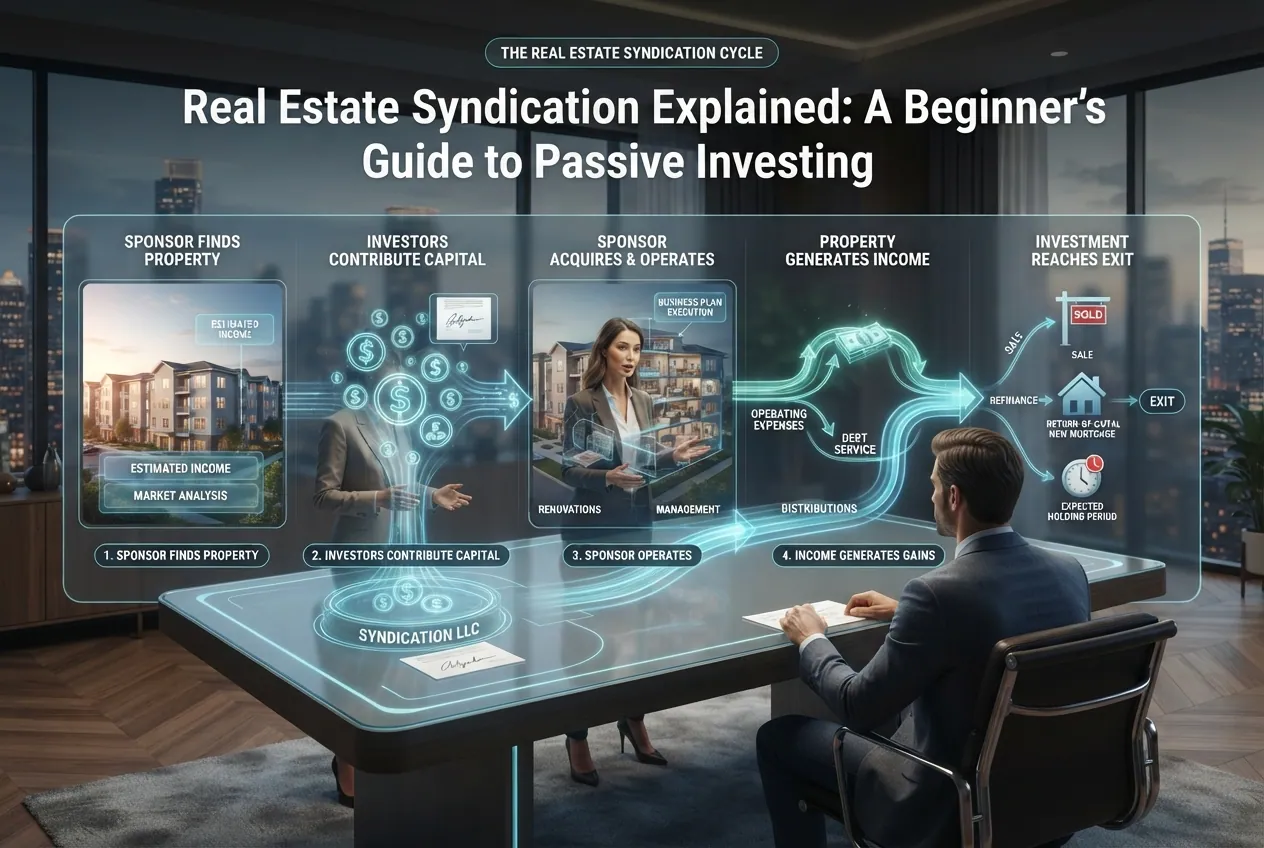
A syndication typically moves through several stages. The exact process depends on the property, financing, sponsor, and investment documents.
- The sponsor finds a property.
The sponsor identifies a property it believes can generate income or increase in value. The team estimates rental income, operating costs, repair needs, financing expenses, and a possible future sale price.
These estimates are part of the investment plan. They are not guarantees.
- Investors contribute capital.
The sponsor presents the investment opportunity and explains how much money it seeks to raise. Investors review the offering and decide whether to participate.
Depending on the offering, the investment may be structured through an LLC, partnership, or another legal entity. Investors should understand exactly what they own: an interest in the entity, not necessarily direct ownership of a specific percentage of the building.
- The sponsor acquires and operates the property.
The investment may combine investor contributions with a commercial mortgage or other borrowing. The sponsor then oversees the agreed business plan, which might include renovations, improved property management, new leases, or cost control.
- The property generates income or gains value.
Rental income first supports the property’s operating expenses, debt payments, reserves, and other obligations. Money remaining may be distributed to investors according to the agreement.
The sponsor may also seek to increase the property’s value before selling it. Higher value alone does not guarantee a profit because selling costs, debt, and other expenses affect the amount available to investors.
- The investment reaches an exit.
The sponsor may sell the property, refinance it, or pursue another outcome permitted by the agreements. A sale may return some or all of the original capital, along with any remaining profit, depending on the deal’s results and distribution rules.
Refinancing can provide cash to investors in some circumstances, but it also changes the property’s debt obligations and does not guarantee that the investment will end.
Do not assume every deal will finish within a particular number of years. Review the expected holding period, extension rights, and possible exit delays in the actual documents.
How Do Passive Real Estate Investors Make Money?
Investors may earn money through property income, gains in property value, or both. Their actual results depend on operating performance, financing, fees, taxes, and the investment agreement.
Cash Distributions From Rental Income
A property collects rent from tenants and pays its operating expenses. These expenses may include maintenance, insurance, property taxes, utilities paid by the owner, management fees, and debt payments.
If enough money remains after expenses and required reserves, the investment may distribute some of that cash to investors.
A property can collect rent without having enough cash to make the distributions shown in an optimistic forecast. Repairs, vacancies, rising expenses, or debt costs can reduce the available amount.
Profit From a Property Sale
Suppose a sponsor buys an apartment building, improves its operations, and later sells it for more than the total acquisition and improvement costs.
The resulting profit must still account for outstanding debt, selling expenses, other obligations, and the investor distribution arrangement. An increase in the property’s market value is not the same as cash already earned by investors.
What Is a Preferred Return?
A preferred return is a contractual distribution priority often used in syndications. It commonly means investors are entitled to receive a specified return allocation before the sponsor receives certain incentive profits.
The exact meaning depends on the documents. A preferred return is not automatically guaranteed interest or a guaranteed payment. If the property does not produce enough cash or sale proceeds, investors might receive less than expected or nothing.
Consider this hypothetical example:
An investor contributes $100,000 to a syndication with an 8% annual preferred return. If the agreement calculates the preferred return on the original contribution, the annual amount would be:
$100,000 × 8% = $8,000
This calculation shows the stated return amount under those assumptions. It does not establish that the property will produce $8,000 in cash or that the amount will be paid every year.
The agreement may define whether unpaid preferred returns accumulate, when payments can be made, and how sale proceeds are distributed.
What Is a Waterfall Structure?
A waterfall is the set of rules that determines how available investment proceeds are divided among investors and the sponsor.
For example, the agreement might provide that investors first receive specified capital or preferred-return amounts. The sponsor may then receive a larger share of additional profits after certain conditions are met.
Do not judge a deal by its preferred-return percentage alone. Read the complete waterfall to understand who receives money at each stage and what conditions must be satisfied.
How Much Money Do You Need, and Who Can Invest?
There is no universal minimum investment for real estate syndication. Each sponsor sets the terms of its offering, subject to applicable laws and the structure of the deal.
One offering may accept a smaller contribution than another, but a low minimum does not necessarily make it suitable. You must consider how much of your available savings would be tied up in one investment and whether you could handle a loss.
Before investing, keep enough money available for emergencies, regular bills, and near-term goals. Avoid borrowing money simply to meet a syndication’s minimum contribution.
What Is an Accredited Investor?
In the United States, accredited-investor status can determine who may invest in certain private offerings.
Under the commonly used individual financial tests, a person may qualify by meeting either of these general criteria:
- Net worth above $1 million, excluding the value of the primary residence, individually or with a spouse or partner.
- Income above $200,000 individually or $300,000 jointly with a spouse or partner in each of the prior two years, with a reasonable expectation of reaching the same income level in the current year.
The rules also recognize other qualifying categories, including certain financial professionals. Check the SEC’s accredited-investor guidance for the applicable definition.
Not every syndication requires accredited-investor status. Some offerings may accept qualifying non-accredited investors under specific exemptions.
For example, Rule 506(b) can allow a limited number of non-accredited investors, subject to conditions and disclosure requirements. Rule 506(c) allows broader solicitation but requires that all purchasers be accredited and that the issuer take reasonable steps to verify their status. See the SEC’s guidance on Rule 506(b) and Rule 506(c).
An offering’s eligibility requirements, minimum contribution, and investment restrictions must all be checked separately. Meeting a minimum investment amount does not prove that you qualify.
How Do You Evaluate a Real Estate Syndication and Its Sponsor?
A credible investment review looks beyond a presentation or projected return. You need to understand who manages the deal, how the property is expected to perform, and how the investment might behave when conditions worsen.
Check the Sponsor’s Track Record
Ask the sponsor for information about completed deals and compare original projections with actual results.
Useful questions include:
- Which properties has the team bought, operated, and sold?
- How did the actual results compare with the original business plans?
- Have investors experienced losses, delayed distributions, or extended holding periods?
- How did the sponsor handle previous problems?
- Does the sponsor invest its own money in the deal, and on what terms?
- How often will investors receive updates and financial reports?
A list of properties purchased is not the same as a record of successful investments. Ask about completed outcomes, losses as well as gains, and how the sponsor reports difficult results.
Examine the Property and Business Plan
The sponsor should be able to explain how the property is expected to make money.
For an apartment building, review tenant demand, current rents, vacancy assumptions, repair costs, insurance, property taxes, management expenses, and financing. For an office or retail property, examine lease terms, tenant concentration, and the risk that space may remain vacant.
Check whether the investment depends on aggressive assumptions, such as large rent increases or rapid improvements in occupancy.
Ask what evidence supports those assumptions. If the sponsor cannot explain why its projections are reasonable, the deal may not be ready for your money.
Stress-Test the Numbers
A business plan should make sense beyond its most optimistic forecast.
Ask what happens if vacancies rise, repairs cost more, insurance premiums increase, interest rates change, or the sale price is lower than expected. If the loan has a variable rate or a refinancing deadline, understand how that could affect cash available to investors.
You do not need to build a sophisticated financial model to ask these questions. You do need to know whether a small change in assumptions could create a large problem.
Examine Fees and Conflicts of Interest
The sponsor may receive fees for acquiring the property, arranging financing, managing the investment, or selling the asset. Some agreements also give the sponsor a share of profits after specified investor priorities are met.
These fees are not automatically improper. The important question is whether they are clearly disclosed and how they affect the economics of the deal.
Check whether the sponsor or its affiliates receive payments from other parties involved in the transaction. Ask whether the sponsor earns a fee even when the investment performs poorly.
Review Investor Reporting
Before committing money, find out what reports you will receive and how often.
The sponsor should explain how it will report rental performance, expenses, debt obligations, distributions, and material changes to the business plan. It should also describe how investors can raise questions and what decisions they are permitted to influence.
Clear reporting cannot prevent a loss, but it helps investors understand what is happening and recognize problems earlier.
What Fees, Documents, and Taxes Should Beginners Understand?

The advertised return is only one part of an investment’s economics. Fees, legal terms, and tax obligations can change the final result.
Common Fees
Depending on the offering, you may encounter:
- Acquisition fee: Payment for arranging or completing the purchase.
- Asset-management fee: Payment for overseeing the investment.
- Property-management fee: Payment for day-to-day property operations.
- Financing or refinancing fees: Costs associated with obtaining or changing debt.
- Disposition fee: A fee that may apply when the property is sold.
Not every deal uses every fee. The name, amount, calculation method, and recipient can vary.
Read the fee schedule and check which expenses are paid by the property, deducted from investment proceeds, or charged separately. Ask whether the sponsor can charge fees through related companies.
Do not assume the returns shown in a presentation are what you will receive after every cost unless the documents clearly explain that calculation.
Documents to Review
Private syndications often provide some or all of the following:
- Private Placement Memorandum (PPM): Explains the offering, material risks, investment terms, and other disclosures.
- Subscription agreement: Records an investor’s commitment to purchase an interest and the related representations.
- Operating agreement or partnership agreement: Describes the entity’s governance, investor rights, distribution rules, fees, and other important terms.
Document names and structures vary. Read the actual package rather than assuming every deal follows the same format.
Pay particular attention to withdrawal restrictions, transfer rules, voting rights, the sponsor’s authority, additional capital obligations, and possible extensions to the investment period.
Before signing or transferring money, have a qualified securities lawyer review any terms you do not understand, especially when the investment is large or the documents give the sponsor broad discretion. A short conversation before signing may help you identify terms that are difficult to change later.
You can also review the SEC’s private-placement guidance to understand why private offerings can involve limited disclosure, resale restrictions, and the risk of losing your entire investment.
How Do Syndications Affect Taxes?
Some real estate syndications are structured as partnerships for federal tax purposes. In these cases, investors may receive a Schedule K-1 reporting their share of partnership income, deductions, credits, and other tax items.
The amount reported for tax purposes may differ from the cash distributed to an investor. Depending on the facts, an investor may owe tax on allocated partnership income even when that amount was not paid out in cash.
Depreciation, property sales, the investor’s tax status, and other factors can affect the tax result. Do not assume that a distribution is entirely profit or that you owe no tax if the property makes no cash distribution.
Read the IRS instructions for Schedule K-1 (Form 1065) and consult a qualified tax professional when you need advice about your own circumstances.
What Are the Biggest Risks of Passive Real Estate Syndication?
Passive syndication can reduce the work you do, but it does not remove investment risk.
Loss of Capital
A property can perform poorly because of weak demand, unexpected repairs, rising expenses, or declining property values. Heavy borrowing may increase the impact of these problems.
Investors may receive less than their original contributions or lose all their invested capital. Do not invest money that you cannot afford to lose.
Illiquidity
Private syndication interests are usually not as easy to sell as shares traded on a public stock exchange. The agreement may restrict transfers, and there may be no willing buyer when you want to exit.
Even if the sponsor expects to sell the property within a few years, that outcome may be delayed. A refinancing may also fail to provide the expected cash.
Only commit money you can reasonably leave invested for the period described in the offering, with room for delays.
Debt and Refinancing Risk
Borrowing can help a sponsor acquire a larger property, but debt creates obligations that must be met even when rental income falls.
A loan may become more expensive when a variable interest rate changes or when the property needs refinancing. If the property cannot support the debt, the sponsor may need to change its plan, sell the asset, or take other steps that harm investor returns.
Sponsor and Operating Risk
The sponsor may misjudge the market, manage expenses poorly, or fail to complete planned improvements. A weak sponsor may also communicate badly when results fall short.
Review the team’s past decisions and reporting practices. Ask how it plans to respond when assumptions prove wrong rather than focusing only on the expected outcome.
False Confidence in Projected Returns
A preferred return, projected cash yield, or target sale price describes contractual terms or expectations, not a guaranteed result.
Private-placement fraud is another concern. The SEC warns that investors may face limited disclosures and may find it difficult or impossible to recover money from a fraudulent offering. Verify the people involved, review the documents, and be cautious of pressure to transfer money quickly.
Real Estate Syndication vs. REITs vs. Direct Ownership
Syndication is only one way to invest in real estate. The right choice depends on how much control you want, how much time you can give the investment, and how soon you might need your money.
| Feature | Real estate syndication | Publicly traded REIT | Direct property ownership |
| Day-to-day work | Usually managed by sponsor | Managed by REIT | Owner manages or hires help |
| Control | Limited under deal terms | Little control over individual properties | Greater control over the property |
| Liquidity | Often limited | Shares can generally be traded on an exchange | Depends on the ability to sell the property |
| Diversification | May focus on one property or project | Can provide exposure to many properties | Depends on the owner’s portfolio |
| Main concern | Sponsor, property, debt, and exit risks | Share-price changes and REIT-specific risks | Property costs, debt, tenants, and management |
When Is Each Option Suitable?
Syndication may suit investors who want exposure to a specific larger property but do not want to manage it. In exchange, they give up much of the day-to-day control and may have limited access to their capital.
Publicly traded REITs can provide a simpler way to gain real estate exposure through a brokerage account. Their shares can usually be bought and sold on an exchange, although their market prices may rise or fall. REIT funds and exchange-traded funds (ETFs) can provide exposure to multiple real estate companies.
Direct ownership may suit someone who wants control over the property and is prepared to handle, or pay for, management, repairs, financing, and tenant issues.
Be careful not to treat all REITs as equally liquid. Non-traded REITs may have substantial restrictions on selling or redeeming shares. The Investor.gov REIT guide explains key differences among REIT structures.
A Beginner’s Checklist Before Investing
Use these steps before committing money to any syndication.
- Check your finances. Confirm that your bills, emergency savings, and near-term goals are covered without relying on this investment.
- Confirm eligibility. Check the offering’s investor requirements and applicable securities rules.
- Investigate the sponsor. Review completed deals, actual outcomes, delays, losses, and investor reporting.
- Understand the property. Examine the operating plan, expected costs, tenant demand, financing, and proposed exit.
- Read the documents. Identify fees, distribution priorities, restrictions, voting rights, and possible additional capital obligations.
- Test the downside. Ask what happens if income falls, expenses increase, or the sale is delayed.
- Get professional help when needed. Ask a qualified securities lawyer or tax professional about issues that affect your decision.
- Be willing to walk away. Do not invest if major questions remain unanswered or the expected outcome depends on assumptions you cannot justify.
Before proceeding, make sure you can explain how the investment is supposed to make money, how you could lose money, who controls the project, and when you might be able to recover your capital.
Frequently Asked Questions
Are real estate syndications a good investment?
They may suit investors who understand the deal, can accept the risk of losing money, and do not need quick access to their capital. The quality of the sponsor, property economics, fees, financing, and legal terms matters more than the label “passive income.” No syndication is automatically a good investment simply because it involves real estate.
Can you invest in real estate syndication without being an accredited investor?
Sometimes. Certain private offerings can accept qualifying non-accredited investors, subject to the relevant legal requirements and disclosure rules. Other offerings require every purchaser to be accredited. Check the specific offering’s exemption and eligibility terms before assuming you can participate.
How can I make $10,000 a month in passive income?
There is no guaranteed way to earn $10,000 per month through real estate syndication. The capital required depends on the actual cash distributions you receive, which can change or stop.
For illustration, $10,000 a month equals $120,000 a year. If an investment actually paid annual cash distributions equal to 6% of invested capital, producing $120,000 a year would require $2 million invested. At 8%, it would require $1.5 million. These are hypothetical calculations before taxes and any costs not reflected in the assumed distribution rate—not forecasts or recommended returns.
What is the most profitable passive income for beginners?
There is no single option that is the most profitable for everyone. A publicly traded REIT, a diversified investment fund, a syndication, or another investment may suit different goals and financial circumstances. Compare the potential return with the risk, fees, capital required, diversification, time commitment, and access to your money.
Make Your Next Step a Careful One
Passive real estate syndication can offer a way to participate in larger property investments without managing tenants or repairs yourself. But it requires careful evaluation of the sponsor, investment terms, property economics, and risk of loss.
Start by learning the model and comparing it with more liquid alternatives. When reviewing a specific deal, focus on the evidence behind its financial assumptions and the legal terms that determine your rights. A well-informed decision is more valuable than chasing an attractive return that you cannot verify.
Disclaimer
This article provides general educational information, not personalized investment, legal, or tax advice. Investment terms, risks, costs, and outcomes vary, and returns are never guaranteed. Consult a qualified professional when you need advice about a specific investment, securities requirements, or your tax circumstances.