

Commercial triple net lease investing can provide rental income from a business property without requiring the owner to manage every daily expense. However, the investment is not risk-free. Your results depend on the tenant’s ability to pay, the lease agreement, the building’s condition, the purchase price, and any financing costs.
A triple net lease, also called an NNN lease, is a commercial rental agreement in which the tenant pays base rent plus three main property expenses: property taxes, building insurance, and maintenance costs. The exact responsibilities depend on the signed lease. Some agreements leave major repairs with the landlord, while others transfer more responsibility to the tenant.
For beginners, the safest starting point is to understand how the lease works, calculate the property’s income, and check what could happen if the tenant leaves. You should assess the building and its future rental potential, not just the tenant’s brand name or the advertised return.
Short Definition
Commercial triple net lease investing involves buying a business property leased under an NNN agreement, where the tenant pays rent plus agreed property taxes, insurance, and maintenance costs. The lease determines the owner’s remaining duties and risks.
Practical Business Tip
Before comparing cap rates, confirm that the reported net operating income includes the expenses the owner must pay under the actual lease. Then model a vacancy period and a major repair. If the investment only works under perfect conditions, investigate further before making an offer.
What Is Commercial Triple Net Lease Investing?
Commercial triple net lease investing means buying a commercial property and renting it to a business under a lease that assigns specified property expenses to the tenant.
The building might be a fast-food restaurant, pharmacy, bank branch, medical office, retail store, or industrial property. The owner receives rent under the lease, while the tenant operates its business from the property.
According to the Cornell Legal Information Institute’s explanation of triple net leases, the three main expense categories are insurance, maintenance, and property taxes.
Here is a simple example.
Imagine you buy a standalone building leased to a restaurant. The restaurant pays $10,000 per month in base rent and reimburses the property taxes, building insurance, and covered maintenance expenses under the agreement.
Your annual base rent would be $120,000. The reimbursements would help cover the expenses assigned to the tenant, but they would not automatically become additional profit.
Your actual income would depend on the expenses you still pay, any unpaid bills, repair obligations, vacancy risk, and the cost of financing the purchase.
What is the difference between NNN and absolute NNN?
A standard NNN lease and an absolute NNN lease are not necessarily the same.
Under a standard NNN lease, the tenant generally pays the three main property expenses. However, the landlord might still be responsible for certain structural repairs, roof replacement, or other major costs.
An absolute NNN lease typically transfers a broader range of property-related expenses and responsibilities to the tenant. The exact terms still matter.
Never assume a property has no owner expenses just because its listing says “triple net.” Review the agreement to determine who pays for repairs, replacements, insurance deductibles, and other exceptional costs.
How Does a Triple Net Lease Work?
An NNN lease sets out the rent, lease period, payment rules, and division of property expenses between the landlord and tenant.
The three main expense categories are:
- Property taxes: Taxes assessed on the commercial property by the relevant government authority.
- Building insurance: Insurance required for the property, as specified in the agreement.
- Maintenance and CAM: Common-area maintenance, or CAM, covers the upkeep of shared areas such as parking lots, walkways, and landscaping where applicable.
A single-tenant property may have fewer shared expenses than a shopping center with several tenants. In a multi-tenant building, the agreement may allocate common expenses among tenants using an agreed formula.
The tenant may also pay utilities and certain repairs, but these responsibilities are not identical in every contract.
How long do NNN leases last?
Many commercial NNN leases are long-term agreements. Ten-year and fifteen-year terms are common examples, although actual lease periods vary by property, tenant, and transaction.
Some leases include rent increases at set intervals. For example, a contract might increase annual base rent by 2% every year or by 10% every five years.
These increases can help the owner’s income keep pace with rising costs. However, a fixed rent increase does not guarantee that the investment will maintain its purchasing power or market value.
A lease might also include renewal options. These give the tenant the right to extend the agreement under specified conditions. You need to know whether the lease is close to expiry, whether the tenant can renew, and what rent would apply afterward.
Why the lease agreement matters
The NNN label alone does not tell you everything about the investment.
Before buying, check the agreement for:
- The exact legal name of the tenant.
- The person or company guaranteeing the lease, if any.
- Rent increases and payment dates.
- Responsibilities for repairs and property replacements.
- Renewal options and lease expiration.
- Rules that apply if the tenant defaults or abandons the property.
A well-known business name on the building does not necessarily mean the parent company guarantees the lease. The actual contracting entity and any guarantee must be verified.
Commercial Triple Net Lease Example With Simple Numbers
A basic financial example can help you understand how buyers compare NNN properties.
Suppose a commercial property has these illustrative figures:
| Item | Amount |
| Purchase price | $1,500,000 |
| Annual net operating income | $100,000 |
| Annual NOI as a percentage of price | 6.67% |
Net operating income, or NOI, is the property’s rental income after its operating expenses have been deducted. It is generally calculated before mortgage payments and income taxes.
The capitalization rate, commonly called the cap rate, is calculated as follows:
CapRate=AnnualNOIPropertyPrice100
Using the example:
\[ \frac{\$100,000}{\$1,500,000}\times100=6.67\% \]
The property’s cap rate is approximately 6.67%.
This does not mean the investor will receive $100,000 in take-home income. If you borrow money to buy the building, mortgage payments will reduce the cash available to you. You may also need to pay for costs that the tenant does not cover.
The NOI figure must also be checked carefully. If the estimate ignores an expense that the landlord must pay, it can make the property appear more profitable than it really is.
What if the asking price changes?
Suppose the same property generates annual NOI of $100,000, but the seller asks $1,600,000 instead.
The cap rate would become:
\[ \frac{\$100,000}{\$1,600,000}\times100=6.25\% \]
The property’s income has not changed, but the return measured against the purchase price is lower.
This is why comparing a property’s price with its sustainable income is important. You should also compare similar properties with similar locations, tenants, lease terms, and repair obligations.
How to Evaluate NNN Returns and Property Value
A cap rate helps you compare a property’s operating income with its purchase price. It does not measure every part of your investment return.
A property’s total return may include rental cash flow and changes in the property’s value. It can also be affected by financing, transaction costs, taxes, and capital improvements.
What is an average return on a triple net lease?
There is no single return that applies to every NNN property. Cap rates vary by property type, tenant credit, location, lease length, and market conditions.
For market context, The Boulder Group reported an overall single-tenant net-lease cap rate of 6.92% for Q3 2026. Its report gave separate figures of 6.69% for retail, 8.00% for office, and 7.28% for industrial properties.
These are market benchmarks, not guaranteed returns for individual investors. The figures and their underlying property groups may not be directly comparable with every advertised listing.
Source: The Boulder Group’s Q3 2026 net-lease market report.
A separate Colliers review of single-tenant retail properties for the first half of 2026 reported a median cap rate of 6.6%. That figure covers a specific retail segment and reporting period, rather than all commercial property.
The difference between these reports highlights an important point: before comparing returns, check the property type, reporting period, and way the benchmark was calculated.
Cap rate versus cash-on-cash return
Cash-on-cash return measures the property’s annual pre-tax cash flow against the cash you invested. It accounts for financing payments that a basic cap rate does not.
For example, two investors could buy similar properties at the same price. One pays cash, while the other uses a mortgage.
Their properties might have similar cap rates, but their cash flow could differ significantly because of loan interest, principal payments, closing costs, and the amount of money each investor contributes.
Borrowing is not automatically beneficial. If financing costs are high relative to the property’s income, debt can reduce cash flow rather than improve it.
For a useful evaluation, calculate both the property’s cap rate and your expected cash flow after financing. Then test whether the investment can handle lower income, higher expenses, or a vacancy.
Benefits of NNN Investing—and Their Limits
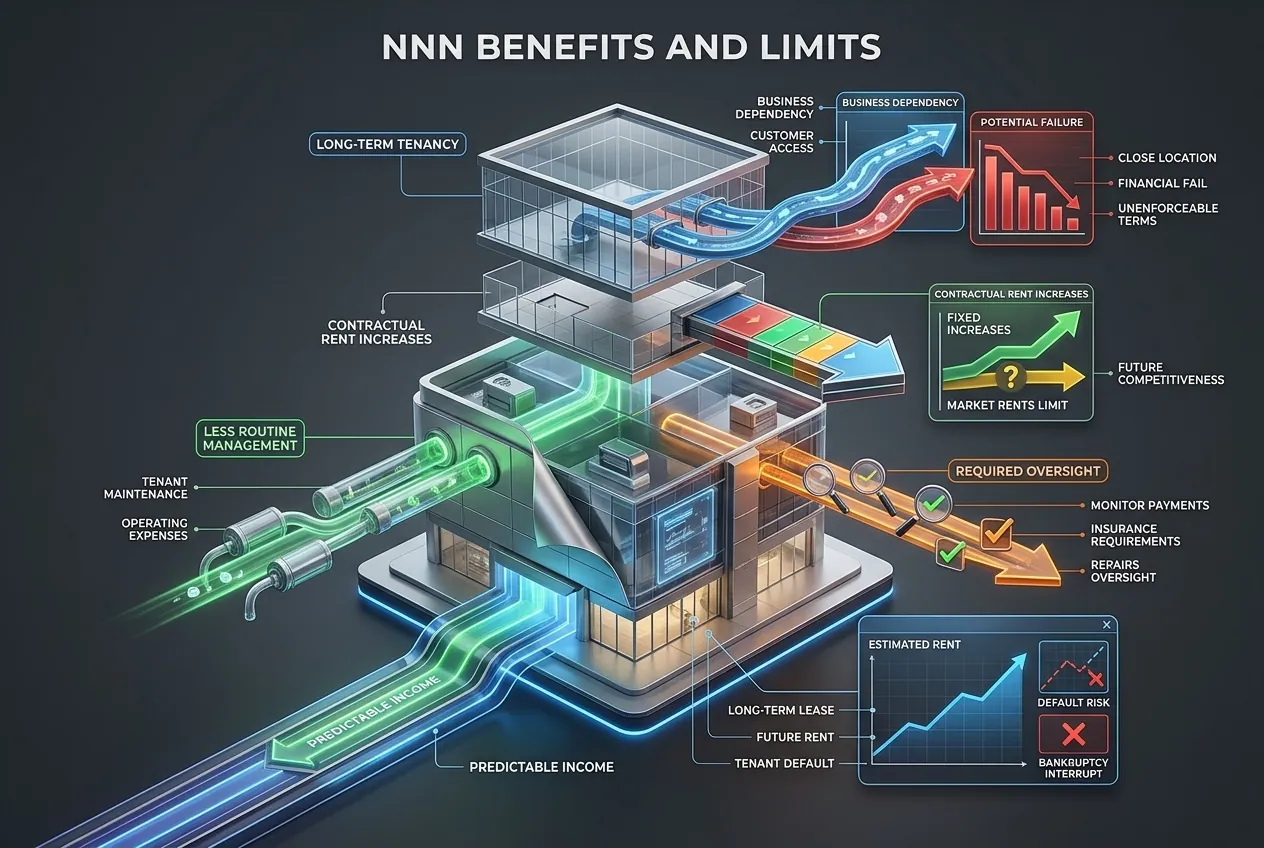
NNN investing has several features that may appeal to commercial real estate investors. Each benefit depends on the contract, the tenant, and the property.
1. Potentially predictable rental income
A long-term lease can make future rent easier to estimate. This may help you plan loan payments, operating costs, and cash reserves.
However, the contract only helps while the tenant meets its obligations. Default, bankruptcy, disputes, or early termination can interrupt rent.
2. Less routine property management
When the tenant handles agreed maintenance and operating expenses, the landlord may have fewer daily tasks than an owner managing an occupied commercial building under a different lease structure.
This can reduce routine work, but it does not eliminate oversight. You may still need to monitor payments, insurance requirements, property condition, lease compliance, and repairs assigned to you.
3. Contractual rent increases
Some NNN agreements include fixed rent increases or other scheduled adjustments. These can increase rental income over time.
Before valuing this benefit, check when each increase happens and whether the future rent remains competitive with market rents.
4. Long-term business tenancy
A tenant that depends on a location for customer access or business operations may have a reason to remain for many years.
Still, a successful business can close a location, restructure its operations, or fail financially. A long lease is valuable only to the extent that its terms are enforceable and the tenant can meet its obligations.
What Can Go Wrong With a Triple Net Lease?
NNN properties can create financial problems even when their advertised cap rates look attractive.
Tenant default or vacancy
With a single-tenant property, the tenant often supplies most or all of the rental income. If that tenant stops paying or leaves, rental income may fall sharply or disappear.
You might still have to cover insurance, property taxes, security, maintenance, and loan payments. Finding a replacement tenant can take time and money.
Before buying, ask how attractive the building would be to another business. Consider its location, layout, permitted uses, parking, visibility, and likely cost of changing it for another tenant.
Major repairs
Some NNN agreements require tenants to cover major repairs. Others place certain costs on landlords.
An aging roof, damaged foundation, failing heating system, or parking lot requiring replacement can create a significant expense if the owner is responsible.
Read the repair clauses before making an offer. Do not rely on a general statement from the seller that the lease is “fully net.”
A weak tenant behind a high cap rate
A property with a higher cap rate can look cheaper relative to its income. Yet the higher rate may reflect a weaker tenant, a short remaining lease, a less desirable location, or a building that will be difficult to re-rent.
A recognizable brand is not enough. Verify which company signed the agreement and whether a stronger parent company or guarantor backs the lease.
Financing pressure
A property may generate enough NOI to look attractive on paper but still struggle after loan payments.
Borrowing terms, interest rates, loan maturity, and required reserves all affect the result. Review how the property performs under less favorable assumptions before taking on a long-term financial commitment.
How to Evaluate an NNN Property Before Buying
A careful review should cover the tenant, the contract, the building, and the numbers. No single check can establish whether the investment is suitable.
Check the tenant and its financial strength
First, identify the exact business that owes the rent. Look at available financial information, credit reports where appropriate, corporate filings, and the terms of any guarantee.
For a public company, annual reports and financial statements can help you assess its condition. For a private business, information may be more limited, making other forms of due diligence important.
A useful question is: if this tenant experienced financial trouble, would you still have a reasonable way to protect your investment or find another tenant?
Read the lease for repair and renewal obligations
Ask a qualified commercial real estate attorney to review the agreement, especially if you have limited experience with commercial leases.
Focus on the following areas:
- What the tenant pays and what the owner retains.
- Who is responsible for the roof, structure, parking lot, and replacement costs.
- Rent increases, options to renew, and the remaining lease term.
- Remedies for missed rent, default, and property damage.
- Any restrictions that could make it difficult to rent the building to another business.
The lease should be read as a legal contract, not just as a summary of rental income.
Inspect the building and its future use
A property inspection can reveal problems that are not obvious from a listing. Depending on the building and its history, you may also need specialist inspections or an environmental assessment.
Check the property’s condition, access, parking, zoning and permitted uses, and local demand for similar spaces.
A building that suits one tenant perfectly may be hard to lease to another. For example, a highly specialized restaurant could require expensive changes before a different business could use the property.
The question is not only whether the building serves the current tenant. It is whether the property would remain useful if that tenant left.
Review the financial assumptions
Ask for the records supporting the claimed rent and operating expenses. Separate income you can verify from projections that depend on future events.
Check comparable sales and local rental evidence when assessing price. Consider realistic repair costs, possible downtime, and the amount you need to keep available for emergencies.
If the property only appears profitable under optimistic assumptions, investigate further before proceeding.
Purchase Costs, Financing, and Cash Reserves
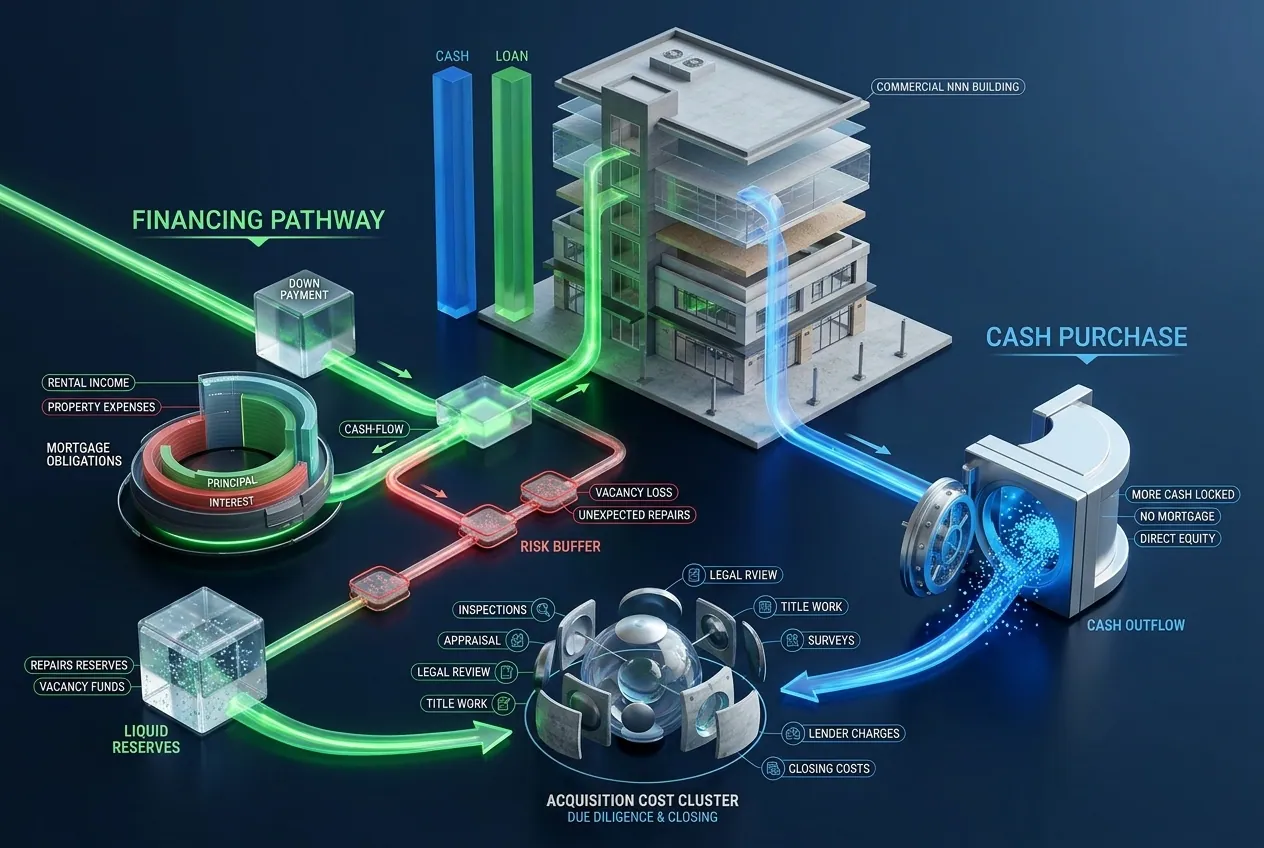
The purchase price is only one part of the money required to acquire a commercial NNN property.
Depending on the transaction, you may need funds for inspections, an appraisal, legal review, title work, surveys, lender charges, closing costs, and other due diligence. You may also need money for repairs or reserves after the purchase.
There is no universal purchase price or down payment that suits every beginner. Requirements depend on the property, the lender, the borrower, and the transaction.
Cash purchase versus financing
Buying with cash avoids mortgage payments but ties up more of your money in one asset.
Using a loan can reduce the amount of cash needed at closing, but adds interest, principal payments, and loan conditions. It can also increase the impact of a vacancy or unexpected repair.
Before committing to financing, prepare a cash-flow estimate that includes:
- Expected rental income.
- Property expenses the owner must pay.
- Mortgage payments and other regular obligations.
- A reserve for repairs, vacancy, and unexpected costs.
Test the numbers under less favorable conditions. For example, ask whether you could still make payments if the tenant stopped paying rent for several months.
Keep sufficient liquid funds for foreseeable costs instead of using every available dollar for the down payment. A property that you cannot afford to maintain through a difficult period may be unsuitable even if its projected return looks strong.
Direct NNN Ownership vs. REITs
Buying a commercial property directly is not the only way to invest in commercial real estate.
A real estate investment trust, or REIT, allows investors to buy an interest in a company that owns or finances income-producing real estate. Some REITs hold retail, industrial, healthcare, or other commercial assets. REIT funds and exchange-traded funds can provide exposure to multiple properties or companies.
Direct ownership
Direct ownership gives you greater control over the specific property and its lease. However, you need enough capital for the purchase, ongoing costs, and unexpected problems.
Your income may also depend heavily on one building or tenant, particularly if you buy a single-tenant property.
Publicly traded REITs
Publicly traded REIT shares can be bought and sold through a brokerage account. They generally require less capital than buying an entire commercial property and may provide exposure to a broader portfolio.
However, share prices can move with the stock market and broader economic conditions. You also have less control over individual property decisions.
Non-traded REITs and private real estate investments
Some real estate investment vehicles are not traded on public stock exchanges. They may have limited opportunities for investors to withdraw their money, along with additional fees and specific redemption rules.
Review the offering documents, fees, conflicts of interest, and exit restrictions before investing.
The SEC’s Investor.gov guidance on non-traded REITs explains important differences in liquidity and costs.
Direct NNN ownership may suit an investor who wants control and can support the property’s financial demands. Public REITs may suit someone who wants real estate exposure without owning and managing an individual building. Neither option guarantees a profit.
Frequently Asked Questions
Is a triple net lease a good investment?
A triple net lease can be a suitable investment when the tenant is financially reliable, the lease terms are favorable, the property has lasting rental demand, and the purchase price makes sense.
It may be unsuitable if the tenant is weak, major repairs are approaching, financing is expensive, or the property would be difficult to re-rent. Assess the complete deal rather than relying on the lease type alone.
What is an average return on a triple net lease?
There is no universal average that predicts what an individual investor will earn. For context, The Boulder Group reported a 6.92% overall single-tenant net-lease cap rate for Q3 2026, with different rates across retail, office, and industrial properties.
That cap rate measures NOI relative to property price. Your personal cash return can be different after financing, transaction costs, and other expenses.
What are the 2% and 7% rules for rental property?
These are informal rental-property screening ideas, not official commercial real estate standards.
The 2% rule is commonly described as a test in which monthly rent equals at least 2% of the purchase price. The 7% rule is used in different ways, so its meaning can vary by source.
Neither should replace a proper commercial property analysis. NNN leases have specific expense arrangements, lease terms, and tenant risks that simple rent-to-price rules cannot capture.
Who pays for the roof and major repairs in an NNN lease?
The signed agreement determines who is responsible. Some leases assign substantial repair duties to the tenant, while others leave certain structural repairs or replacements with the landlord.
Check the actual repair and maintenance clauses before relying on projected income.
What happens if the tenant leaves?
Rental income may stop while the owner continues to pay any uncovered property costs and loan payments. The owner must then consider finding a new tenant, negotiating a lease, selling the building, or using another permitted option.
The cost and time required depend on local demand, property condition, the lease, and the building’s suitability for other businesses.
A Practical Checklist Before You Make an Offer
Before buying a commercial NNN property, make sure you can answer these questions:
- Have I verified the tenant’s financial strength and the exact company responsible for rent?
- Do I understand the lease’s repair, insurance, tax, and renewal obligations?
- Have I inspected the property and considered its future use if the tenant leaves?
- Are the asking price and expected income supported by reasonable market evidence?
- Have I calculated cash flow after financing and included reserves for unexpected costs?
- Can I manage a period without rental income?
- Have I reviewed the lease and transaction documents with the appropriate professionals?
A good NNN investment is more than a long lease and an attractive cap rate. It is a property with supportable income, manageable obligations, credible tenant risk, and a price that makes sense under realistic assumptions.
For a first investment, take the time to examine the lease and the property’s future rental potential before making an offer. If direct ownership requires too much capital or concentration for your circumstances, compare it with REIT alternatives. The right choice is the one you can understand, finance, and hold through less favorable conditions—not simply the one advertising the highest return.
Disclaimer
This article provides general educational information, not individualized investment, legal, or tax advice. Property terms, costs, regulations, and investment outcomes vary, and returns are not guaranteed. Consult qualified real estate and tax professionals when reviewing a specific transaction, and confirm financing terms directly with the lender.