

Starting a drywall business in the United States can require around $12,000 to $56,000 for a basic small-business setup, according to one 2026 planning estimate. A more fully equipped operation with a work vehicle, specialized tools, and cash reserves can cost substantially more. Your actual startup budget depends on the work you offer, the equipment you already own, and whether you hire employees.
Drywall businesses can be profitable, but revenue alone does not tell you how much money you will keep. You must cover materials, labor, insurance, transportation, equipment repairs, and other overhead before calculating net profit. The safest approach is to start with a clear cost estimate, price each job carefully, and keep enough cash available to pay expenses while customers owe you money.
Direct Answer
Starting a drywall business may cost around 12,000–56,000 for a small setup, depending on tools, vehicle needs, and working capital. Profit margins depend on job pricing, labor, overhead, and payment timing.
What Does It Cost to Start a Drywall Business?
A useful starting point is to plan around your business model rather than one universal startup figure. A solo contractor who already owns a suitable truck and basic tools needs less money upfront than a contractor preparing to handle large construction projects with an installation crew.
The following published estimates show how widely startup budgets can differ.
| Business setup | Published startup estimate | Main assumptions |
| Small drywall business | 11,935–55,900 | A planning estimate covering different equipment, vehicle, and cash needs |
| More fully equipped installation operation | 37,200–100,500 | A setup with a work vehicle, more equipment, initial materials, and working capital |
These ranges come from Zarla’s September 2026 drywall business guide and IdeaCrystal’s September 2026 startup analysis. They use different assumptions, so the figures should not be treated as directly comparable quotes or guaranteed costs.
You may be able to start with less by using a reliable vehicle you already own, buying essential tools, and taking smaller jobs. However, do not confuse a low equipment budget with enough cash to run the business.
Before committing money, identify three figures: your one-time startup expenses, your expected monthly operating costs, and the working capital needed to cover bills before customers pay.
What Are the Main Drywall Business Startup Costs?
Your initial budget should include the equipment, transportation, legal requirements, insurance, and cash needed to complete your first jobs.
1. Tools and equipment

Drywall work requires tools for hanging sheets, cutting panels, fastening screws, applying joint compound, and finishing seams. Your exact equipment list depends on whether you focus on installation, taping and finishing, or repairs.
Common purchases include:
- Screw guns, utility knives, measuring tools, and drywall squares.
- Taping knives, mud pans, mixers, and other finishing tools.
- Ladders, stilts where suitable, or work platforms.
- Sanders and dust-control equipment.
- A drywall lift for certain ceiling and installation jobs.
Zarla’s 2026 estimate places a basic selection of drywall tools and equipment at approximately $2,000 to $8,000. Specialized automatic taping tools can add several thousand dollars, depending on the set.
Start with equipment you need for the jobs you can already perform well. Automatic taping tools may save time on repeated, large jobs, but buying them before securing enough work can tie up money that you need for insurance, supplies, and bills.
Compare used equipment carefully. Check its condition, replacement parts, and repair costs before buying.
2. A truck or cargo van
Transportation can be one of your largest startup expenses. You need a practical way to move tools and equipment and, when appropriate, carry materials safely.
Zarla estimates that a used work truck or van may cost around $6,000 to $25,000. IdeaCrystal’s estimate for a used, work-ready truck or cargo van is higher, at $18,000 to $38,000. These are published planning ranges, not verified offers for a particular vehicle or location.
If you already own a suitable truck, you may be able to avoid a major upfront purchase. First check its reliability, carrying capacity, insurance requirements, and expected maintenance costs.
Also, decide whether you will transport drywall sheets yourself or arrange delivery to the job site. Supplier delivery can reduce your transportation burden, although delivery fees can affect job profitability.
Before financing a vehicle, calculate the full commitment. Include the down payment, loan payments, insurance, fuel, repairs, and any business-use requirements. If you do not yet have reliable customer demand, keeping your existing vehicle or arranging delivery may be the safer starting option.
3. Registration, licensing, and insurance
Your business may need state registration, local permits, or a contractor license, depending on its location and activities.
The U.S. Small Business Administration’s business-launch guidance explains that registration, licensing, permits, and fees vary by state and locality. Do not assume that a requirement in one state applies nationwide.
You should also investigate insurance before accepting a contract. Customers and general contractors may require proof of coverage before allowing you onto a job site.
According to Insureon’s drywall contractor insurance data, updated August 2026, reported median monthly premiums include:
| Insurance policy | Reported median monthly cost |
| General liability | $62 |
| Workers’ compensation | $141 |
| Commercial auto | $299 |
| Tools and equipment coverage | $41 |
These figures cover separate policy types and are not a combined insurance package. Your actual premiums may differ based on location, payroll, claims history, vehicle details, coverage limits, and other factors.
General liability can help cover certain third-party injury or property-damage claims. Commercial auto covers eligible business vehicle risks, while workers’ compensation addresses covered workplace injuries under applicable rules.
Ask insurers for quotes that match your actual work. Also check whether your state requires particular coverage and whether your customers have additional insurance requirements.
4. Initial materials, marketing, and working capital
Your first jobs may require drywall panels, joint compound, tape, screws, corner bead, and other supplies before you receive payment.
You may also spend money on a basic website, business cards, local search visibility, estimating software, and outreach to builders or remodelers.
Working capital is the money available to cover normal business expenses while you wait for customer payments. It is especially important when you work as a subcontractor and pay for labor and materials before a general contractor pays your invoice.
Create a separate cash reserve based on your expected payment schedule. Do not spend all your available money on equipment and then rely on your first customer payment to cover every remaining bill.
What Does It Cost to Run a Drywall Business Each Month?
Startup expenses are only part of the budget. A drywall company must pay its recurring bills and cover the costs of each job.
Typical monthly expenses may include:
| Expense | What to include |
| Insurance | General liability, commercial auto, and applicable workers’ compensation |
| Vehicle | Fuel, maintenance, loan or lease payments, and repairs |
| Labor | Employee wages, payroll costs, or subcontractor payments |
| Materials | Drywall panels, tape, compound, screws, and finishing supplies |
| Equipment | Repairs, replacement tools, sanding supplies, and rental fees |
| Marketing | Website costs, local outreach, and paid lead services |
| Administration | Phone, bookkeeping, estimating tools, and other office expenses |
Zarla’s 2026 guide estimates monthly operating costs of approximately $1,760 to $14,050 for a small drywall operation before the owner’s own pay. The wide range reflects major differences in materials, labor, vehicle costs, and business size.
This is a planning reference, not a guaranteed monthly bill. A solo repair contractor and a business paying several workers will not have the same expense structure.
Separate fixed costs from variable costs when making your own budget. Fixed costs continue even during a slow month, while variable costs usually rise or fall with the amount of work completed.
For example, vehicle insurance may remain due even when no job is scheduled. Material spending, by contrast, generally increases when you take on more installation work.
This distinction helps you calculate how much work you must sell each month to cover your basic expenses.
What Profit Margins Can a Drywall Business Expect?
Drywall profit margins vary with job pricing, labor efficiency, material waste, and overhead. There is no single independently established net-profit percentage that accurately describes every drywall contractor.
A company that prices jobs carefully and finishes work on schedule may perform better than one that wins jobs through low bids but repeatedly underestimates labor or materials.
Gross profit versus net profit
Gross profit is revenue minus the direct costs assigned to the work. These often include job materials and direct labor.
Net profit is the amount left after the business pays its applicable operating expenses and other business costs included in the calculation.
Profit margin expresses profit as a percentage of revenue.
The formulas are:
- Gross profit = Revenue − Direct costs
- Gross profit margin = Gross profit ÷ Revenue × 100
- Net profit margin = Net profit ÷ Revenue × 100
For example, imagine a drywall contractor completes a job for $10,000.
| Item | Hypothetical amount |
| Customer revenue | $10,000 |
| Materials | $2,500 |
| Direct labor | $3,500 |
| Other direct job costs | $500 |
| Gross profit | $3,500 |
| Gross profit margin | 35% |
| Allocated overhead and other expenses | $1,500 |
| Net profit before taxes | $2,000 |
| Net profit margin before taxes | 20% |
This example assumes that the direct costs and overhead are complete for the chosen calculation. It is not a report of an actual drywall company’s performance.
The example shows why a 35% gross profit margin does not mean the owner keeps 35% of sales. Once other costs are paid, the remaining margin is lower.
When you work on jobs yourself, also account for the economic value of your labor when assessing whether your prices support a sustainable business. The accounting treatment of owner compensation depends on the business structure, but unpaid owner labor should not be mistaken for free labor when making pricing decisions.
Why profit margins vary
Several factors can affect drywall business profitability.
Labor productivity: If a crew takes longer than expected, labor costs can rise without an increase in the agreed price.
Material waste: Poor measurements, unnecessary cuts, damaged panels, and incorrect orders can increase supply costs.
Rework and callbacks: Returning to repair cracks, rough seams, or other quality problems uses time that may not be billable.
Project type: Small repairs, residential renovations, and large commercial jobs have different scheduling, labor, and customer-payment needs.
Overhead: Vehicle expenses, insurance, administration, and equipment repairs can reduce the profit left from jobs.
A 2024 National Subcontractor Market Report from Billd surveyed nearly 700 construction executives about conditions during 2023. It reported an average 57-day wait for payment after submitting a pay application. The report also found that subcontractors who included working-capital costs in bids reported a 14.1% profit margin, compared with 12.7% among those who did not.
These are self-reported, cross-industry findings, not audited drywall-specific results. They illustrate how payment timing and financing costs may affect construction profitability; they do not prove that every contractor will achieve either margin.
How Should You Price a Drywall Job?
A profitable estimate must cover the actual work, the costs of completing it, and the business expenses that sales need to support.
Use this process when preparing a job quote.
1. Measure the work and define the scope
Determine how much drywall must be installed or repaired. Identify the wall and ceiling areas, panel requirements, finish level, and any special conditions.
Write down what the price includes. For example, clarify whether the job covers hanging, taping, finishing, sanding, cleanup, and disposal.
A measured estimate is more reliable than pricing a job based only on a quick visual guess.
2. Estimate materials and labor
List the expected supplies and quantities. Then estimate the hours or days needed for each stage of the work.
Use realistic labor costs, including the time required to prepare the site, move materials, finish seams, and correct minor issues. If you employ workers, include the relevant payroll costs.
For small repairs, remember that a minor patch may still require several visits as compound dries between stages. A minimum charge can help cover travel and setup time that a simple square-foot rate would miss.
3. Add direct costs and overhead
Include other job-specific expenses such as delivery, equipment rental, fuel, disposal, or subcontractor charges.
Next, account for overhead. You can allocate a reasonable share of recurring expenses to each job based on expected sales, labor hours, or another consistent method.
4. Set a price using your target margin
Do not confuse markup with profit margin.
Suppose your estimated total costs for a job are $8,000 and you want a 20% profit margin before taxes. Your price needs to be:
Required price = Total estimated cost ÷ (1 − Target profit margin)
Using the example:
$8,000 ÷ (1 − 0.20) = $10,000
The $10,000 selling price leaves $2,000 above the estimated $8,000 in costs, or a 20% margin.
By comparison, simply adding a 20% markup to $8,000 produces a price of $9,600. The $1,600 difference is only 16.7% of that selling price, not 20%.
This formula works only when the cost estimate includes all relevant costs and the target margin is defined consistently. It does not guarantee that the job will earn that margin; delays, mistakes, or unexpected conditions may change the final result.
5. Check local prices and contract terms
Compare your estimate with current local rates for similar work. Consider the level of finish, job size, site conditions, customer type, and any extra work.
Published consumer estimates can provide context. For example, Angi’s October 2026 drywall installation guide reports that prices vary by project size, panel type, finish level, and location.
These homeowner-facing prices are not the same as a contractor’s profit.
Before accepting a job, review the payment schedule, material responsibilities, change-order process, and timing of final payment. If the customer changes the work, agree on the price and scope change in writing before proceeding whenever possible.
How Much Can a Drywall Business Earn?

Your earning potential depends on how much work you can complete, the rates customers will accept, your operating costs, and how consistently you collect payment.
A solo operator may keep the business simpler, with fewer payroll commitments. A crew-based company may complete more work but also face higher costs and greater scheduling responsibility.
Solo repair and residential work
Repair work may include filling holes, fixing damaged seams, replacing small sections of drywall, or finishing part of a renovation.
This model can suit someone who already has the necessary skills and wants to build a customer base gradually. Smaller jobs may have higher prices per unit of work, but travel, setup, drying time, and customer scheduling can make them less efficient.
A contractor can test demand by contacting local homeowners, remodelers, painters, and property managers before investing in expensive equipment.
Crew-based and commercial contracting
A larger operation may focus on new construction, commercial interiors, or repeated projects from builders and general contractors.
The potential benefit is more job volume. The trade-off is the cost of hiring workers, purchasing materials, maintaining equipment, and covering expenses during slow periods or delayed payments.
Before hiring, check whether the expected work can support wages and related employment costs even if a job takes longer than planned.
The Bureau of Labor Statistics’ drywall installer and taper guide reports median annual wages of $58,930 for drywall and ceiling tile installers and $68,270 for tapers in May 2025.
These figures describe employee wages, not what business owners earn. A contractor’s business profit depends on sales, expenses, owner compensation, and the business model.
The best measure of your own earning potential is a realistic financial forecast based on local job rates, expected completed work, direct costs, overhead, and payment timing—not a general income promise.
How Can You Protect Cash Flow?

Cash flow is the movement of money into and out of your business. You can report a profit on completed work and still struggle to pay bills if customer payments arrive too late.
Billd’s survey found that 77% of respondents had paid for materials before receiving payment for their work, while 46% identified cash flow as a substantial challenge to business growth.
You can reduce this risk with a few practical steps.
- Use clear payment terms. Agree on deposits or progress payments where appropriate and permitted by the contract and local law.
- Plan bills against expected receipts. List payroll, material purchases, insurance, and loan payments alongside the dates customers are expected to pay.
- Track every job’s costs. Compare your original estimate with actual labor hours, supplies, and other expenses.
- Follow up on invoices. Send accurate invoices promptly and check their status before they become seriously overdue.
- Keep a reserve. Set aside cash for operating expenses during payment delays and slower periods.
Be careful with credit cards, lines of credit, and material-financing offers. They may help bridge a temporary cash shortage, but interest and fees can reduce already thin profit margins.
Before borrowing, compare the full financing cost, repayment schedule, and your ability to repay if a customer pays late. Do not rely on future work that has not been confirmed.
What Licenses and Insurance Might You Need?
Requirements depend on where you operate and the type of work you perform.
Start with the SBA’s launch guidance, then check your state contractor licensing authority and local government. Ask whether your work requires registration, a contractor license, a local permit, or special certification.
For example, California has a specific C-9 drywall contractor classification. That rule is not a nationwide licensing requirement, and requirements in other states may differ.
Also check whether work in older homes triggers lead-safe requirements. The Environmental Protection Agency’s Renovation, Repair and Painting program can apply to paid work that disturbs painted surfaces in pre-1978 homes and child-occupied facilities. Review the EPA’s official lead-safe renovation guidance before accepting covered work.
Insurance requirements depend on state law, contract terms, vehicles, and staffing. Workers’ compensation may be required when you hire employees, while clients may require proof of general liability coverage even when a particular policy is not legally mandated.
For tax planning, consult the IRS guidance on estimated taxes. Self-employed business owners may need to make estimated tax payments during the year, depending on their circumstances.
What Common Mistakes Reduce Drywall Business Profits?
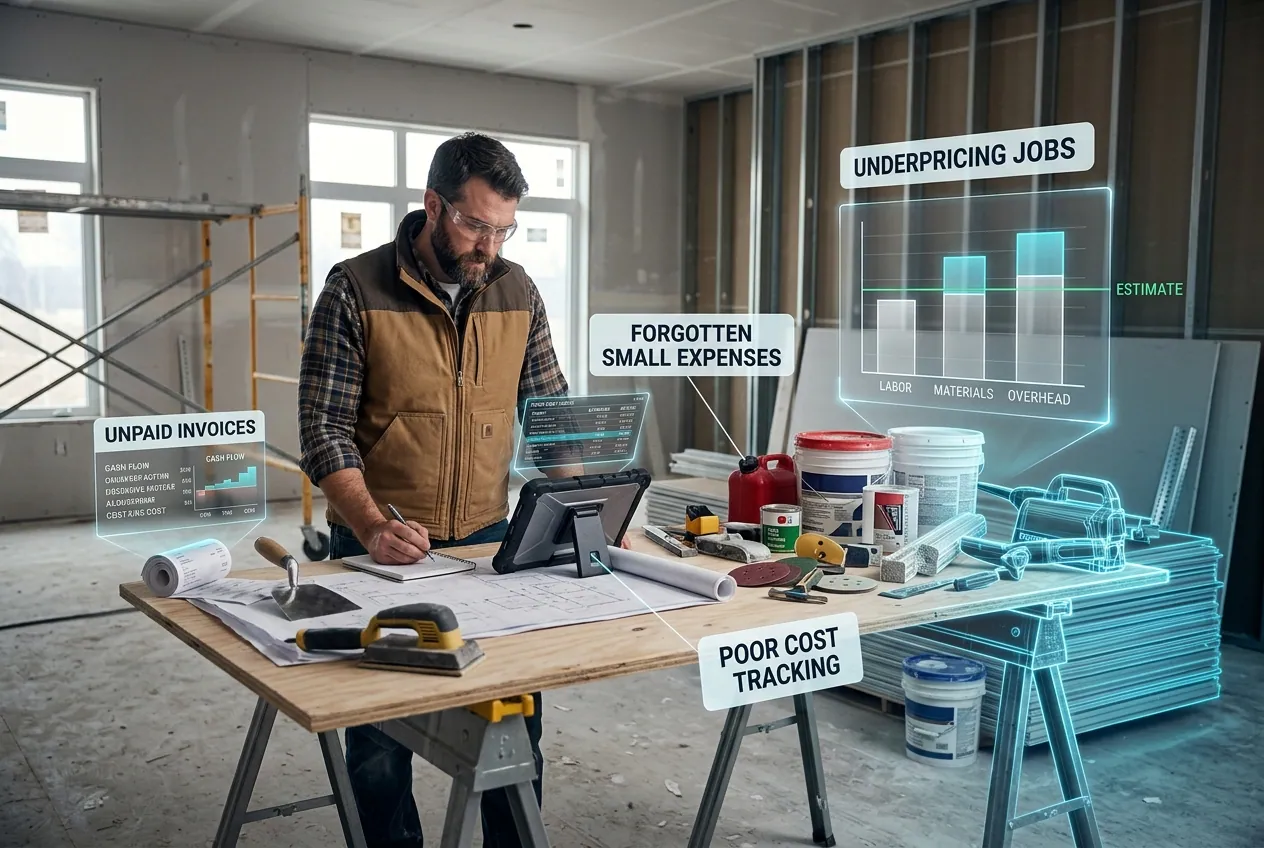
Several avoidable mistakes can turn a busy business into an unprofitable one.
- Underpricing jobs: A low bid may win work but leave too little money for labor, overhead, or unexpected problems.
- Buying equipment too soon: Expensive tools can tie up cash before you have enough work to justify them.
- Ignoring unpaid invoices: Completed work is not the same as collected cash.
- Forgetting small expenses: Fuel, sanding supplies, delivery fees, and tool repairs add up.
- Failing to track job costs: Without actual cost records, you may repeat the same estimating errors.
- Growing before demand is proven: Hiring workers or taking on larger jobs increases financial commitments.
Review each completed job. Compare estimated costs with actual expenses and investigate meaningful differences. If you consistently spend more labor hours than planned, improve your estimating process before trying to solve the problem by taking on more jobs.
Frequently Asked Questions About Drywall Business Costs and Profits
Are drywall businesses profitable?
They can be profitable when job prices cover materials, labor, overhead, and other costs. Actual profitability depends on local demand, estimating accuracy, labor productivity, rework, and payment terms. Calculate expected net profit rather than assuming a standard industry margin.
Where do drywallers make the most money?
There is no universally highest-paying type of drywall work. Residential repairs, renovation projects, and commercial subcontracting have different pricing, labor, and cash-flow demands. Compare the profit per job and the return on your time and equipment, not just the total contract price.
How much does it cost to drywall a 1,500-square-foot house?
The home’s 1,500-square-foot floor area does not tell you how much drywall surface must be installed. The total depends on wall and ceiling measurements, room layout, ceiling height, panel type, finish level, labor, and location. Measure the actual surface area and compare itemized quotes from local contractors before estimating the project cost.
How much money do drywall contractors make?
Contractor earnings vary with sales, operating costs, business size, and the owner’s role. Employee wage data can provide context, but it cannot predict a business owner’s profit. Estimate your expected monthly sales, deduct direct costs and overhead, and account for taxes and owner compensation appropriately.
How to Take the Next Step
Start by choosing the type of drywall work you want to offer. Then list the tools, vehicle, insurance, licensing, and initial cash you will need for that model.
Get local quotes, prepare an estimate for a typical job, and calculate the gross profit and expected net profit. Test your assumptions against real customer interest before committing to a large vehicle purchase, specialized equipment, or a full crew.
A drywall business does not need to start at a large scale to build a sound financial foundation. What matters most is knowing your costs, charging enough to cover them, completing work efficiently, and keeping enough cash available to run the business while you wait to be paid.
Disclaimer
Business startup costs, profit margins, licensing requirements, and earnings vary by location, business model, and individual circumstances. This content provides general educational information, not a guarantee of income or business success. Check applicable local requirements and seek qualified professional advice for legal, tax, or accounting decisions when needed.