
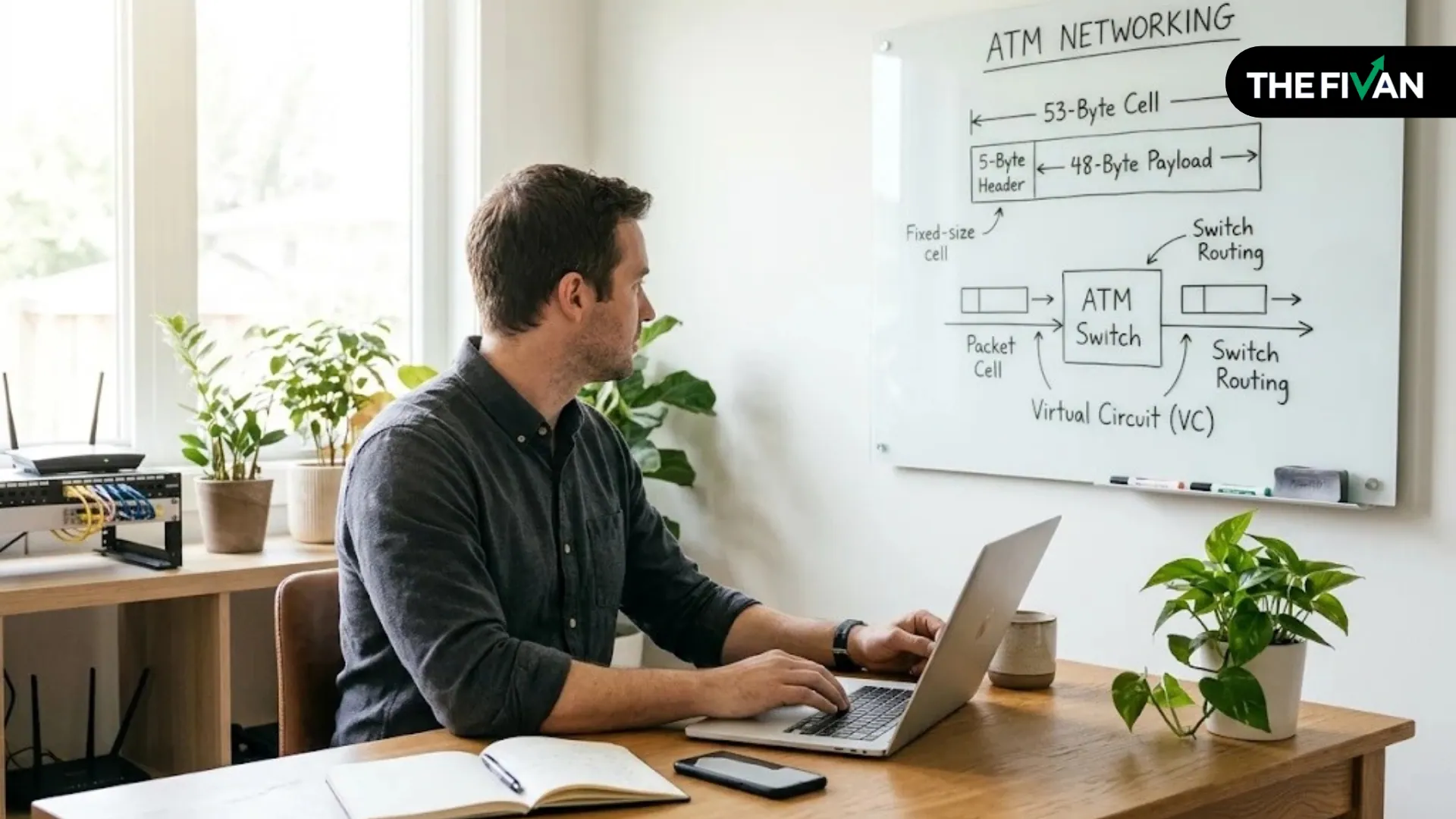
ATM stands for Asynchronous Transfer Mode. It is a networking technology that carries voice, video, and data using small, fixed-size units called cells. Each ATM cell is exactly 53 bytes long, with a 5-byte header and a 48-byte payload. ATM was once important in telecommunications networks because it supported different types of traffic over a shared network.
ATM networking is also called a connection-oriented technology because a logical connection must be established before data can travel. ATM switches forward cells through these connections. Although ATM helped shape telecommunications networks, Ethernet and IP-based technologies have replaced it in many applications. Understanding ATM remains useful for networking students, telecommunications learners, and anyone studying older network systems.
Short Definition
ATM networking (Asynchronous Transfer Mode) is a connection-oriented telecommunications technology that carries voice, video, and data in fixed-size 53-byte cells, each containing a 5-byte header and a 48-byte payload.
Practical Insight Box
When studying ATM networking, remember the 53-byte cell format first: 5 bytes for the header and 48 bytes for the payload. Then learn how VPI and VCI identify virtual connections and help ATM switches forward cells through the network.
What Is ATM Networking?
ATM networking is a method of transferring information through a network using fixed-size cells and virtual connections. Its full name is Asynchronous Transfer Mode. The technology was developed to help networks carry different kinds of information, including voice calls, video, and computer data.
The word asynchronous refers to how network resources are shared without requiring every user to transmit data at fixed, repeating time intervals. ATM can serve different traffic streams according to their needs and the network’s traffic-management rules.
ATM is different from a traditional banking ATM. In computer networking, the term describes a telecommunications technology rather than a cash machine.
Why Was ATM Developed?
Older communication systems often handled voice, video, and computer data through separate technologies. Network operators wanted a more flexible way to carry these services over shared infrastructure.
ATM was developed as part of the broader Broadband Integrated Services Digital Network (B-ISDN) approach. It combined cell switching, logical connections, and traffic-management mechanisms to support different service requirements.
For example, imagine a telecommunications provider carrying voice calls and computer data across the same network. Voice traffic may be sensitive to delay, while ordinary data can often tolerate some variation in delivery time. ATM was designed to help manage these different needs.
Its design was particularly relevant to telecommunications backbones and wide area networks (WANs), which connect locations over large distances.
What Is an ATM Cell?
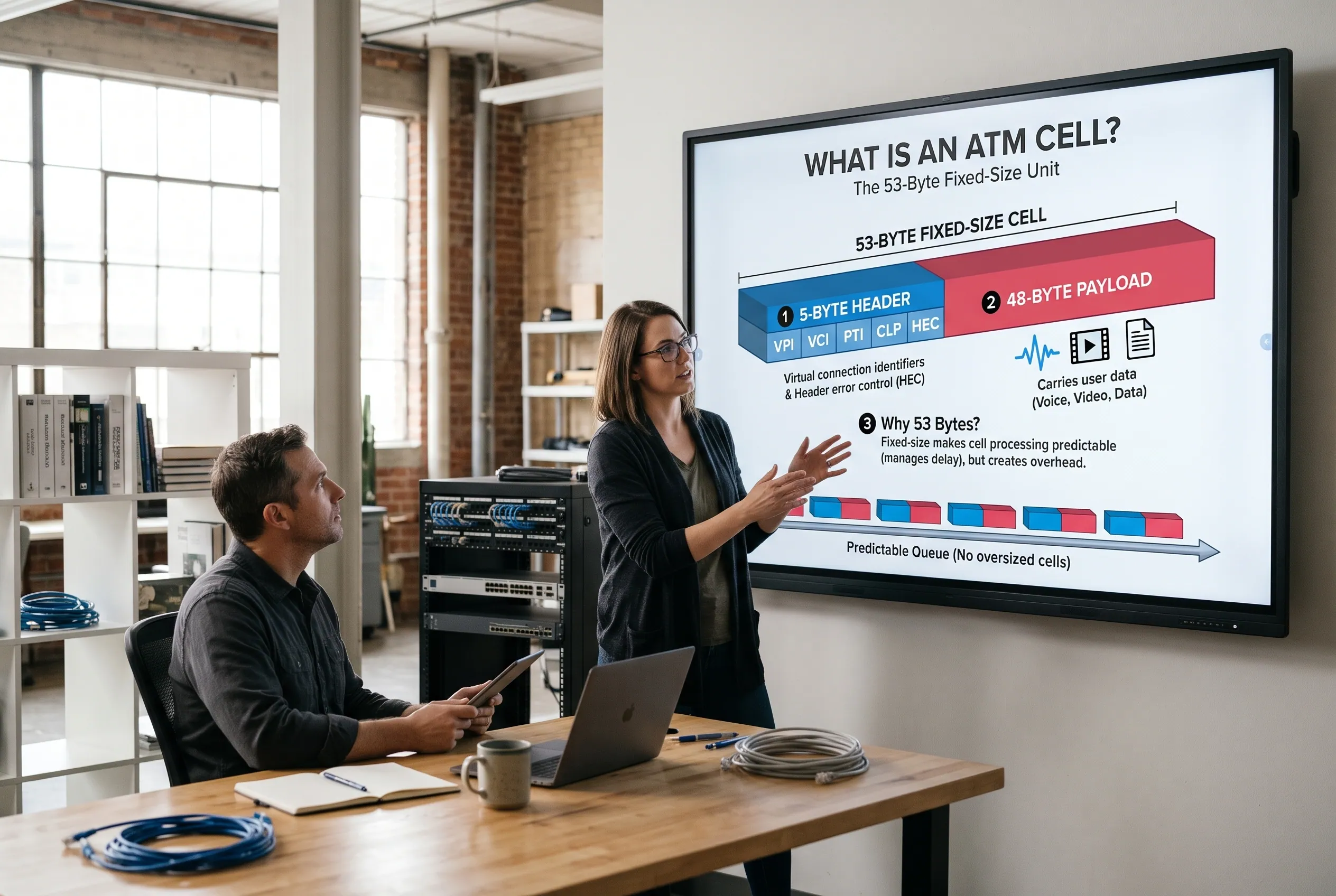 An ATM cell is the small, fixed-size unit used to carry information across an ATM network. Every standard ATM cell contains exactly 53 bytes.
1. The 5-byte header
The header contains information that helps the network handle and forward the cell. Depending on the interface, its fields include virtual connection identifiers and other control information.
Important fields include:
- VPI (Virtual Path Identifier): Identifies a virtual path used to group related virtual channels.
- VCI (Virtual Channel Identifier): Identifies a virtual channel within the relevant path and interface context.
- PTI (Payload Type Indicator): Indicates information about the payload, including certain control or congestion-related meanings.
- CLP (Cell Loss Priority): Marks cells that may be treated as lower priority during congestion.
- HEC (Header Error Control): Helps detect errors in the header and supports cell-boundary identification.
The header allows an ATM switch to make forwarding decisions without examining the entire contents of every cell.
2. The 48-byte payload
The payload carries part of the information being transmitted. That information may come from a voice stream, video service, or higher-level data protocol.
A larger message normally needs multiple ATM cells because 48 bytes is a small amount of space. Additional adaptation mechanisms help divide larger data units into cells and reconstruct them at the receiving end.
Why are ATM cells fixed at 53 bytes?
Fixed-size cells make cell processing more predictable. A switch does not need to handle many different cell lengths, and a large data unit cannot occupy the network simply by being one oversized ATM cell.
This design can help manage delay-sensitive traffic. However, fixed-size cells also create overhead because each cell needs its own header. The network must process more cells when carrying a large message than it would with a larger transmission unit.
ATM therefore makes a trade-off: predictable cell handling in exchange for additional per-cell overhead.
How Does ATM Networking Work?
ATM networking follows a connection-oriented process. A logical connection is established first, information is divided into cells, switches forward those cells, and the receiving system reconstructs the original information.
Here is the process in simple steps.
1 :Establish a connection
The network sets up a logical path between the communicating endpoints.
2 :Prepare the information
An adaptation layer divides the information into units that can be carried in ATM cells.
3 :Forward the cells
ATM switches use header information to forward cells along the established connection.
4 : Reassemble the information
The receiving side processes the cells and reconstructs the higher-level data.
Step 1: Establish a logical connection
Before data moves through a connection-oriented ATM network, the relevant virtual connection must be established. Signaling procedures may be used to request, configure, and release connections.
A virtual connection is a logical route through the network. It does not mean that one physical cable is reserved exclusively for one user.
The network uses connection identifiers to recognize which route a cell belongs to. The exact identifiers and signaling procedures depend on the ATM interface and network configuration.
Step 2: Divide information into cells
Suppose an application needs to send a larger block of data. The ATM adaptation layer prepares that data for transmission and divides it into appropriately sized units.
Each resulting ATM cell has a 5-byte header and a 48-byte payload. Because the payload is small, a larger message may require many cells.
Step 3: Forward cells through ATM switches
An ATM switch reads the relevant header information and consults its forwarding information to determine where the cell should go next.
The switch forwards the cell toward the next part of the virtual connection. Several switches may handle the same cell before it reaches the destination.
Cells belonging to a connection generally follow its configured route, although congestion, loss, or other network conditions can affect delivery.
Step 4: Reconstruct the original data
At the receiving end, the appropriate adaptation layer processes the cells and reconstructs the higher-level data unit.
For applications that use ATM to carry IP packets, the adaptation and encapsulation procedures help recover the original packet. The receiving system can then pass it to the next protocol layer.
Important point: ATM switches forward cells, not complete web pages, documents, or video files as single objects. Higher-level protocols and applications determine what the carried data means.
Understanding ATM Network Architecture
ATM architecture describes how endpoints, switches, virtual connections, and interfaces work together to transfer cells. Each part has a specific role, but the network works as a complete system.
What is an ATM switch in networking?
An ATM switch is a network device that receives ATM cells and forwards them toward their destinations. It examines the cell header, uses its connection information, and selects the appropriate outgoing interface.
Unlike a device that routes IP packets by examining their network addresses, an ATM switch normally relies on the virtual connection identifiers and its configured forwarding information.
For example, a cell arriving on one switch interface may carry a particular VPI and VCI. The switch looks up the matching entry and forwards the cell using the identifiers and interface associated with the next connection segment.
An ATM switch is therefore a central part of the technology’s cell-switching architecture.
Virtual paths and virtual channels
ATM uses two related concepts to organize connections:
- Virtual path: A logical grouping of virtual channels that can share a path through the network.
- Virtual channel: A logical connection used to carry cells between relevant endpoints.
The VPI identifies the virtual path, while the VCI identifies a virtual channel within the relevant interface and path context.
These identifiers are not necessarily global addresses. Their meaning can change as cells pass through switches, which may translate the identifiers when forwarding cells between network segments.
This arrangement lets network operators organize connections without requiring a separate physical cable for every communication session.
What are UNI and NNI?
ATM defines different interface formats for communication at different points in the network.
| Interface | Full form | Main purpose |
| UNI | User-Network Interface | Connects user equipment to an ATM network |
| NNI | Network-Network Interface | Connects ATM network equipment, such as switches |
The standard UNI header includes a Generic Flow Control (GFC) field, while the standard NNI header uses those header bits differently as part of the virtual path identifier. Actual details depend on the applicable interface specification.
These interfaces help define how ATM cells are exchanged between endpoints and network equipment.
What Are ATM Adaptation Layers?
ATM cells carry only 48 bytes of payload each. Most applications, however, produce larger messages or data units. ATM adaptation layers (AALs) help prepare these data units for transmission and recover them at the receiving end.
An adaptation layer sits above the ATM layer and handles functions needed by the type of service being carried.
The main adaptation-layer types include:
| Adaptation layer | General purpose |
| AAL1 | Supports constant-bit-rate services, including certain timing-sensitive streams |
| AAL2 | Supports variable-bit-rate real-time services, including applications that may combine short voice packets |
| AAL3/4 | Designed for data services with specified segmentation and error-handling functions |
| AAL5 | Commonly used to carry higher-level data, including IP packets, over ATM |
These are broad descriptions rather than guarantees that every service or implementation uses each adaptation layer in the same way.
How AAL5 carries data
AAL5 is particularly useful for understanding how ATM relates to IP networking. It allows a higher-level data unit, such as an IP packet, to be prepared for transmission across an ATM connection.
The sender adds the required adaptation information, divides the data into ATM-sized payloads, and transmits the resulting cells. The receiver processes the cells and reconstructs the original higher-level unit.
The process introduces overhead and requires correct handling at both ends. For a deeper technical reference, see IETF RFC 2684, which describes how network protocols are carried over ATM.
Benefits and Limitations of ATM Networking
ATM was designed to address important telecommunications needs. However, its technical strengths came with trade-offs.
Main benefits
- Predictable cell processing
Every cell has the same total length. This gives switching equipment a consistent unit to process and can help control how long one cell occupies a transmission link.
- Support for different traffic types
ATM was designed to carry voice, video, and data across shared network infrastructure. Its traffic-management mechanisms allow different service requirements to be considered.
- Quality of Service controls
Quality of Service (QoS) means managing network traffic to meet requirements such as bandwidth, delay, and cell loss. ATM supports traffic classes and related mechanisms intended to help meet these requirements.
QoS does not mean that every cell will arrive without delay or loss. Actual performance depends on network configuration, available resources, congestion, and the service being used.
- Logical connection management
Virtual paths and channels provide a structured way to organize traffic. Network operators can manage connections without creating a separate physical network for every service.
Main limitations
- Header overhead
Each cell uses 5 bytes for its header and 48 bytes for its payload. This means that some transmission capacity is spent on control information rather than the data itself.
- Added complexity
ATM requires specialized cell processing, connection management, adaptation functions, and traffic configuration. This adds complexity compared with simpler Ethernet-based designs in many common networking environments.
- Equipment and deployment costs
Building and maintaining a dedicated ATM environment can require specialized equipment and expertise. The actual cost depends on the network, equipment availability, and support requirements; there is no single price that applies to every installation.
- Competition from other technologies
Ethernet continued to scale to higher speeds, while IP-based networking and MPLS became important for carrying traffic across modern networks. These technologies reduced the need for ATM in many traditional applications.
ATM was not abandoned because fixed-size cells had no technical value. Rather, competing technologies offered attractive combinations of speed, flexibility, operational simplicity, and cost.
ATM vs. Ethernet vs. Frame Relay
 ATM, Ethernet, and Frame Relay have all been used to connect computers and carry data, but they work differently. Understanding those differences helps explain why ATM was important historically and why other technologies became more common.
| Feature | ATM | Ethernet | Frame Relay |
| Basic transmission unit | Fixed 53-byte cell | Variable-length frame | Variable-length frame |
| Forwarding approach | Virtual connections and cell switching | Frames switched using link-layer addresses; routing may occur at higher layers | Virtual-circuit-based frame switching |
| Connection model | Connection-oriented | Depends on the service and network; basic Ethernet does not require ATM-style virtual circuits | Connection-oriented virtual circuits |
| Main historical strength | Integrated traffic types and QoS controls | Flexible local networking and increasing link speeds | Efficient wide area networking |
| Main trade-off | Cell overhead and implementation complexity | QoS and traffic engineering depend on the wider network design | Less suitable for many modern high-speed network requirements |
| Modern role | Mainly legacy or specialist environments | Widely used in local and data-center networks | Largely a legacy WAN technology |
ATM vs. Ethernet
Ethernet is widely used to connect computers, switches, servers, and other network devices. It carries data in frames rather than ATM’s fixed-size cells.
Ethernet’s flexible frame format avoids the need to divide every transmission into 48-byte payloads. Ethernet also supports a broad range of link speeds and can work with IP routing and other network technologies.
ATM, in contrast, was designed around virtual connections, fixed-size cells, and integrated traffic management.
For a new ordinary office or home network, Ethernet is generally the practical choice. ATM is more likely to matter when studying telecommunications history or maintaining an existing specialized system.
ATM vs. Frame Relay
Frame Relay also used virtual circuits to carry data across wide area networks. However, it transmitted variable-length frames rather than ATM’s fixed-size cells.
Frame Relay became an important way to connect business locations before faster IP-based WAN options became widespread. ATM offered more detailed traffic-management mechanisms and was designed to support different service types.
Both technologies lost ground as newer network services became more attractive. Neither should be treated as a standard first choice for a new general-purpose network today.
Where does IP/MPLS fit?
Internet Protocol (IP) provides the addressing and packet-delivery foundation for many modern networks. Multiprotocol Label Switching (MPLS) can help providers forward traffic through engineered paths using labels.
MPLS is not simply another name for ATM. It is a different forwarding technology that can support traffic engineering and service separation within IP-based networks.
Together, Ethernet, IP, and MPLS provide many of the capabilities that network operators need without requiring a traditional ATM infrastructure.
Is ATM Networking Still Used?
ATM networking has declined significantly in many applications, but it is not accurate to claim that every ATM deployment has disappeared.
Ethernet and IP-based networks have replaced ATM in many modern telecommunications and enterprise environments. However, ATM may still appear in legacy telecommunications equipment, older broadband systems, specialist installations, and networks that have not yet been fully migrated.
The exact status depends on the provider, equipment, service, and location. The available research does not establish a reliable current count of active ATM networks.
Should you learn ATM networking today?
That depends on your goal.
- If you are learning computer networking: Understand ATM’s cell format, virtual connections, and QoS concepts. These ideas help explain the development of networking technology.
- If you are studying telecommunications: ATM may be relevant when learning about legacy carrier networks and broadband history.
- If you are building a new home or office network: Focus first on Ethernet, Wi-Fi, IP addressing, switching, routing, and network security.
- If you maintain an existing ATM system: Check the equipment documentation, supported interfaces, operational requirements, and migration options before changing the network.
ATM remains worth understanding as a technical concept. Its historical importance does not mean it is the most suitable choice for a new installation.
Frequently Asked Questions About ATM Networking
1. What is the full form of ATM in networking?
ATM stands for Asynchronous Transfer Mode. It is a telecommunications networking technology that transmits voice, video, and data in fixed-size cells containing 53 bytes each.
2. What is the format of an ATM cell?
An ATM cell contains 53 bytes: a 5-byte header and a 48-byte payload. The header carries control and forwarding information, while the payload carries part of the transmitted data.
3. Which operating system does ATM use?
ATM is a networking technology, not an operating system. It does not require one specific operating system by definition. Support depends on the network equipment, interface hardware, drivers, and software implementation.
4. What is ATM and PTM in networking?
ATM means Asynchronous Transfer Mode, which uses fixed-size 53-byte cells. PTM means Packet Transfer Mode in relevant DSL contexts and carries information in packets rather than ATM cells. The available modes depend on the broadband technology and equipment being used.
5. What is an ATM switch in networking?
An ATM switch is a device that forwards ATM cells through a network. It uses cell-header information and configured connection mappings to send cells toward their destinations.
Final Takeaway
ATM networking introduced an important approach to telecommunications by combining fixed-size cells, virtual connections, and traffic-management mechanisms. Its 53-byte cell format is the key detail to remember: 5 bytes form the header, and 48 bytes carry data.
Although Ethernet and IP-based technologies have replaced ATM in many applications, learning how ATM works can help you understand network architecture, switching, Quality of Service, and the evolution of modern telecommunications.
For beginners, the most useful next step is to understand Ethernet switching and IP routing, then use ATM as a comparison when studying legacy networking systems.
Disclaimer
This article is intended for general educational and informational purposes only. Networking technologies, compatibility, and deployment practices may vary by equipment and service provider. Always consult the relevant technical documentation before making changes to a live network.