

Are storage units a good investment? They can be, but the right property, purchase price, and local market matter more than the promise of easy rental income. A well-run self-storage facility can generate recurring revenue, while a poorly priced property with high expenses or too much competition can lose money.
You can invest by buying an existing facility, building a new one, or purchasing shares in a self-storage real estate investment trust (REIT). A REIT lets you invest in real estate through shares without directly operating a facility. Each option has different costs, risks, and responsibilities.
The key is to look beyond how much rent a facility collects. You need to understand its operating expenses, potential cash flow, financing costs, and the demand for storage in its area before deciding whether it is worth your money.
Direct Answer
Storage units can be a good investment when local demand and rental income support the purchase price, operating costs, financing, and needed cash reserves.
Experience
Before judging a facility, calculate annual net operating income after routine operating costs, then account for loan payments and a reserve for major repairs. High occupancy alone does not prove the deal will produce strong cash flow.
Are Storage Units a Good Investment?
Self-storage can be a worthwhile investment when customers need the space, rental income covers operating costs, and the purchase price leaves room for a reasonable return. However, high occupancy or a large number of units does not automatically make a property profitable.
Storage facilities may benefit from customers who need space during a move, downsizing, home renovation, or business expansion. Some customers also rent storage for longer periods because they lack enough space at home or work.
However, demand varies by location. A facility near growing neighborhoods may face a very different market from one surrounded by competitors offering discounts and newer units.
The United States market also shows why investors should avoid broad promises. In September 2026, Yardi Matrix reported that advertised self-storage rates had fallen 1.9% year over year in August. The report also noted that excess supply continued to pressure some markets. These figures describe a national market measure, not every city or facility. (Yardi Matrix market update)
Before investing, focus on three questions:
- Can the facility attract and retain enough paying customers?
- Will rental income cover operating expenses, financing, and needed reserves?
- Is the potential return worth the capital, effort, and risk involved?
If the numbers only work under optimistic assumptions, the property may not be a good investment.
What Makes a Self-Storage Investment Profitable?
A storage facility earns money mainly by renting units to individuals and businesses. Its profitability depends on how much rent it collects and how much it spends to keep the property operating.
Where storage facilities earn revenue
The main source of income is monthly rent. Customers may rent small lockers, medium-sized rooms, large units, or spaces designed for business inventory and equipment.
Some facilities also earn money from optional services or products, such as packing supplies, moving equipment, or vehicle storage. These additions can increase revenue, but only when customers need them and the extra income exceeds the associated costs.
A useful distinction is the difference between potential rent and collected rent.
Suppose a facility has 100 units that could each rent for $150 per month. If every unit were rented at that rate for a full year, the maximum rental revenue would be:
100 units × $150 × 12 months = $180,000.
But vacant units, discounts, unpaid bills, and other collection problems can reduce that figure. A facility with $180,000 in potential annual rent does not necessarily collect $180,000.
Understanding operating expenses and net operating income
Storage facilities have costs even when some units are empty. Common expenses include:
- Property taxes and insurance.
- Maintenance, repairs, and cleaning.
- Electricity, water, and other utilities.
- Advertising and customer acquisition.
- Staff or professional management.
- Security systems, access controls, and software.
- Accounting and other administrative expenses.
The exact expenses depend on the facility’s size, location, condition, services, and management model.
After subtracting operating expenses from operating revenue, you get net operating income (NOI). NOI shows how much the property earns from operations before debt payments and income taxes.
For example, if a facility collects $160,000 in annual revenue and spends $64,000 on operating expenses, its NOI is $96,000.
That figure is more useful than revenue alone, but it still does not show the owner’s final take-home income. Loan payments, major capital replacements, and taxes may reduce the money left over.
A property can have positive NOI and still produce poor cash flow if the owner paid too much for it or borrowed too heavily to buy it.
How Much Does It Cost to Buy or Build a Storage Facility?
 The cost of investing in storage units depends on whether you purchase an operating business, buy an existing property that needs work, or develop a facility from the ground up.
There is no single purchase price that applies to every market. A small property in a less expensive area can have very different costs from a large facility in a growing metropolitan area.
Buying an existing facility
Purchasing an existing facility may allow you to review its operating history before investing. You can examine its rental income, occupancy, expenses, and customer records.
However, an established property may require repairs, updated security, better marketing, or improvements to attract customers. You also need to check whether its current rents are sustainable or depend on temporary discounts.
Your initial costs may include:
- The purchase price and closing expenses.
- Property inspections and legal review.
- Immediate repairs and equipment upgrades.
- Working capital to cover early operating needs.
- Cash reserves for vacancies and unexpected expenses.
Do not assume that the seller’s reported income will continue after the sale. Verify the financial records and compare the facility’s actual performance with nearby competitors.
Building a new facility
Development can offer more control over the unit mix, layout, access, and features. It also introduces risks that buyers of operating facilities may face to a lesser degree.
You may need to pay for land, design, surveys, permits, construction, utilities, drainage, paving, access systems, and marketing before the facility earns meaningful rental income.
The project may take longer than expected, and local demand may not support the rent levels used in the original plan. Construction costs, zoning restrictions, and financing terms can also change the outcome.
Before committing money to land or construction, check zoning and permitted use with the relevant local authority. Confirm that the proposed facility can legally operate as planned. Development approval and construction costs should be established before treating projected rental income as achievable.
Ongoing costs matter just as much
A facility’s operating budget should account for maintenance, insurance, property taxes, marketing, management, and routine repairs. You may also need separate reserves for major roof work, paving, gates, security equipment, or other replacements.
A lower purchase price does not always mean a better investment. An inexpensive property with major repair needs and weak local demand may cost more to operate than a better-maintained facility.
Compare the complete cost of ownership, not just the asking price.
How Do You Calculate Potential Returns on Storage Units?
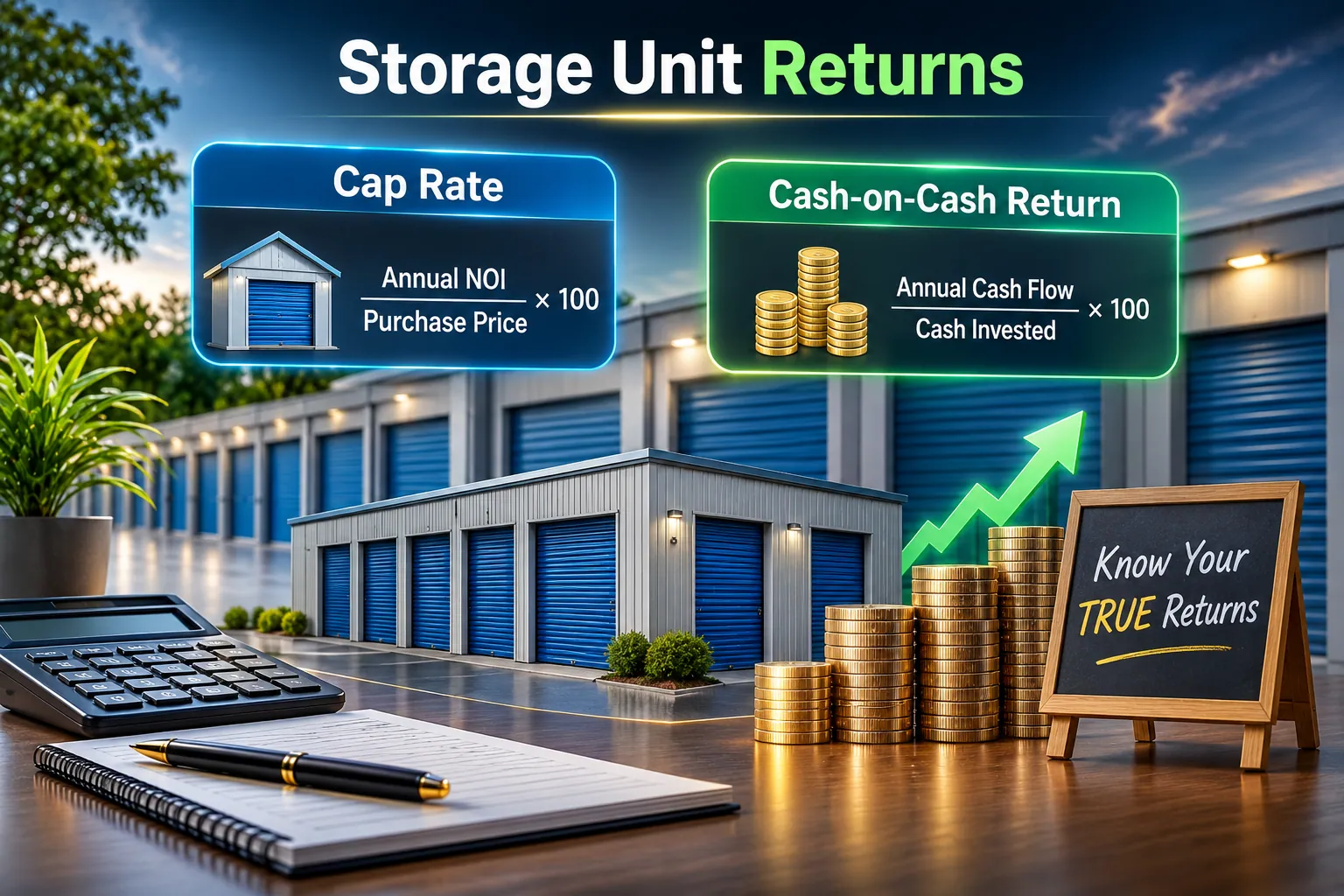 Investors commonly use the capitalization rate, or cap rate, to compare properties. Another useful measure is cash-on-cash return, which examines the annual cash flow relative to the cash invested.
These measures answer different questions.
Understand cap rate and cash-on-cash return
The cap rate compares a property’s annual NOI with its purchase price.
Cap rate = Annual NOI ÷ Purchase price × 100
If a property has $100,000 in annual NOI and costs $1 million, its cap rate is 10%.
This measures the property’s operating income relative to its price before financing. It does not tell you how much money you will keep after mortgage payments, major improvements, or income taxes.
Cash-on-cash return looks at annual cash flow after debt payments relative to the cash invested.
Cash-on-cash return = Annual cash flow after debt payments ÷ Total cash invested × 100
You need to define which costs are included in cash invested and whether the calculation deducts capital reserves. Otherwise, two return estimates may appear comparable when they are not.
Neither measure guarantees a profit or includes every possible source of return, such as a future sale at a higher price.
A hypothetical storage facility calculation
Imagine you are evaluating a facility with the following assumptions. These figures are for illustration only, not a current market quote or an estimate of typical returns.
| Item | Hypothetical amount |
| Number of units | 100 |
| Potential monthly rent per unit | $150 |
| Potential annual rental revenue | $180,000 |
| Actual annual rental revenue at 88% collection | $158,400 |
| Operating expenses, assumed at 40% of collected revenue | $63,360 |
| Annual NOI | $95,040 |
| Purchase price | $1,500,000 |
The cap rate is:
$95,040 ÷ $1,500,000 × 100 = 6.34%.
This figure tells you how annual NOI compares with the purchase price. It does not yet include the effect of borrowing.
Now suppose the buyer makes a 30% down payment and finances the remaining $1,050,000 with a hypothetical loan carrying a 7% annual interest rate, amortized over 25 years. This rate and term are example assumptions, not an offer from a lender.
Under those assumptions, annual loan payments would be approximately $89,054.
The estimated cash flow after debt payments would be:
$95,040 − $89,054 = approximately $5,986 per year.
Suppose the buyer also spends $50,000 on closing costs and initial setup, bringing the total initial cash invested to $500,000. Before setting aside money for major replacements, the cash-on-cash return would be about 1.2%.
But imagine the facility also needs a $10,000 annual reserve for capital replacements. Cash remaining after that reserve would be approximately negative $4,014 for the year.
This example shows why a seemingly reasonable cap rate may not translate into attractive cash flow after financing and necessary reserves.
It also shows why you should not rely on one optimistic projection. Lower occupancy, weaker rent, higher expenses, or more expensive financing could make the investment less attractive.
How much can a 100-unit facility make?
There is no reliable answer based on unit count alone. Two facilities with 100 units can produce different results because one may charge higher rents, collect more of its potential revenue, or operate at a lower cost.
To estimate income, start with the units, achievable rents, and realistic occupancy. Then subtract operating expenses to calculate NOI. After that, account for loan payments and necessary capital spending to estimate the cash available to the owner.
Also distinguish business cash flow from personal income. An owner may need to keep money in the business for repairs, debt obligations, taxes, and future expenses rather than withdrawing everything the property generates.
Should You Buy a Facility or Invest Through a Self-Storage REIT?
You do not have to purchase a physical storage facility to invest in the sector. A self-storage REIT owns or finances real estate and allows investors to gain exposure through shares.
The two routes suit different goals.
| Factor | Direct ownership | Publicly traded REIT |
| Starting capital | Usually requires substantial capital | You can generally begin with the cost of shares |
| Management | You operate the property or hire a manager | The company manages its real estate operations |
| Control | You make property-level decisions | You do not control individual properties |
| Liquidity | Selling a property can take time | Shares are generally easier to trade |
| Main risks | Vacancy, repairs, debt, competition, and property value | Share-price changes, company performance, and market risk |
Buying a facility
Direct ownership may suit someone who has sufficient capital, understands commercial property, and is willing to handle operations or pay for professional management.
It can offer greater control over rents, improvements, unit sizes, and customer service. However, that control comes with responsibility for the property’s expenses and performance.
Borrowing increases the risk. A mortgage creates scheduled payments even when vacancies rise or rental income falls. You should test whether the property could cover its obligations under weaker operating conditions.
Investing through a REIT
A publicly traded self-storage REIT may suit someone who wants exposure to storage real estate without operating a building. You can generally buy shares through a brokerage account, subject to the account’s terms and access.
However, a REIT share is not the same as owning a storage unit. Its price can fall, and its results depend on management, borrowing, property performance, and broader market conditions.
Non-traded REITs also require extra care. The SEC’s Investor.gov REIT guide explains that non-traded REITs can be difficult to sell and may carry substantial upfront fees.
Compare the specific REIT’s fees, holdings, financial reports, and liquidity terms before investing. Neither a publicly traded REIT nor direct ownership guarantees positive returns.
How Do You Evaluate a Storage Market Before Investing?
Local market research can help you avoid paying too much for a facility in an area with weak demand or heavy competition.
National reports are useful for understanding broad trends, but they cannot tell you whether a specific property will perform well.
1. Compare nearby facilities
Look at competing storage businesses within a realistic driving distance. Compare advertised rents for similar unit sizes, climate control, access hours, security, and other features.
Pay attention to discounts for new customers. An advertised introductory rate may not represent the rent a business collects over a full year.
When evaluating an existing facility, request records showing actual rental income, occupancy, concessions, and tenant turnover. Check whether those figures match bank deposits and accounting records.
2. Investigate local demand and supply
Look for factors that may affect the need for storage, such as housing activity, household growth, business demand, moving patterns, and nearby development.
Also consider competing facilities that are planned or under construction. New supply can place pressure on rents and force existing operators to offer discounts.
Market conditions can change quickly. Marcus & Millichap’s 2026 U.S. Self-Storage Outlook projected slower inventory growth and an improvement in national vacancy by year-end, while also noting that performance differs considerably between markets. Its projections are industry estimates, not guarantees for an individual property.
3. Test weaker conditions before buying
Do not rely only on the seller’s expected occupancy or future rent increases. Estimate what could happen if rentals take longer to fill, rents fall, or repairs cost more than expected.
A practical review should consider at least three scenarios:
- Expected case: Reasonable occupancy, achievable rents, and normal expenses.
- Downside case: Lower rental income, slower leasing, or higher operating costs.
- Severe case: A longer vacancy period, major repairs, or financing pressure.
If the property becomes financially unworkable under a modest downturn, reconsider the purchase price, financing, or investment itself.
What Risks Could Reduce Your Storage Investment Returns?
Self-storage has several attractive features, but it is not risk-free.
Oversupply and competition: A new facility nearby may attract customers with lower rents or better features. This can reduce occupancy, force discounts, and weaken income.
Vacancies and slower lease-up: An empty unit does not generate rental revenue, but the property still has expenses. A new or recently purchased facility may need more time and marketing than expected to reach its target occupancy.
Unexpected repairs: Gates, roofs, paving, drainage, lighting, and security systems can require expensive work. Without sufficient reserves, these costs can absorb the cash flow the owner expected to receive.
Borrowing and refinancing: High debt payments can leave little room for operating setbacks. A loan that must be refinanced later may also become more expensive or harder to obtain if market conditions change.
Poor management: Weak customer service, inadequate security, billing problems, and ineffective marketing may affect tenant retention and revenue.
Limited liquidity: Selling a commercial property can take time and involve broker fees, legal expenses, and other transaction costs. You may not be able to access the money quickly when you need it.
Storage demand may hold up during some economic changes because people need space during moves or life transitions. Still, this does not make storage facilities recession-proof. Economic conditions, local demand, debt, and competing supply can all reduce returns.
Can Storage Unit Investments Qualify for Tax Deductions?
Some expenses associated with a storage business may qualify as tax deductions, but not every property cost is an immediate write-off.
For a US business, operating expenses generally need to meet the applicable tax rules. Repairs and routine operating costs can receive different treatment from major improvements that add value or extend a property’s useful life.
Depreciation allows eligible property costs to be recovered over time under tax rules. The building and land must be treated separately because land is not depreciated. Certain nonresidential real property is generally depreciated over 39 years under the standard general depreciation system, but the correct treatment depends on the property, its use, and when it is placed in service.
The IRS provides further guidance in Publication 334, Tax Guide for Small Business.
Your deductions may also depend on the business structure, ownership arrangements, records, and applicable state rules. A qualified tax professional can help determine how the rules apply to an actual investment.
What Should You Check Before Buying a Storage Facility?
Before making an offer, review the property carefully. A structured checklist can help you find problems that a headline return or seller’s income estimate may hide.
- Verify the income: Review actual rent collections, occupancy records, discounts, unpaid bills, and tenant turnover.
- Verify the expenses: Check property taxes, insurance, utilities, maintenance, staffing, marketing, and management costs.
- Inspect the property: Obtain suitable inspections and estimates for urgent repairs and major future replacements.
- Check the local market: Compare nearby facilities, realistic rents, competing supply, and evidence of customer demand.
- Review the financing: Understand the interest rate, term, payment schedule, fees, refinancing conditions, and any required cash reserves.
- Budget for setbacks: Allow for vacancies, unexpected repairs, and periods when income is lower than expected.
- Check legal requirements: Verify permitted use, permits, insurance requirements, and applicable state rules before committing to the transaction.
- Test the numbers: Calculate NOI and cash flow under expected and downside scenarios. Confirm that the deal still makes sense when assumptions become less favorable.
Before signing a binding purchase agreement or making a major nonrefundable payment, resolve material gaps in the property records, inspection findings, financing, and legal permissions. A real-estate attorney, accountant, or other qualified specialist may be needed for issues within their area of expertise.
Frequently Asked Questions About Storage Unit Investments
1. How much does a 100-unit storage facility make?
It depends on average rent, occupancy, collected revenue, and operating expenses. A 100-unit facility charging $150 per month could generate $180,000 in potential annual rental revenue if every unit stayed rented at that price. Actual income would be lower if there were vacancies, discounts, or unpaid rent, and the owner’s cash flow would also depend on expenses and debt payments.
2. What is the average return on investment for storage units?
There is no single return that applies to every storage investment. Cap rates and cash-on-cash returns vary by market, property condition, purchase price, expenses, and financing. Evaluate a specific property’s expected income and costs rather than assuming that a published industry percentage represents your likely return.
3. How much does a storage unit owner make per month?
Monthly owner income depends on what the business collects and spends. Gross rent is not the same as profit, and NOI is not the same as cash available after loan payments. The owner may also need to retain money for major repairs, taxes, and future expenses.
4. Can a storage unit be a tax write-off?
Some eligible operating expenses may be deductible, and qualifying building costs may be depreciated over time. The treatment depends on the property and its use, ownership structure, records, and applicable rules. Not every purchase or improvement can be deducted immediately, so review the relevant IRS guidance or consult a tax professional.
5. Are self-storage REITs better than owning a facility?
A REIT may be more suitable for someone who wants real-estate exposure without directly managing property. Direct ownership may suit someone who has sufficient capital and wants control over operations. Both involve investment risk, so compare costs, liquidity, responsibilities, and possible losses before choosing.
How to Decide Whether Storage Units Fit Your Investment Goals
Self-storage can be a good investment, but the decision should come from the numbers rather than attractive income claims. The purchase price, local rental demand, operating costs, financing, and cash reserves all influence the result.
If you want to own and manage commercial property, start by evaluating a specific facility and testing whether its income can support its costs under realistic conditions. If you prefer a more hands-off approach, compare publicly traded self-storage REITs and their risks.
The most useful next step is to build a conservative estimate for the property or investment you are considering. If the return only looks attractive when every assumption goes right, it may not be worth the risk.
Disclaimer
This article provides general financial education, not personalized financial, investment, legal, or tax advice. Financial circumstances, property conditions, product terms, and applicable laws vary, and investment returns are not guaranteed. Consider qualified professional guidance when evaluating a significant property purchase or its tax and legal consequences.