
Vending machines can be a good investment if you find a location with steady demand, control your costs, and sell products people want to buy. But buying a machine does not guarantee sales or profits. A poorly placed machine can tie up your money while bringing in too little income to cover its expenses.
For beginners in the United States, the smartest approach is to check the location and estimate the numbers before buying equipment. You need to budget for the machine, inventory, payment fees, maintenance, and any commission paid to the property owner. You also need time to restock products, solve problems, and track sales.
A vending machine business can work as a side business or grow into a larger operation. The key is to judge it by the money left after expenses, not by sales figures or promises of passive income.
Direct Answer
Vending machines can be a worthwhile small-business investment when a location has steady demand and sales cover inventory, commissions, payment fees, maintenance, and other costs. Profit is not guaranteed, and the work is not fully passive.
Experience
Practical Finance Tip: Before buying a machine, confirm the location in writing and estimate monthly profit after product costs, commissions, payment fees, travel, and repairs. Treat seller income claims as unverified until you can check the records.
How Does a Vending Machine Business Make Money?
A vending machine business makes money by buying products at wholesale or retail-supply prices and selling them to customers at higher prices. The difference helps pay operating expenses and, if sales are strong enough, leaves a profit for the owner.
For example, imagine you buy a bottled drink for $1 and sell it for $2. The $1 difference is your gross profit on that product before other business costs.
However, you cannot keep the entire $1. You may need to pay a property owner for the space, cover payment-processing fees, travel to the location, replace damaged products, and repair the machine.
It helps to understand three basic financial terms:
- Revenue: The total money customers pay for products.
- Gross profit: Revenue minus the cost of the products sold.
- Operating profit: The money left after operating expenses, such as location commissions, payment fees, travel, and maintenance.
Your personal take-home income can be lower still. Taxes, loan payments, equipment depreciation, and the value of your own time may affect how much the business really adds to your finances.
This is why two machines with similar sales can produce very different results. One may have low operating costs and reliable customers, while the other may require frequent trips, expensive repairs, or a large commission.
How Much Does It Cost to Start a Vending Machine Business?
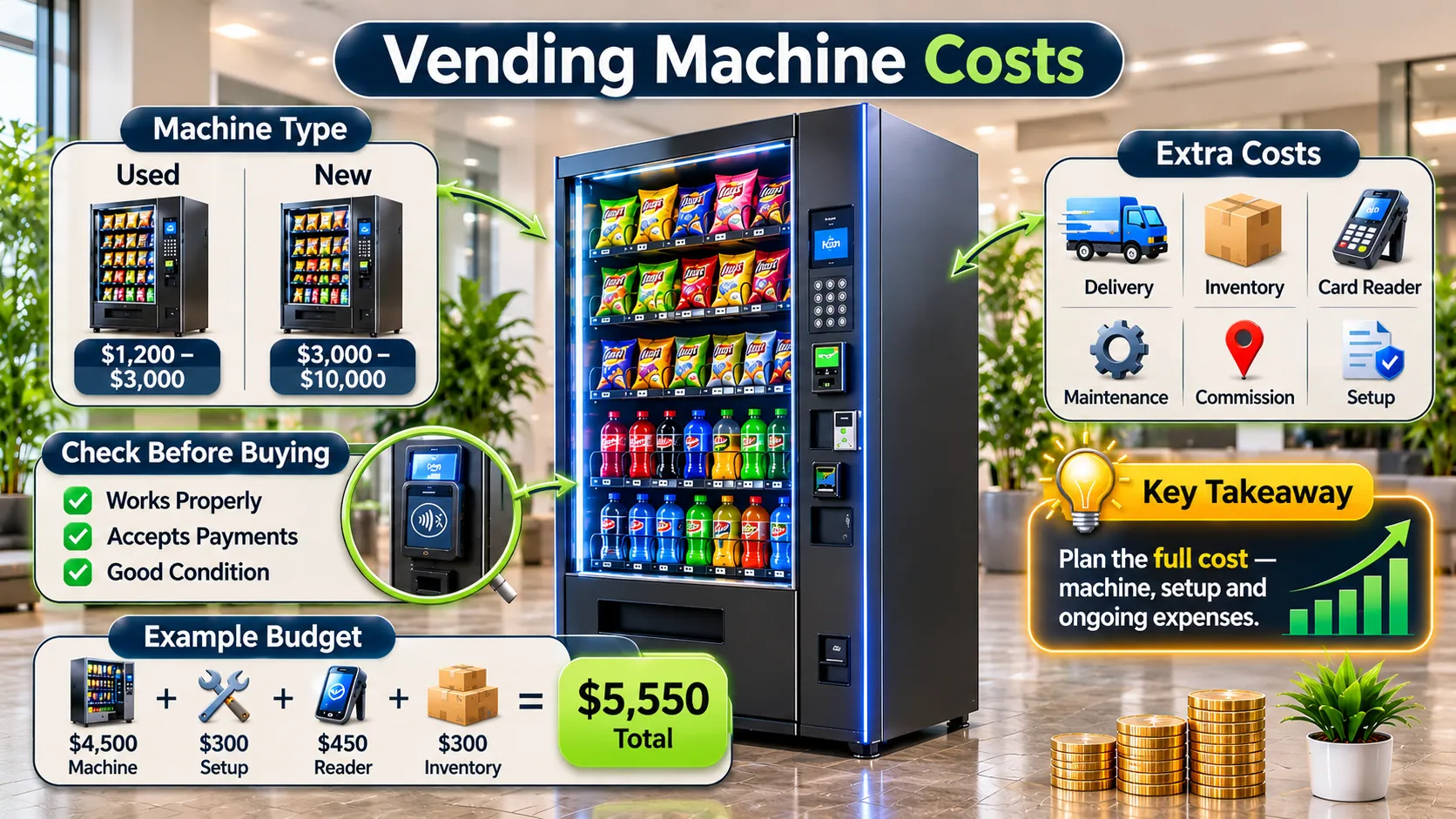
The cost depends on the machine type, condition, payment features, delivery requirements, and products you plan to sell.
As a broad published estimate, NerdWallet’s vending machine business guide places used or refurbished machines around 1,200–3,000 and new machines around 3,000–10,000. These are general ranges, not guaranteed current prices for every model.
Current supplier catalogs provide another useful reference. For example, VMFS USA’s combo machine listings show different snack-and-drink models priced from roughly $3,650 to $6,950. Optional payment hardware and other features can change the final cost, so request a written quote before budgeting.
Used machines versus new machines
A used machine may suit someone with limited startup capital. It can reduce the initial purchase cost, but its age, condition, and repair history matter.
Before buying a used machine, check that it cools properly if needed, accepts payments correctly, dispenses products reliably, and has parts available for repairs. Ask to see it working with products loaded. A cheap machine that repeatedly fails can cost more in lost sales and repairs than a more reliable unit.
A new machine may offer a warranty, newer payment options, and fewer immediate repair concerns. However, the higher purchase price means you need more money upfront. A warranty also has limits, so check what it covers, how long coverage lasts, and who pays for service or shipping.
The extra costs beginners often miss
The machine itself is only one part of the budget.
| Expense | What to check |
| Delivery and installation | Whether delivery brings the machine inside and whether setup is included |
| Initial inventory | The cost of filling the machine with enough products to begin selling |
| Card reader | Hardware cost, compatibility, and installation |
| Payment processing | Transaction fees and any monthly service charge |
| Location commission | The percentage of sales or other payment required by the property owner |
| Maintenance | Repairs, parts, cleaning, and replacement equipment |
| Travel | Fuel, parking, and time spent restocking or collecting money |
| Business setup | Applicable registration, permits, insurance, and tax requirements |
| Cash reserve | Money available for repairs, slow sales, and replacement inventory |
For a concrete example, suppose a machine costs $4,500, delivery and setup cost $300, a payment reader costs $450, and opening inventory costs $300. Your initial spending would be $5,550.
That is a hypothetical budget, not a current market quote. It also excludes possible permits, insurance, financing costs, and a repair reserve.
A useful rule is to calculate the full cost of getting the machine ready to earn money. Do not spend your entire available budget on equipment and then discover you cannot afford the stock or repairs needed to operate it.
How to Calculate Vending Machine Profit
The best way to judge a vending machine investment is to make a simple profit estimate using clear assumptions.
Consider this hypothetical example of one snack-and-drink machine operating for a month.
Suppose the machine generates $1,500 in sales. Customers buy a mix of products that cost you $750 to purchase.
Your gross profit is:
$1,500 − $750 = $750
Now subtract the other assumed monthly expenses.
| Monthly item | Amount |
| Sales revenue | $1,500 |
| Product costs | −$750 |
| Location commission (10% of sales) | −$150 |
| Payment processing | −$36 |
| Fuel and travel | −$80 |
| Maintenance and reader service | −$40 |
| Damaged or unsold inventory allowance | −$25 |
| Estimated operating profit | $419 |
In this example, the business produces $419 in monthly operating profit before income taxes, owner labor, financing costs, and depreciation.
The figures are illustrative, not an industry average or a promise of earnings. Actual product costs, sales, commissions, and repair expenses can differ significantly.
What does this example tell you?
First, $1,500 in sales does not mean $1,500 in income. Half of the revenue in this example goes toward buying products, and other expenses reduce the amount left.
Second, small changes can matter. If monthly sales fall but travel and service costs stay the same, profit can shrink quickly. A machine with poor sales may not be worth the time needed to maintain it.
Third, your own time has value. Suppose you spend eight hours a month sourcing products, driving, restocking, and checking the machine. The $419 remaining would equal about $52 per hour before taxes and other excluded costs. If the machine instead needs 20 hours of work, the same cash profit would equal about $21 per hour.
These are simply ways to evaluate the example, not predictions about what you will earn.
How long could it take to recover your startup cost?
The payback period is the time it takes for business profit to cover the money you initially invested.
Using the example above, suppose startup costs total $5,550 and monthly operating profit remains $419.
The simple calculation is:
$5,550 ÷ $419 ≈ 13.2 months
That suggests a payback period of about 14 months under the stated assumptions. It does not mean you are guaranteed to recover the money that quickly.
Sales may change with the season, location, competition, and product demand. A major repair or several weeks of downtime could extend the payback period. The calculation also excludes taxes, owner labor, financing costs, and equipment depreciation.
Use a conservative estimate rather than assuming your best sales month will continue throughout the year.
Why Location Matters More Than the Machine Price
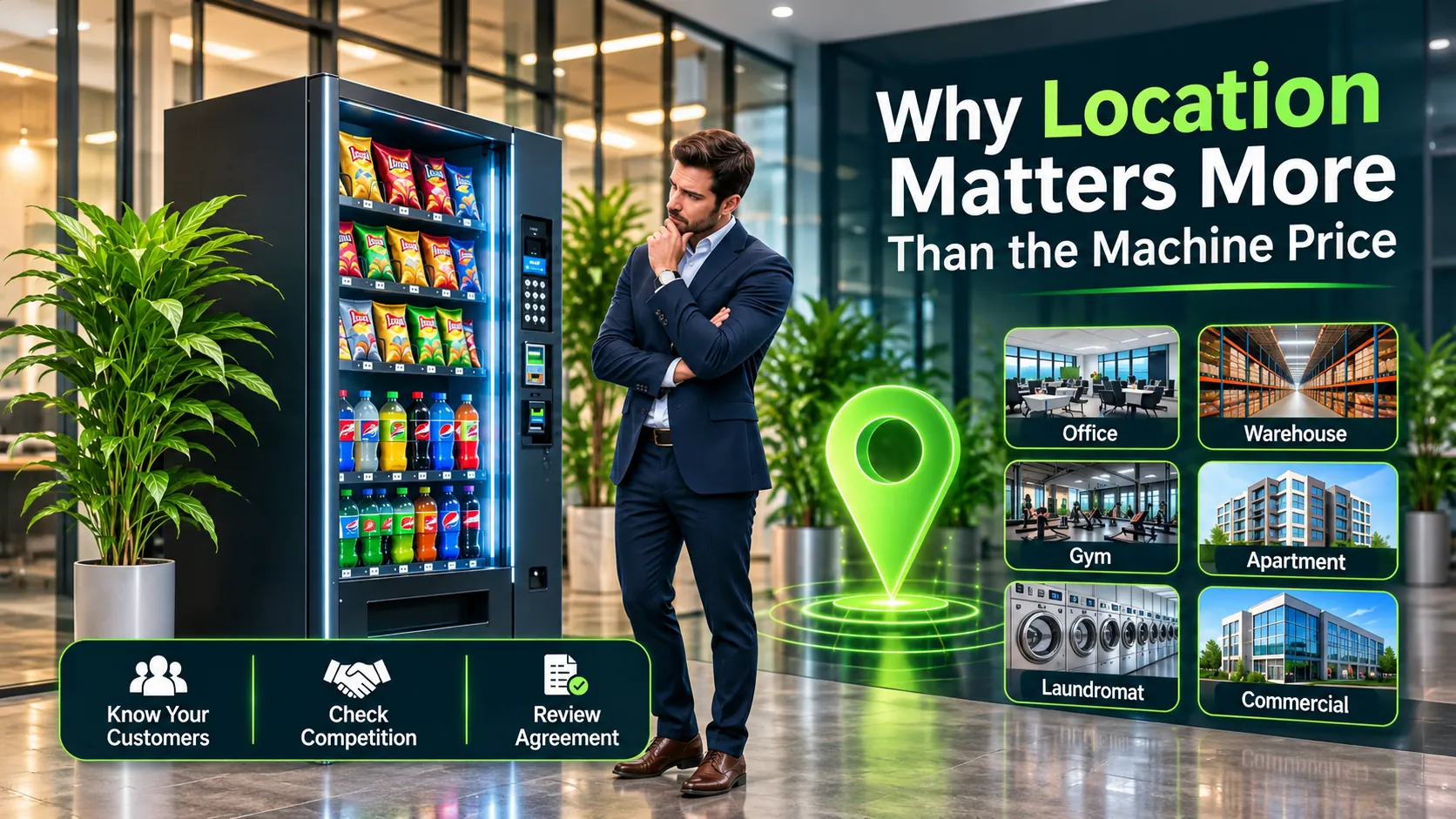 A vending machine needs customers. Even a reliable machine with attractive products can perform poorly if few people pass it or if those people have no reason to buy what it sells.
Potential locations include offices, warehouses, apartment buildings, gyms, laundromats, and other commercial spaces. None guarantees good sales. The right location depends on who uses the space, how often they visit, their needs, and the alternatives available nearby.
For example, a warehouse with several work shifts may create regular demand for drinks and snacks. A small office with few employees may produce less demand, even if the office is busy during certain hours.
Before committing to a location, ask these questions:
How many potential customers are there? Look beyond total building occupancy. Think about how many people regularly pass the machine and whether they are likely to buy something.
When do people need the products? A machine in a workplace with overnight shifts may serve customers when nearby stores are closed. A gym may need drinks and suitable snacks rather than a standard mix.
What other choices do customers have? Nearby convenience stores, cafeterias, and free workplace snacks may reduce demand.
Who pays for electricity and service? Clarify responsibilities for power, access, cleaning, repairs, and restocking.
What does the placement agreement say? Confirm the length of the agreement, the commission, access hours, termination terms, and what happens if the location no longer works.
NerdWallet reports that property owners may charge a commission of around 5%–25% of vending revenue. This is a published range, not a standard fee for every location. A lower rate does not automatically make a location better if sales are weak.
Whenever possible, discuss demand with the property manager before buying equipment. If you are buying an existing route, ask for machine-level sales records rather than relying only on the seller’s total revenue.
Which Vending Machine Type Should You Choose?
The best machine is the one that matches the needs of the customers at your location and the amount of money you can afford to invest.
Snack and drink machines
Traditional snack and beverage machines are familiar to customers and can suit workplaces, shared residential spaces, and other locations with regular traffic.
Their main advantage is product familiarity. Their disadvantages include restocking needs, competition, refrigeration costs for cold drinks, and possible product waste.
A combination machine can sell snacks and drinks from one cabinet. It may help you offer a useful mix while managing one unit, but its capacity and range of products may be smaller than separate machines.
Bulk and toy vending
Bulk vending machines may sell small toys, stickers, or similar items. These products can need less frequent restocking than refrigerated goods, depending on sales volume.
However, these machines still depend on suitable locations and customer interest. A toy machine in a place with few children or little family traffic may perform poorly.
Smart vending machines
Smart vending equipment can add features such as cashless payment, remote sales tracking, inventory alerts, or electronic product recognition. These features may help you manage stock and spot problems without visiting the machine as often.
The trade-off is additional complexity and possible hardware, software, connectivity, or service costs. Paying for advanced features makes little sense if your first location has limited demand or if a simpler machine can do the job.
Start with customer needs and the total cost of operating the machine. Do not buy specialized equipment simply because it looks modern.
What Are the Biggest Risks of Owning Vending Machines?
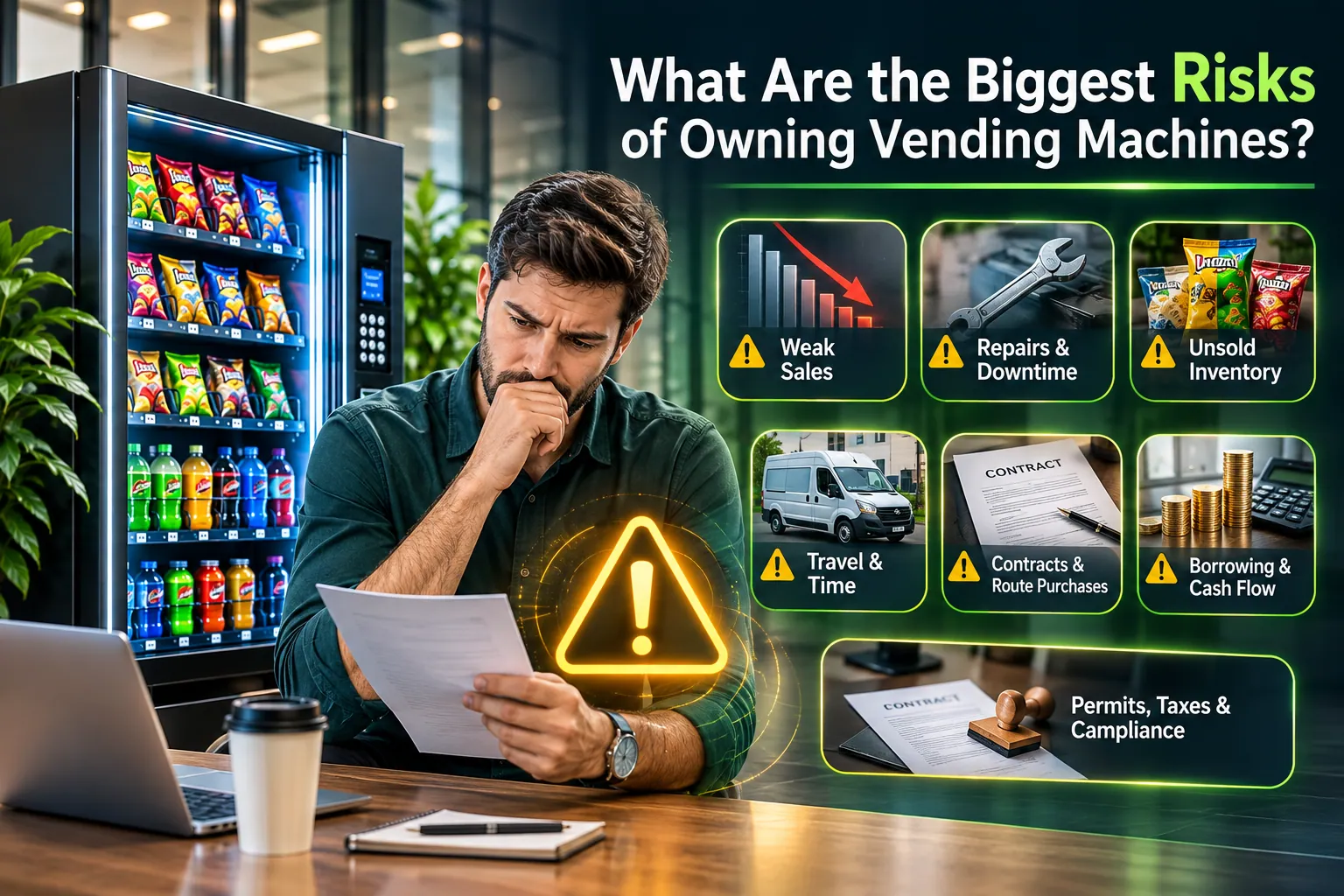 Vending machines can lose money, and several common problems deserve attention before you invest.
Weak sales
The location may attract fewer customers than expected, or customers may not want the products you stock. Start by testing demand and reviewing similar locations before committing a large amount of money.
Repairs and downtime
A machine that stops cooling or dispensing products can lose sales while still creating repair expenses. Ask about warranties and local repair support. Keep a reserve for unexpected problems rather than assuming the equipment will never fail.
Unsold or damaged inventory
Products can expire, become damaged, or sell more slowly than planned. Start with a smaller range of suitable products, monitor what sells, and adjust the selection using real sales data.
Travel and time
Restocking requires buying or collecting inventory, loading the vehicle, visiting the location, and checking the machine. Several machines spread across a wide area can create expensive travel and a demanding schedule.
A machine may look profitable on paper but offer a weak return once your time and travel costs are considered.
Contracts and route purchases
Buying a vending route means buying an existing set of machines, locations, or related business arrangements. Its value depends on the machines’ condition, actual sales, and whether the location agreements can be transferred to you.
Before paying for an existing route, verify the sales and contracts yourself. Request monthly sales records, inventory and maintenance expenses, repair history, and written confirmation that the locations will remain available. Check that the seller has the right to transfer any agreements being sold.
Be cautious if a seller promises guaranteed income, refuses to provide records, or demands a quick payment. A list of locations is not proof of a profitable business.
Borrowing and cash flow
A loan can reduce the amount you pay upfront, but it creates required payments whether sales are strong or weak. Interest, fees, and the repayment term affect your total cost.
Before financing a machine, calculate how much cash remains in a low-sales month. Do not rely on projected vending revenue to cover payments if you could not afford them during a slow period.
Permits, taxes, and compliance
Rules depend on your location and what you sell. The U.S. Small Business Administration’s launch guidance explains that licenses and permit requirements can vary by state, county, and city, including for vending operations.
Sales-tax treatment also varies. For example, the Idaho State Tax Commission’s vending guidance explains the state’s requirements for taxable vending sales and seller permits. That guidance applies to Idaho, not every state.
Some federal food-labeling rules may also apply. The FDA’s vending machine labeling requirements generally cover operators with 20 or more machines, subject to certain exemptions; smaller operators can also register voluntarily.sba.gov/counseling/launch-your-business
Before launching, check the rules for your own state and locality. Keep records of sales, product purchases, travel, repairs, and equipment costs. The IRS recordkeeping guidance explains how business records support income reporting and expenses.
What to Check Before Buying Your First Vending Machine
You do not need to buy several machines to learn whether the business suits you. A careful first purchase can help you test the model without committing too much money.
Use this checklist before spending your savings.
- Confirm the location. Speak with the property manager, assess customer demand, and obtain written permission. Do not assume you can place a machine wherever there is spare floor space.
- Calculate the full startup cost. Include equipment, delivery, payment hardware, inventory, setup, permits where required, and a reserve for repairs.
- Estimate monthly profit. Use realistic sales assumptions. Subtract inventory, commissions, payment fees, travel, maintenance, and other operating expenses.
- Inspect the equipment. Test the machine, check its condition, and confirm parts and repair services are available. Review warranty conditions for a new unit.
- Check all agreements. Understand the commission, contract length, access requirements, service responsibilities, and cancellation terms. For an existing route, independently verify sales and transfer rights.
- Decide how much time you can give it. Consider how often you can restock, resolve problems, and review performance. A machine that needs frequent visits may not fit your schedule.
- Set a review point. Track sales, inventory costs, operating expenses, and hours worked from the beginning. After a suitable test period, compare actual results with your original estimate.
If the machine consistently misses its sales target, investigate why. Adjusting products or negotiating a better arrangement may help, but the right decision may also be to leave an unprofitable location or avoid expanding.
Frequently Asked Questions
How profitable is owning a vending machine?
Profitability depends on sales, product costs, location commission, payment fees, maintenance, and the time needed to operate the machine. A machine with strong revenue can still produce little profit if expenses are high. Build a monthly estimate using realistic sales and all relevant costs before buying.
How many vending machines do you need to make $100,000 a year?
There is no fixed number because machines produce different results. Using the earlier hypothetical example, $419 a month equals $5,028 a year in operating profit per machine. Dividing $100,000 by $5,028 gives roughly 20 machines.
This is only a mathematical illustration, not an earnings forecast. It excludes additional route-level overhead, taxes, and changes in sales. The actual number could be much higher or lower.
What is the biggest disadvantage of owning a vending machine?
The biggest disadvantage is that you commit money to equipment before knowing how strong demand will be. You must also restock products, travel to locations, handle breakdowns, and deal with possible theft or weak sales. A poor location can make the work and costs outweigh the profit.
Can you make money with just one vending machine?
Yes, one machine can make money if customer demand is strong and costs remain under control. Starting with one unit can also limit the amount you risk while learning the business. However, its income may be small or inconsistent, and travel and maintenance can take up a large share of the profit.
The Bottom Line: Should You Invest in Vending Machines?
Vending machines can be a worthwhile small-business investment, but the opportunity depends on the numbers and the location, not the equipment alone. The strongest starting point is to find a location with real demand, calculate total costs, and estimate operating profit before buying anything.
If the figures still look sensible after allowing for repairs, slow sales, and your own time, a single machine may be a reasonable way to test the business. If the numbers only work under optimistic assumptions, keep your money until you find a better opportunity.
The goal is not to own as many machines as possible. It is to operate machines that earn enough to justify the money, work, and risk involved.
Disclaimer
This article provides general financial education, not personalized financial, investment, legal, or tax advice. Costs, regulations, contracts, and business results vary by location, and income or investment payback is not guaranteed. Check applicable local requirements and consult a qualified accountant or other appropriate professional when needed.