
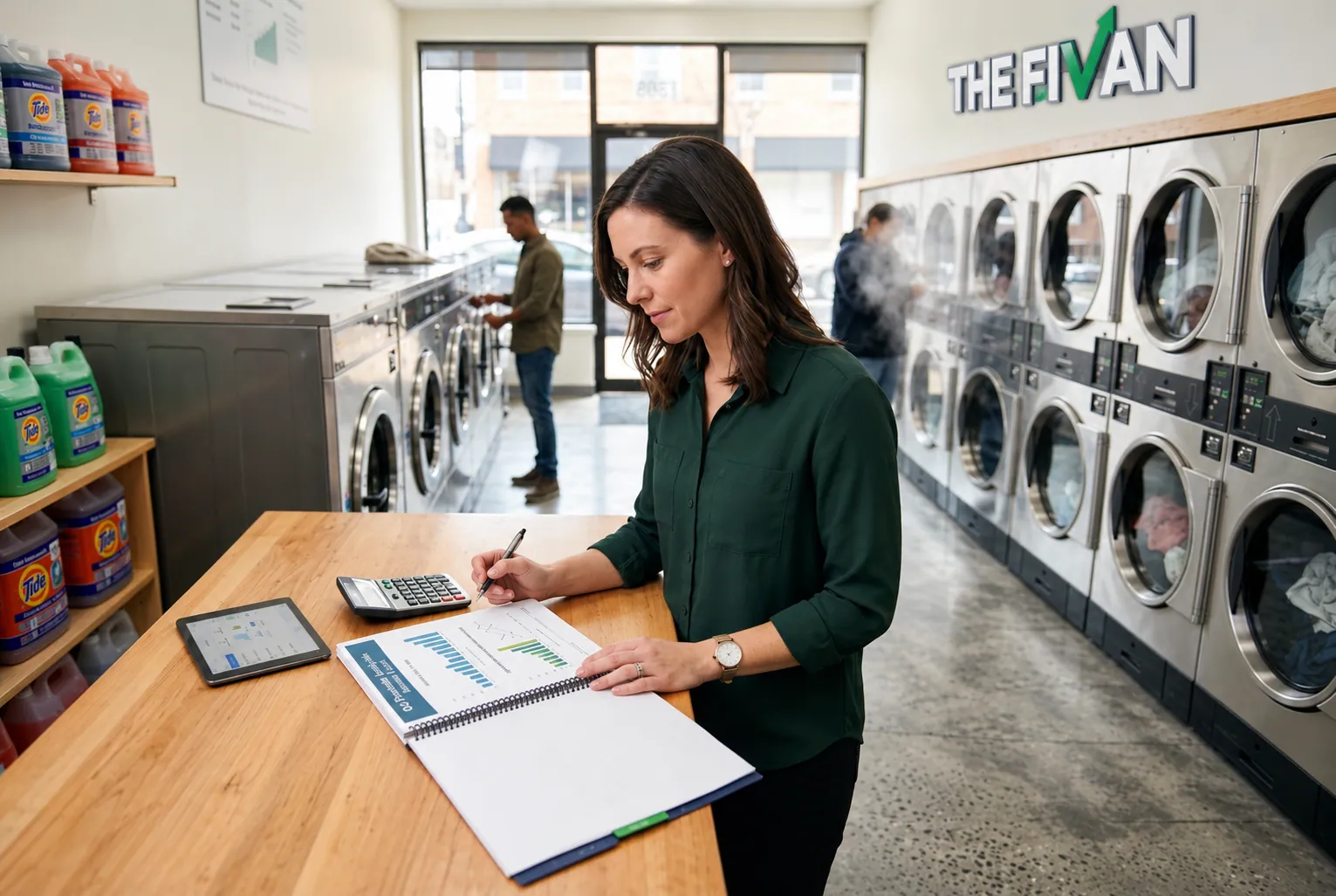
How much money do laundromats make in the United States? The answer depends on the store’s location, size, customer demand, operating costs, and services. A laundromat may bring in hundreds of thousands of dollars in yearly sales, but the owner does not keep all that money.
The Coin Laundry Association’s 2024 industry survey reported median gross revenue of $335,000 per store for the revenue period covered by the survey. By comparison, BizBuySell’s laundromat business-sale data reported median annual revenue of $219,878 for businesses sold between 2021 and 2025. These figures describe different groups of businesses, not one universal national average.
The key is to separate gross revenue, operating profit, and the money an owner can actually take home. Once you understand those differences, you can judge laundromat earnings more realistically.
Direct Answer
Laundromat earnings depend on sales and operating costs. US benchmarks show median annual gross revenue of $219,878 to $335,000 across two different datasets, but neither figure guarantees owner income.
Experience
Before judging a laundromat, compare its sales reports with payment records and deposits. Review utility bills, rent, payroll, repairs, and lease terms, and verify which expenses and owner labor are included in the seller’s profit figures.
How Much Money Do Laundromats Make?
Laundromats can generate substantial annual sales because customers regularly need clean clothes, sheets, towels, and other washable items. However, sales vary widely between individual stores.
Two useful sources provide different views of the business:
| Earnings measure | Coin Laundry Association survey | BizBuySell sold-business data |
| Reporting period | 2023 store revenue | Businesses sold during 2021–2025 |
| Median annual gross revenue | $335,000 | $219,878 |
| What the figure represents | Responding store owners | Reported financials of sold businesses |
| Main limitation | Voluntary survey responses | Businesses that were listed, sold, and reported on the platform |
The Coin Laundry Association survey received 377 usable responses, representing a 6% response rate. Its results offer valuable industry insight, but the respondents may not represent every US laundromat. BizBuySell’s figures describe businesses that changed hands through its marketplace, so they do not represent every operating store either.
The difference between the figures is not necessarily a contradiction. Stores that respond to an industry survey may differ from businesses that come up for sale.
More importantly, neither figure tells you how much an owner earns personally. A store can collect $300,000 in a year and still leave its owner with a much smaller amount after expenses.
Gross Revenue vs. Profit: How Much Money Does the Owner Actually Keep?
Before estimating a laundromat owner’s income, understand four basic financial terms.
Gross revenue is the total money a business earns from sales before expenses are deducted. It includes money customers pay to wash and dry clothes and, where offered, additional services.
Operating expenses are the costs of running the business. These often include rent, utilities, employee wages, insurance, cleaning, supplies, and machine repairs.
Operating profit is what remains after operating expenses are deducted from revenue. The exact meaning depends on which expenses the business includes in its calculation.
Seller’s discretionary earnings (SDE) is a measure commonly used when valuing a small business for sale. It generally adjusts business earnings for one working owner’s compensation and certain expenses, such as interest, taxes, depreciation, amortization, and documented one-time costs. The seller’s adjustments must be checked rather than automatically accepted.
These measures answer different questions. Revenue shows how much business the laundromat generates. Operating profit indicates how well it covers its operating costs. SDE helps buyers estimate the financial benefit a business may provide to one owner-operator.
None automatically equals the cash a buyer will personally keep.
For example, an owner who buys a laundromat with a loan must account for debt payments. The business may also need money for new machines, unexpected repairs, taxes, and working capital, which is cash available to cover ongoing business needs.
That is why a business advertising $300,000 in annual revenue may be less attractive than another store with lower sales but better-controlled expenses.
How Much Does a Laundromat Make Per Day, Month, and Year?
You can convert annual revenue benchmarks into daily and monthly figures by dividing by 12 months or 365 days.
The following table shows simple averages based on the two datasets discussed above.
| Revenue benchmark | Per year | Per month | Per day |
| CLA survey median | $335,000 | About $27,917 | About $918 |
| BizBuySell sold-business median | $219,878 | About $18,323 | About $602 |
These are gross-revenue equivalents, not daily or monthly profit. The calculations spread annual revenue evenly across the calendar, even though actual sales fluctuate.
A laundromat might have busy weekends, slower weekdays, seasonal changes, or local demand patterns that affect its receipts. A store also may earn more during some periods because of added services or changes in pricing.
Consider the CLA benchmark. Dividing $335,000 by 12 gives approximately $27,917 in monthly gross revenue. That amount still has to support the store’s costs.
The same principle applies to daily revenue. Collecting an average of about $918 per day does not mean the owner earns $918 a day. The business must pay its bills before the owner can decide how much money is available for personal use.
Use these figures as reference points, not promises about what a particular store will earn. When evaluating a real business, its records matter more than a national benchmark.
What Determines How Much a Laundromat Makes?
Several factors help explain why one laundromat earns more than another.
1. Location and customer demand
A laundromat needs enough customers within a convenient travel distance. Areas with many apartment residents, renters, students, or households without suitable home laundry equipment may offer useful demand.
However, a large nearby population does not guarantee strong sales. You also need to consider existing competitors, parking, visibility, safety, opening hours, and how easily customers can reach the store.
A location with steady demand and manageable rent may perform better than a more expensive location that attracts more people but leaves little profit.
2. Number and capacity of machines
More machines can provide room for more sales, but only when customers use them.
A store with large-capacity washers may serve households washing bedding or several loads together. Smaller machines can suit customers with ordinary laundry needs.
The purchase and maintenance costs matter too. Installing more machines does not automatically increase profit if demand is weak or the extra equipment is expensive to operate.
3. Machine usage and pricing
Each paid wash or dry cycle brings in revenue. The number of times a machine is used during a day is often called its turns per day.
A machine that runs several paid cycles may generate more sales than one that sits idle for long periods. But higher usage also means more wear, which can increase repair and replacement needs.
Owners need to balance prices with local competition, utility costs, equipment quality, and what customers are willing to pay.
4. Service quality and operating hours
Customers are more likely to return when machines work, the store is clean, prices are clear, and payment is convenient.
Longer opening hours may help some locations attract additional customers. They can also increase cleaning, staffing, security, or utility costs.
The goal is not simply to open longer or buy more equipment. It is to provide a useful service at a cost the business can support.
What Expenses Reduce Laundromat Profit?
Laundromats have several recurring expenses. A few deserve special attention because they can quickly reduce the money left from sales.
Utilities
Water, sewer service, electricity, and gas can make up a major part of operating costs.
In its 2024 survey, the Coin Laundry Association reported median utility spending equal to 20% of gross revenue for the 2023 period covered. The same survey found that 53% of respondents identified high utility costs as a major business problem.
These figures describe survey respondents, not a required cost percentage for every store. Rates, machine efficiency, water usage, pricing, and local conditions can change a store’s actual bills.
Rent and lease costs
A rented space creates a recurring payment even when customer traffic falls. Some leases also pass maintenance, property taxes, insurance, or other charges to the tenant.
Before buying a laundromat, check whether the lease has enough time remaining to support the purchase and any financing. A low rent may be less helpful if the lease is about to expire or the landlord can sharply increase it.
Employee wages
Some laundromats operate mainly through self-service, while others employ staff for cleaning, customer assistance, machine care, or laundry services.
Adding wash-and-fold or delivery may require more labor. Payroll taxes and other employment costs may also apply.
If an owner works in the store without paying themselves a salary, the reported business profit can make the business look more attractive than it would be with a paid manager. Buyers should account for the work the owner actually performs.
Repairs and equipment replacement
Commercial washers and dryers need regular servicing. Parts wear out, plumbing develops problems, payment systems fail, and older machines may need replacement.
A laundromat can appear profitable during a year with few major repairs and then face a substantial bill later. Keep a repair budget and plan for future equipment needs instead of treating every dollar left over as available personal income.
Other costs
Other expenses may include insurance, cleaning supplies, payment processing, security, waste collection, accounting, licenses where required, and marketing.
Loan payments and taxes also affect the owner’s finances. Remember that loan principal repayment is a cash outflow but is not the same as an operating expense in an accounting profit calculation.
The key lesson is simple: use the store’s actual expense records rather than assuming a fixed percentage of revenue will become your income.
A Simple Laundromat Profit Calculation
Imagine a hypothetical US laundromat that collects $300,000 in gross revenue over one year.
Suppose its records show the following annual operating costs. These numbers are illustrative inputs, not a national average or a claim about what a particular store will spend.
| Annual item | Illustrative amount |
| Gross revenue | $300,000 |
| Utilities | $60,000 |
| Rent | $54,000 |
| Employee wages and payroll costs | $54,000 |
| Repairs and maintenance | $27,000 |
| Insurance, cleaning, supplies, and payment costs | $18,000 |
| Total listed operating expenses | $213,000 |
| Operating profit before financing, taxes, and owner compensation | $87,000 |
The calculation is:
$300,000 revenue − $213,000 operating expenses = $87,000 operating profit.
The resulting operating margin is 29%, calculated by dividing $87,000 by $300,000. Again, this is a hypothetical example, not a forecast or a typical result.
Now suppose the owner must make $30,000 in annual loan payments and sets aside another $15,000 for future equipment needs.
The remaining cash is:
$87,000 − $30,000 − $15,000 = $42,000 before taxes and owner compensation.
That $42,000 is not automatically the owner’s final take-home income. The example has not calculated taxes or assigned a salary to the owner’s work. It also assumes the listed operating costs cover the current operating period and does not treat the equipment reserve as a current accounting expense.
A real business could produce a different result because of its lease, staffing, utility bills, financing, machine condition, and customer demand.
This is why you should build a calculation from a real store’s statements before deciding what it is worth or how much money it could provide to you.
How Laundromats Make More Money
Self-service washing and drying are the core revenue sources for many laundromats, but owners can add services when local demand supports them.
Wash-and-fold services
Customers leave their laundry with the business, and staff wash, dry, and fold it for them. This service charges for labor as well as machine use.
The Coin Laundry Association’s 2024 survey reported a median drop-off wash-and-fold base price of $1.50 per pound. A separate American Coin-Op report published in April 2026 found reported prices ranging from $1 to $3.50 per pound among respondents to its industry poll.
These are survey findings, not prices available at every store. Local rates depend on competition, labor, service quality, order size, and what the price includes.
Wash-and-fold may bring in more revenue, but employees must sort, handle, fold, and organize customers’ clothes. Owners need to price the service high enough to cover those costs.
Pickup and delivery
Some laundromats collect laundry from homes or businesses and return it when finished.
This option may help reach customers who value convenience. However, vehicles, fuel, driver time, scheduling, insurance, and missed deliveries can eat into the additional revenue.
Before offering delivery, test whether enough customers in a small service area will pay for it. More orders do not guarantee more profit if the delivery route is expensive to operate.
Commercial laundry
A laundromat may provide laundry service to gyms, salons, short-term rentals, or other businesses.
These customers can provide repeat orders, but commercial work may involve large volumes, fixed collection schedules, special handling needs, and price negotiations.
A contract is most useful when its price covers the labor, utilities, equipment use, transport, and other work required to fulfill it.
Vending and other services
Soap dispensers, snack machines, laundry supplies, and other useful add-ons can generate extra sales.
They are not completely passive. Products need restocking, machines need maintenance, and some sites require an agreement with a vending operator.
Start with services that solve a real customer problem. It is better to offer a small number of profitable additions than to spend money on extras that customers rarely use.
How Much Does a Laundromat Owner Make in a Year?
Laundromat owner earnings vary substantially. Business-sale data offers one useful reference, but it should not be mistaken for a salary guarantee.
BizBuySell’s reported sales data for 2021–2025 showed median seller’s discretionary earnings of $76,560 per year. This is a measure used to value small businesses, not a universal estimate of the owner’s final after-tax income.
A buyer’s actual result may be lower because of financing, different operating costs, the need to hire a manager, or equipment replacement. Some buyers may improve the business, but that possibility should not be treated as a guaranteed return.
A published Moneywise report from December 2025 described an Arizona owner named Cami who reported $475,000 in revenue and nearly $120,000 in profit in 2024. The report also said she employed six people.
That example shows how a specific business can perform. It does not prove that most laundromats generate the same revenue or profit. It also does not establish that every dollar of reported profit becomes the owner’s personal income.
When reviewing any business earnings claim, ask what the figure includes, which year it covers, how owner labor is treated, and whether debt payments and major equipment needs remain.
What to Check Before Buying a Laundromat
Buying an existing laundromat may give you an established location, equipment, and customer base. It also means taking on the risks attached to that specific business.
Before agreeing to buy, check these areas.
- Verify sales and expenses. Review financial statements, tax records where available, sales reports, payment records, and bank deposits. Ask how the seller calculated reported income and investigate unexplained differences.
- Review utilities and rent. Examine water, sewer, gas, and electricity bills. Read the lease carefully, including renewal terms, rent increases, maintenance responsibilities, and any landlord approval required for a transfer.
- Inspect the machines. Check machine age, maintenance history, known faults, and expected replacement needs. An equipment inspection can help identify costs that may not be obvious from sales records.
- Calculate the full purchase cost. Include the business price, professional fees, initial repairs, working capital, and any other required spending. If you plan to borrow, review the interest rate, payment schedule, fees, total repayment obligation, and what happens if sales fall short.
- Test the earnings under less favorable conditions. Work out whether the business can cover essential expenses if revenue decreases or utility costs rise. Consider what you would need to change if one or more major machines stopped working.
For a significant purchase, an accountant can help review the financial records and the assumptions behind the seller’s earnings figures. A lawyer can help with the lease, purchase agreement, and legal obligations.
Can I buy a laundromat for $15,000?
A $15,000 budget is far below the median prices in BizBuySell’s reported laundromat sales data. The median sale price was $250,000 across the 2021–2025 period, and the median for 2025 alone was $287,000.
That does not mean every opportunity must cost that much. An advertised low price could relate to used equipment, a partial interest, a distressed business, or a deal with additional obligations.
Before paying a deposit, establish exactly what is included, whether the seller has the right to transfer it, what debts or lease obligations remain, and how much additional cash is required to operate the business.
Can I open a laundromat with $50,000?
Possibly under a limited arrangement, but $50,000 should not be assumed sufficient to buy a typical established laundromat outright or fund a complete new store.
It might form part of a larger plan involving financing, partners, or a specific lower-cost opportunity. Each route creates different obligations and risks.
Before committing money, prepare a startup budget that includes equipment, installation, plumbing and electrical work, lease costs, permits where required, insurance, opening supplies, and working capital. Obtain actual local quotes and check financing terms. A business is not affordable simply because the initial payment fits your available cash.
Frequently Asked Questions
Is owning a laundromat actually profitable?
Yes, a laundromat can be profitable, but results depend on revenue, utility costs, rent, payroll, maintenance, and financing. Review the actual store’s financial records and allow for equipment replacement before judging whether its earnings justify the purchase price.
How much money does a laundromat owner make a year?
There is no single figure for all owners. BizBuySell reported median SDE of $76,560 for laundromats sold between 2021 and 2025. That business-sale measure does not guarantee the buyer will receive that amount as personal, after-tax income.
How much money do laundromats make a day?
Annual gross revenue of $335,000 works out to about $918 per calendar day when divided by 365. This is a simple average of the CLA survey benchmark, not a measure of daily profit or a promise about an individual store’s sales.
Can I buy or open a laundromat with limited savings?
A low budget may be part of a purchase or startup plan, but it does not prove the business is affordable. Compare the full acquisition or setup cost with your available capital, financing obligations, lease terms, equipment needs, and working-capital reserve before moving forward.
A Practical Way to Judge Laundromat Earnings
Laundromats can produce meaningful revenue, but the number that matters most is what remains after the business pays its costs and meets its obligations.
Start with reliable financial records. Check revenue against supporting evidence, calculate operating expenses, review the lease and equipment, and account for debt payments and future replacement needs. Then estimate what remains for taxes and owner compensation.
A realistic calculation may make a laundromat look less exciting than a large headline revenue figure. It also gives you a better basis for deciding whether the business fits your goals and budget.
Disclaimer
This article provides general financial education, not personalized financial, investment, legal, or tax advice. Costs, business terms, and results vary by location and individual circumstances, and no level of revenue or profit is guaranteed. Consider consulting an accountant or lawyer when evaluating a specific laundromat purchase.