
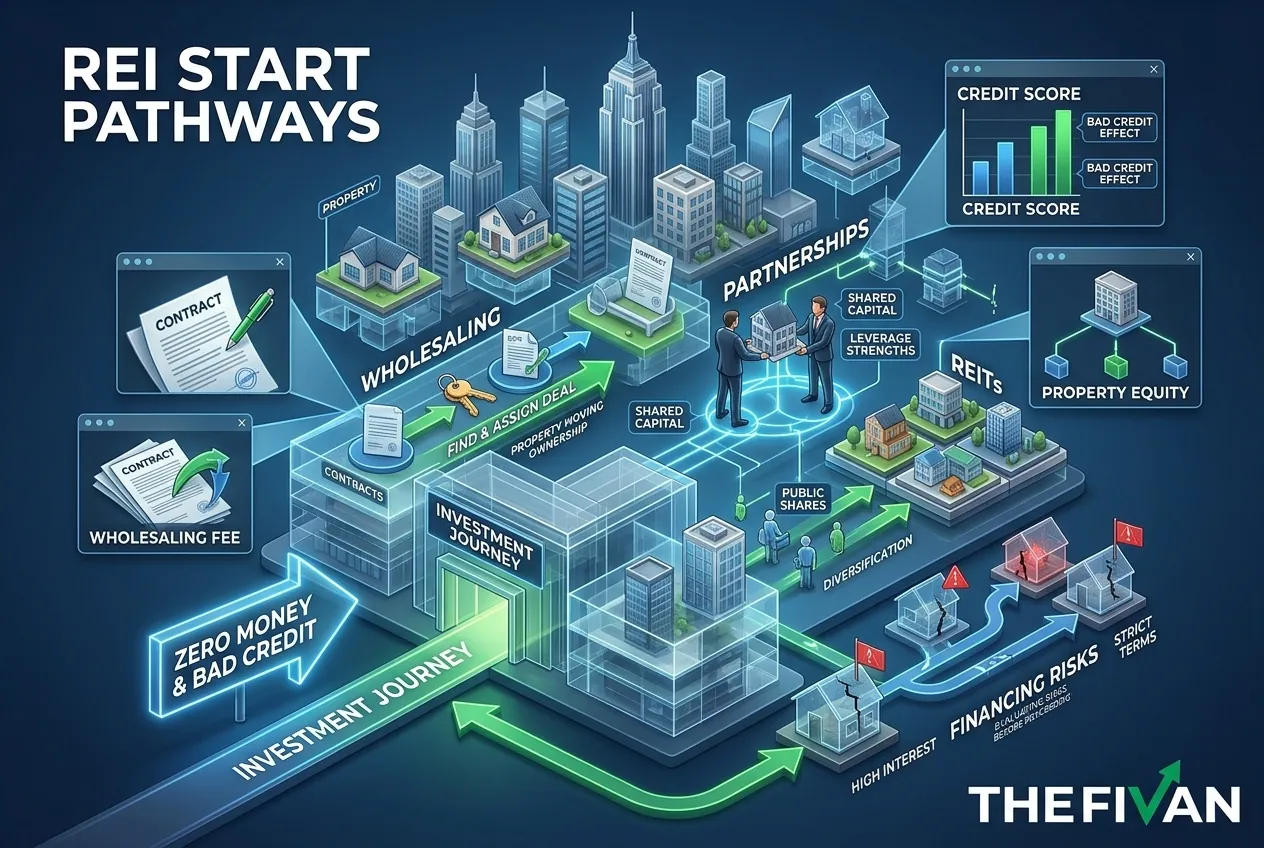
Starting real estate investing with no money and bad credit can feel difficult, especially when traditional lenders expect a down payment, steady income, and a solid credit history. However, buying a property with a mortgage is not the only way to enter the real estate market.
You can start by finding property deals for investors, partnering with someone who has capital, negotiating seller financing, or investing in real estate investment trusts (REITs). Each option has different costs, skills, and risks. Some let you begin without buying property, while others may lead to ownership if you meet the necessary requirements.
The important thing is to avoid treating “no money” as “no costs.” Even creative investment strategies can require cash, legal knowledge, time, or financial commitments. Your first goal should be to choose a realistic route, learn how it works, and avoid taking on debt you cannot afford.
Short Definition
You can begin real estate investing with no money and bad credit by exploring deal sourcing, partnerships, or REITs, but buying property usually requires funds, qualifying financing, or a clearly structured agreement.
Experience
Practical Business Tip: Before pursuing any “no-money” deal, write down every upfront cost, deadline, and worst-case outcome. If you cannot cover a required deposit or explain how the deal exits, keep researching rather than signing.
Can You Start Real Estate Investing With No Money and Bad Credit?
Yes, you can begin working toward real estate investing without strong credit or substantial savings. However, the right approach depends on whether you want to own property, earn fees by finding deals, work with a financial partner, or invest passively.
Direct property ownership is usually more difficult because lenders and sellers may require a down payment, closing costs, proof of income, and other financial qualifications. If you have no available cash, an immediate property purchase may not be realistic.
Consider three possible starting situations:
- No cash available: Learn deal analysis, research local markets, build relationships with investors, or explore ways to earn income before investing.
- Some cash but poor credit: Compare low-capital investment options and work on improving your financial position before seeking property financing.
- Limited savings and a partner with capital: Investigate a joint venture in which you contribute research, deal sourcing, management, or other useful skills.
A joint venture is an agreement between people or businesses to work together on a project. In real estate, one partner might provide money while another finds and evaluates properties.
The main lesson is simple: You do not necessarily need to begin as a property owner. You can start by developing the skills, relationships, and financial foundation that help you participate in real estate deals later.
Compare the Best Starting Options for Your Situation
Before choosing a strategy, consider how much money you can access, how much time you have, and whether you want active work or passive investing.
| Strategy | Money needed upfront | Credit dependence | Main trade-off |
| Wholesaling | Potentially low, but some cash may be needed | Usually less dependent on mortgage credit | Requires deal-finding and contract skills |
| Money partner | May be low if a partner funds the deal | Depends on the transaction and lender | You share control and potential profits |
| Seller financing | Often some money is needed | Seller-dependent, not automatically credit-free | Contract terms and default risks matter |
| House hacking | Down payment and closing funds, or eligible zero-down financing | Depends on loan eligibility | You must live in the property and manage housing risks |
| Publicly traded REITs | The cost of purchased shares | No property mortgage approval needed | Investment value can fall |
| Hard-money financing | Often requires cash or equity | Lender-dependent | Borrowing can be expensive and short-term |
These options solve different problems. Wholesaling focuses on finding and assigning deals. Partnerships combine different resources. REITs provide investment exposure without requiring you to manage a property.
Hard-money financing, on the other hand, is not a reliable solution for someone who has neither money nor a workable repayment plan.
1. Start With Wholesaling if You Can Find and Evaluate Deals
Real estate wholesaling involves finding a property opportunity, entering a valid purchase contract, and assigning your contractual interest to another buyer when the contract permits it.
An assignment transfers your rights under the contract to another buyer. You may receive an assignment fee in return. The fee is not guaranteed, and the original contract may impose conditions or obligations you must satisfy.
This method can reduce the need for a mortgage because you are not necessarily purchasing the property yourself. However, it still requires market knowledge, careful negotiation, and compliance with local law.
How to get started
Step 1: Learn one local market.
Research properties in a small area rather than searching everywhere. Study recent comparable sales, property conditions, local rents, and the types of homes investors actually purchase.
Step 2: Identify potential opportunities.
Look for properties that may suit an investor’s goals. Owners facing repair problems, inherited-property decisions, or other challenges might consider different selling arrangements, but their circumstances do not guarantee that they will sell at a discount.
Step 3: Find genuine buyers.
Build relationships with local investors who purchase properties in your target area. Ask about their preferred locations, property types, repair budgets, and buying criteria.
Step 4: Understand the contract before signing.
Review the purchase price, deadlines, inspection rights, termination conditions, earnest money, and assignment provisions. Earnest money is a deposit that may demonstrate a buyer’s commitment to a purchase. Depending on the contract, you could lose it if you fail to meet your obligations.
Important: Wholesaling laws vary by state. Texas, for example, requires accurate disclosure of the interest being offered when someone assigns a purchase-contract interest. Review the Texas Real Estate Commission’s guidance on equitable interests, and check the rules in your own state.
Wholesaling may suit someone who has time to research properties, communicate with sellers, and build an investor network. It is less suitable if you cannot handle contract obligations or have no way to cover even modest transaction expenses.
2. Find a Money Partner by Bringing Skills or a Strong Deal
A financial partner can help you enter an investment that you could not fund alone. Your contribution might include finding properties, researching rents, estimating repair costs, coordinating contractors, or managing agreed project tasks.
For example, imagine you identify a small rental property that appears promising. You research comparable rents, estimate expenses, and explain the risks to an investor who has available capital. If both parties agree that the opportunity makes sense, they could form a partnership with defined responsibilities.
Your contribution does not have to be money. It does, however, need to create real value.
How to approach a potential partner
Start by preparing a simple deal summary. Include the asking price, expected repairs, comparable rents or sales, estimated operating costs, likely financing terms, and the risks that could reduce the return.
Do not present optimistic assumptions as established facts. Explain what you have verified and what still needs checking.
Next, agree on each person’s role. The money partner may provide capital and handle financing. You might handle research and project coordination. The final arrangement depends on each person’s contribution and the deal’s structure.
Put the agreement in writing. It should address:
- Each partner’s financial and work contributions.
- Ownership percentages and how profits or losses are allocated.
- Who controls spending and major decisions.
- What happens if repairs cost more than expected.
- How either partner can exit the investment or resolve disputes.
A published account offers an example of this model. Commercial real estate investor Tyler Cauble described a partnership involving a 42-unit townhome development in a published podcast interview. He reported contributing project-related work and receiving a 10% profit share while the developer supplied major project resources.
This is one person’s self-reported commercial-development experience, not proof that a beginner will obtain the same arrangement or result.
Practical tip: Do not approach investors with only an idea. Bring clear numbers, credible research, a realistic plan, and a fair description of the risks.
3. Could Seller Financing Help You Buy Property?
Seller financing is an arrangement in which the property seller provides financing for the buyer instead of relying entirely on a traditional bank mortgage.
You make payments to the seller under an agreed contract. Depending on the arrangement, the seller may collect interest and receive payments over a set period.
This approach may help buyers whose circumstances do not fit a traditional lender’s requirements. However, it depends on the seller’s willingness, the property’s existing debt, the transaction terms, and applicable laws.
What should you negotiate?
Review the following terms before considering an offer:
Purchase price: Compare it with similar properties in the area. Flexible financing does not automatically make an expensive property a good investment.
Down payment: Ask how much the seller expects upfront. A seller willing to finance the purchase may still require a substantial deposit.
Interest rate and monthly payment: Calculate whether the payments fit your budget and expected rental income.
Balloon payment: Some agreements require a large remaining payment after a specified period. You must have a realistic way to cover it, whether through accumulated funds, refinancing, or another permitted source.
Default and foreclosure terms: Understand what could happen if you miss payments or violate the agreement.
Seller financing does not automatically remove federal or state legal requirements. The Consumer Financial Protection Bureau’s Regulation Z guidance on seller financing identifies specific conditions and exceptions for certain sellers.
Before signing, have a qualified real estate attorney review the agreement. If the arrangement fails, you could lose money or the property.
4. Use House Hacking to Explore Lower-Down-Payment Ownership
House hacking means living in a property while receiving rental income from part of it. You might rent out a spare room or live in one unit of a small multifamily property while tenants occupy the others.
This strategy can help an owner offset housing costs. However, it still requires a property that you can afford and a financing arrangement for which you qualify.
Understand FHA and VA financing
FHA-insured loans may allow eligible borrowers to make a down payment as low as 3.5%. Actual approval depends on applicable FHA policies, lender requirements, credit information, income, debts, and the property.
You can review the Consumer Financial Protection Bureau’s FHA loan guidance for an overview.
Eligible military borrowers, veterans, and certain other qualified applicants may also have access to VA-backed home loans with no down payment. However, the borrower must meet the program’s requirements, and VA financing is intended for an eligible home purchase or other permitted use—not simply an unrestricted investment-property purchase. Read the official VA home-loan guidance.
Neither option guarantees approval for someone with bad credit. Zero-down financing also does not mean zero closing costs or zero financial risk.
A hypothetical example
Suppose an eligible borrower considers purchasing a $200,000 property using an FHA loan with a 3.5% down payment.
- Down payment: $7,000.
- Estimated closing costs at 2%–5% of the purchase price: 4,000–10,000.
- Combined amount: approximately 11,000–17,000, before any other applicable upfront expenses.
The closing-cost range comes from the CFPB’s home-buying guidance. This is an illustration, not a quote for a particular property or loan.
The example shows why a low-down-payment loan does not solve a complete lack of savings.
Before pursuing house hacking, check the lender’s requirements, the property’s rental potential, repairs, insurance, taxes, and your ability to cover the mortgage if a tenant leaves. Also confirm the loan’s occupancy requirements.
This route may suit someone who wants to own a home and can live in it for the required period. It is less suitable if moving into the property is impossible or the monthly payment would stretch the budget too far.
5. Consider REITs if You Want Real Estate Exposure Without Buying a Property
A real estate investment trust, or REIT, is a company that owns or finances income-producing real estate. Its investments may include apartments, warehouses, shopping centers, hotels, or other property-related assets.
By buying shares in a publicly traded REIT, you can invest in real estate without purchasing a building or managing tenants yourself.
This can be a practical starting point if you have a small amount of investable money but cannot qualify for a mortgage.
How to begin
- Learn the differences between REITs that invest in residential, commercial, industrial, or other property types.
- Review the investment’s business model, financial reports, fees, and risks.
- Check the share price and any brokerage costs before investing.
- Invest only money you can afford to expose to market risk.
Some brokerages offer fractional-share investing, which may let investors buy less than a full share. Availability and fees depend on the provider. There is no universal starting amount for every REIT or brokerage arrangement.
The SEC’s Investor.gov REIT guide explains how REITs work.
Be careful when comparing publicly traded and non-traded REITs. Publicly traded REIT shares can generally be bought and sold through an exchange. Non-traded REITs may have restricted redemption programs and limited opportunities to sell quickly. Some also charge substantial fees.
REITs can lose value, and dividend payments are not guaranteed. They also do not give you the same control as directly owning a property.
Choose this route when: You want real estate investment exposure without property management or mortgage approval. It is not the right choice if your main goal is to control a physical property or receive guaranteed monthly income.
6. Understand Why Hard Money Is Not a True No-Money Solution
Hard-money loans are generally short-term property-secured loans offered by private lenders or specialist lending companies. These lenders may place significant weight on the property’s value, renovation plan, and potential exit strategy.
Some may consider borrowers whose credit history makes conventional financing difficult. That does not mean they ignore credit, income, experience, collateral, or the borrower’s ability to repay.
Hard-money loans can involve higher interest rates, upfront fees, required equity, and short repayment deadlines.
Imagine borrowing to renovate a property and resell it. If repairs take longer than expected, construction costs rise, or the property attracts a lower offer, you may struggle to repay the loan on time.
The lender may have rights to the property used as collateral, so a failed investment could lead to substantial losses.
Before taking this type of loan, calculate the complete borrowing cost and identify a realistic repayment plan. Consider what would happen if the sale or refinancing failed.
A hard-money loan overview from Chase provides additional context.
For a beginner with no available cash, this is usually a poor starting point unless there is a credible financial arrangement covering upfront needs and unexpected costs.
7. Check the Numbers Before You Commit to a Deal
Regardless of the investment strategy, evaluate the numbers before committing money or signing a binding contract.
A property may look attractive because its expected rent is high. But rent alone does not tell you whether it can cover expenses or produce positive cash flow.
Cash flow is the money left after the income and relevant expenses for a given period are accounted for.
For a rental property, review:
- Purchase price and closing costs.
- Expected rent supported by local market evidence.
- Vacancy and unpaid rent.
- Repairs and routine maintenance.
- Property taxes and insurance.
- Property-management costs, if applicable.
- Mortgage or other financing payments.
- Emergency reserves for unexpected expenses.
A hypothetical rental example
Imagine a property earns $2,000 per month in rent.
| Monthly item | Illustrative amount |
| Rental income | $2,000 |
| Mortgage payment | -$1,100 |
| Property taxes and insurance | -$300 |
| Maintenance and vacancy allowance | -$250 |
| Other operating expenses | -$150 |
| Estimated monthly cash flow | $200 |
Under these assumptions, the property produces $200 a month before any additional expenses not included above and before income taxes.
This is only an example. The figures are not current market estimates or a prediction of actual performance. Real expenses can be higher, and income can be lower.
Also distinguish gross rent from net income. A property that collects $2,000 in monthly rent does not give the owner $2,000 in profit.
If you cannot verify local rent, estimate repairs, or explain how the deal will be funded, pause and gather more information.
For tax-related matters, the IRS’s Publication 527 on residential rental property explains rental income, expenses, and depreciation. Your particular tax treatment may depend on your circumstances.
8. Avoid Common Mistakes and Protect Yourself
The pressure to find a way into real estate without money can make risky offers look attractive. A few basic precautions can help you avoid preventable losses.
Do not trust guaranteed-profit promises. Real estate values, rents, financing conditions, and renovation costs can change. Treat guaranteed returns and pressure to pay immediately as warning signs.
Do not sign contracts you do not understand. Check deadlines, deposits, termination rights, assignment terms, and default consequences before committing.
Do not assume an LLC solves bad credit. A limited liability company can provide a business structure, but forming one does not guarantee a loan, eliminate the need for capital, or remove a lender’s ability to require a personal guarantee. Compare the costs and responsibilities before creating an entity.
Do not rely on unverified buyers or partners. Check their identity, relevant track record, and ability to perform their promised role. Keep written records and use suitable legal agreements.
Do not ignore state and local rules. Property transactions, rental operations, contract assignments, and financing arrangements may be subject to different requirements. Check the rules that apply where the property is located.
Finally, protect your personal finances. Avoid risking essential living expenses or borrowing money you cannot repay if the investment fails.
Your First Steps Toward Real Estate Investing
You do not need to solve every financial problem before learning about real estate. Start with a small, practical process that helps you identify an appropriate route.
- Assess your starting point. Work out how much cash you can safely use, what your credit situation looks like, how much time you have, and whether you want to own property or invest passively.
- Choose one route to study. If you have useful research or sales skills, learn about wholesaling or partnership opportunities. If you want passive exposure, research publicly traded REITs. If you want to own a home, investigate financing and house-hacking eligibility.
- Study a local market. Compare actual property prices, rents, expenses, and investor requirements. Avoid relying on broad claims about what properties earn.
- Review the risks before committing. Understand how contracts, deposits, debt, partners, and applicable legal requirements could affect you.
- Build toward the next financial step. You may need to improve your credit, increase savings, gain experience, or find a suitable partner before moving forward.
Your first meaningful result may be learning to evaluate a deal correctly rather than buying a property immediately. That knowledge can help you avoid expensive mistakes and make better decisions as your financial position improves.
Frequently Asked Questions
How do I get into real estate investing if I have no money?
Start by learning how to evaluate properties, research local markets, and identify potential deals. You can explore wholesaling, partnerships, or publicly traded REITs, depending on your goals. Some options require little starting capital, but contract-based strategies may still involve deposits or other costs.
How do I get into real estate with bad credit and no money?
First, separate options that require a mortgage from those that do not. REITs and certain deal-sourcing or partnership arrangements do not require you to qualify for a traditional property mortgage personally. If you want direct ownership, review eligible financing programs, improve your financial readiness where possible, and avoid borrowing that you cannot afford.
How much money do I need to invest to make $3,000 a month?
There is no universal investment amount that guarantees $3,000 in monthly income. The answer depends on the property price, rental income, operating expenses, financing costs, vacancy, and investment structure.
A $3,000 monthly net-income goal equals $36,000 a year after the relevant expenses included in your calculation. Start with realistic net cash-flow estimates rather than assuming that gross rent will become profit.
Is $5,000 enough to invest in real estate?
It may be enough to begin buying certain publicly traded REIT shares, depending on the share price, brokerage terms, and the amount you choose to invest. It could also help fund some early research or deal-related expenses, but you should not risk all your available money on an uncertain opportunity.
For direct property ownership, $5,000 may not cover the down payment, closing costs, repairs, and reserves required for a particular purchase. Check the actual costs and eligibility before deciding.
Does forming an LLC help you buy a rental property with bad credit?
An LLC can create a separate business structure, but it does not automatically improve your credit or qualify you for financing. Lenders may consider the company’s financial history, the property’s numbers, the borrower’s finances, and whether a personal guarantee is required.
Before buying property through an LLC, compare the financing conditions and ongoing costs and seek suitable legal or tax guidance.
Choose the Route You Can Afford to Learn
Starting real estate investing with no money and bad credit is more about choosing a workable first step than finding a shortcut. You can develop deal-analysis skills, explore a carefully structured partnership, consider REITs, or prepare for property ownership when your finances allow.
Choose the route that fits your current resources, understand its risks, and verify the numbers before you commit. Building knowledge and making careful decisions now can put you in a stronger position for future opportunities.
Disclaimer
Real estate investment costs, financing options, legal requirements, and risks vary by location, investment strategy, and personal circumstances. This article provides general educational information, not a guarantee of investment returns or financial success. Consider qualified legal, tax, or financial guidance before making decisions that could significantly affect your finances.