

Fidelity Basket Portfolios let you group individual stocks and exchange-traded funds (ETFs) into one portfolio that you can manage with a few clicks. They are designed for investors who want more control over their holdings without managing every trade separately.
Are Fidelity Basket Portfolios worth it? It depends on how much you value the extra tools. The standard service costs $4.99 per month after a 30-day free trial, or $59.88 for 12 paid monthly charges. You may find that cost reasonable if you regularly customize and rebalance your investments. But if you prefer a simple, diversified investment and do not need basket-management tools, a broad-market ETF or index fund may be enough.
The main point to remember is that Fidelity Basket Portfolios help you manage investments; they do not guarantee better returns or protect you from market losses. Before paying for the service, compare its features, costs, limitations, and alternatives.
Direct Answer
Fidelity Basket Portfolios let investors group and manage eligible stocks and ETFs with tools such as fractional shares, Smart Buys, and rebalancing. The service costs $4.99 monthly after a 30-day free trial.
Experience
Before paying for Fidelity Basket Portfolios, list the features you expect to use and compare their value with the $59.88 annualized subscription cost. Remember that rebalancing cannot prevent market losses, and selling investments may have tax consequences.
What Are Fidelity Basket Portfolios?
 Fidelity Basket Portfolios are an optional feature for managing multiple eligible stocks and ETFs together within a Fidelity account. You choose the investments, set a target percentage for each one, and manage them as a group.
For example, you could create a basket containing several technology stocks and an ETF. Instead of placing and tracking every purchase separately, you can use Fidelity’s basket tools to place trades and review your allocation.
Fidelity also offers prebuilt models that you can customize. These include stock-focused themes, sector and income models, and ETF model portfolios. A prebuilt model can give you a starting point, but it is not a guarantee of suitable investments or future performance.
According to Fidelity’s official product overview, the service offers a 30-day free trial followed by a $4.99 monthly subscription.
A basket can hold between two and 50 positions. You can generally create multiple baskets across eligible Fidelity accounts.
One important distinction is that you own the underlying securities in your basket. You are not buying a single mutual fund that owns all those investments for you. This gives you more control, but it also means you must understand what you own and how the investments fit together.
How Do Fidelity Basket Portfolios Work?
The basic process is straightforward: choose investments, assign target weights, invest money, and monitor the basket over time.
Building a basket and setting target weights
A target weight is the percentage of your basket that you want to invest in a particular security.
Suppose you create a hypothetical $1,000 basket with these targets:
| Investment | Target weight | Intended amount |
| Stock A | 40% | $400 |
| Stock B | 30% | $300 |
| ETF C | 30% | $300 |
| Total | 100% | $1,000 |
These amounts illustrate your intended allocation. Actual holdings and values can change as market prices move.
Fidelity supports fractional shares, which are portions of a full share. This makes it possible to allocate smaller dollar amounts across multiple eligible investments instead of needing enough cash to buy a whole share of each stock.
You can also move existing eligible positions into a basket without trading them, according to Fidelity’s Basket Portfolios FAQ.
Fractional shares, Smart Buys, and rebalancing
These three features serve different purposes.
Fractional shares help you invest a chosen dollar amount in a security, even when that amount is less than the price of a full share.
Smart Buys direct new money toward the investments that are most underweight relative to their targets. For example, if Stock A has fallen below its intended portfolio percentage, new money may be allocated to it before the other holdings.
This can help you move closer to your target allocation without automatically selling other securities.
Rebalancing adjusts holdings to bring the basket closer to its target percentages. If one investment grows much faster than the others, you may need to sell part of that holding and buy more of another.
Rebalancing is not the same as earning a profit. A portfolio can lose money even when its allocations match the targets exactly. Selling investments can also create tax consequences in a taxable account.
Fidelity supports recurring investments for existing baskets. When setting one up, you can choose to distribute contributions through Smart Buys or according to target weights. Check the scheduled amount and allocation settings before relying on automatic contributions.
One trading limitation matters: Fidelity Basket Portfolios supports market orders only. A market order aims to execute at the best available market price, but the final price can differ from the most recently displayed price, particularly in a fast-moving market. You cannot use a limit order through the basket feature to specify the maximum price you will pay.
What Do Fidelity Basket Portfolios Cost?
 The standard Fidelity Basket Portfolios subscription has a simple fee structure.
| Cost detail | Current published terms |
| Free trial | 30 days |
| Monthly subscription | $4.99 |
| Cost of 12 paid monthly charges | $59.88 |
| Account minimum for the basket feature | None |
| Minimum investment per eligible security | $1 |
| Additional basket account fee | Fidelity states there are no additional account fees for the basket feature |
These terms come from Fidelity’s official FAQs. The figures describe the published standard subscription, not every possible cost of investing.
After your 30-day trial ends, Fidelity begins charging $4.99 per month unless you cancel. The fee is charged to your selected payment method on the renewal date.
Twelve paid monthly charges total $59.88, which is close to $60 a year. Your actual charges during the first 12 calendar months can differ depending on when the trial ends and billing begins.
How the fee affects different portfolio sizes
The subscription is a fixed fee, not a percentage of your invested assets. Its relative impact is therefore larger when the portfolio is small.
The following table shows the annualized fee as a percentage of hypothetical portfolio values.
| Portfolio value | Annualized fee | Percentage of portfolio |
| $1,000 | $59.88 | 5.99% |
| $5,000 | $59.88 | 1.20% |
| $10,000 | $59.88 | 0.60% |
| $25,000 | $59.88 | 0.24% |
| $50,000 | $59.88 | 0.12% |
These are simple cost comparisons, not predictions of investment performance. They assume 12 paid monthly charges and exclude returns, taxes, and any other applicable expenses.
For example, suppose an investor has a $5,000 basket. The annualized subscription equals about 1.20% of that starting portfolio value. That cost does not automatically make the product unsuitable, but it gives the investor a useful question to consider: does the convenience justify the expense?
A larger portfolio reduces the fee as a percentage of the starting balance. However, a larger account does not automatically make the service worthwhile. You still need to decide whether you use the features enough to justify paying for them.
What other costs should you check?
The subscription does not eliminate every possible investing expense.
If your basket contains ETFs, check their expense ratios. An expense ratio is the annual operating cost of a fund, expressed as a percentage of its assets. It is deducted within the fund rather than billed as the Basket Portfolios subscription.
Also review any applicable account charges or transaction-specific costs. Fidelity’s published terms describe the fee for the basket-management service, not a guarantee that every investment or account activity is cost-free.
Pros and Cons of Fidelity Basket Portfolios
Fidelity Basket Portfolios can make investing more organized, but the extra control comes with a cost and additional decisions.
| Pros | Cons |
| Manage eligible stocks and ETFs as a group | Recurring $4.99 monthly fee |
| Buy fractional shares | Requires decisions about the underlying investments |
| Customize target percentages | Market orders only through the basket feature |
| Use Smart Buys and one-click rebalancing | Rebalancing sales may create taxable gains |
| Set up recurring investments | Overlapping holdings can create hidden concentration |
| Use eligible existing Fidelity accounts | Does not guarantee diversification or better returns |
The main benefits
The biggest benefit is convenience. If you hold several stocks and ETFs, a basket can help organize them under one allocation plan. You can also change target weights and manage eligible holdings together.
Fractional shares make small-dollar allocations easier. Smart Buys can help direct new contributions toward underweight positions, while recurring investments can support a consistent contribution routine.
Investors who enjoy building their own portfolios may appreciate having a single place to monitor these investments.
The main drawbacks
The monthly fee is the clearest drawback, especially for smaller portfolios or people who rarely make changes.
Customization can also create more work than expected. You must choose suitable holdings, understand the risks, review their overlap, and decide when your allocation needs attention.
Finally, convenient portfolio management should not be confused with professional investment management. You remain responsible for selecting and monitoring your investments. A basket does not automatically make an unsuitable portfolio appropriate for your goals.
Are Fidelity Basket Portfolios Good for Diversification?
They can help you organize a diversified portfolio, but the basket itself does not create diversification.
Diversification means spreading investments across different companies, industries, or asset types so that your financial future does not depend too heavily on one investment. It can reduce some risks, but it cannot eliminate the risk of losing money.
Consider a hypothetical basket of ten technology stocks. It contains ten separate holdings, yet its results may depend heavily on the technology sector. If that sector experiences a downturn, many holdings could fall together.
Now consider a basket containing a broad-market ETF and several individual technology stocks. Although the ETF may own hundreds of companies, the additional technology stocks could increase your exposure to the same sector. You need to examine the underlying holdings, not simply count the investments.
The SEC’s Investor.gov guide to asset allocation and diversification explains that investors should consider their time horizon and ability to handle investment losses. It also warns that even multiple ETFs may overlap in their holdings.
Before creating a basket, ask yourself:
- Does it spread investments across different companies and industries?
- Do several holdings depend on the same business trend?
- Does it contain an appropriate mix of investment types for my goals?
- Could I reach my goal more simply with a diversified fund?
Rebalancing can help you keep a chosen allocation. It cannot prevent a broad market decline or guarantee that your original targets were suitable.
Fidelity Basket Portfolios vs. ETFs, Index Funds, and M1 Finance
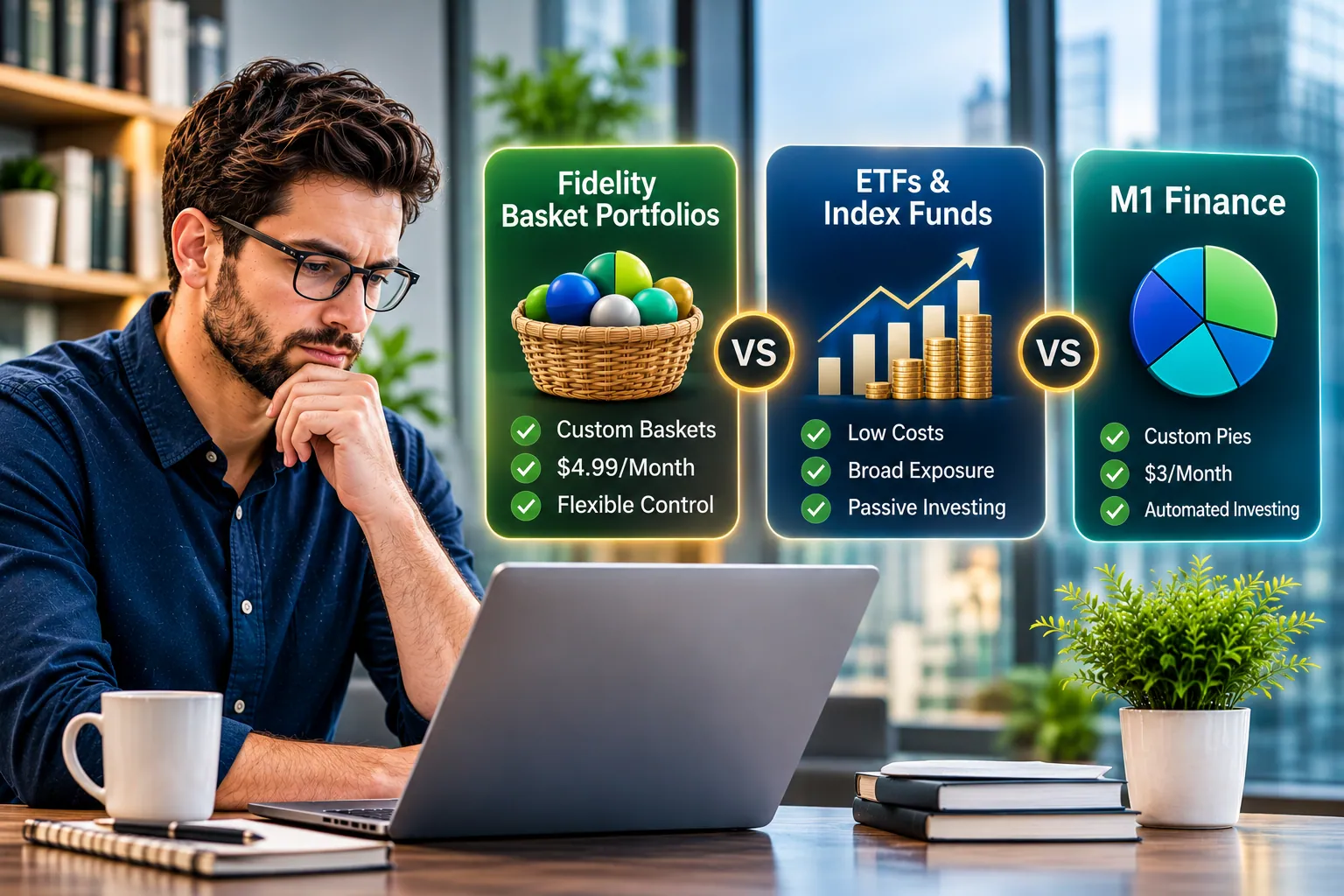 The best alternative depends on whether you want to select individual investments, keep management simple, or use an automated allocation process.
Basket Portfolios vs. broad-market ETFs and index funds
An ETF pools money from many investors and invests it in the securities described by its investment strategy. An index fund follows a selected market index, and it can be structured as an ETF or a mutual fund.
A broad-market ETF may give you exposure to many companies through a single investment. You do not have to choose and manage every underlying company yourself.
This can be a useful alternative for investors who value simplicity and broad exposure. But not every ETF is broadly diversified. A fund focused on one sector or a narrow investment theme may carry substantial concentration risk.
Fidelity Basket Portfolios may suit investors who want to choose individual stocks and ETFs, set their own weights, and manage those holdings as a group. A broad-market fund may suit investors who do not want to make those decisions.
There is no universal winner. The right comparison depends on the strategy, fund expenses, subscription cost, risk and level of control you want.
Fidelity Basket Portfolios vs. M1 Finance
M1 Finance offers a portfolio structure built around customizable groups called Pies. Investors set target percentages for stocks and ETFs, and M1’s tools can direct new deposits toward underweight holdings.
The platforms have similarities, but their prices and trading systems differ.
| Feature | Fidelity Basket Portfolios | M1 Finance |
| Portfolio structure | Baskets of eligible stocks and ETFs | Pies and Slices |
| Published standard monthly fee | $4.99 after a 30-day trial | $3 Platform Fee or IRA Fee when applicable |
| Fee waiver | Standard basket subscription applies | Monthly fee can be waived under specified conditions |
| New contributions | Smart Buys or target weights for basket contributions | Auto-invest can direct deposits toward underweight holdings |
| Rebalancing | One-click rebalancing | User-directed rebalancing and deposit-based allocation |
| Trading approach | Market orders only through the basket feature | Trades generally execute in scheduled trading windows |
According to M1’s March 2026 fee information, the standard platform or IRA fee is $3 per month for accounts that do not qualify for a waiver. The monthly fee can be waived if total M1 assets reach at least $10,000 for at least one day during the billing cycle, or if the customer has an active M1 Personal Loan.
That condition matters. M1 is not automatically free for every investor, and an investment platform fee should not be compared without checking eligibility and other account terms.
M1 also handles trades through scheduled trading windows. Its official rebalancing guide explains that a manual rebalance can sell overweight holdings and buy underweight ones, while deposit-based allocation can move the portfolio toward targets through new purchases.
Choose between the platforms based on their actual features, trading methods, fees and your preference for managing investments. Do not assume that their automatic or manual allocation features work in exactly the same way.
Using a regular Fidelity brokerage account instead
If you already have a Fidelity brokerage account, you may be able to buy and manage eligible securities without subscribing to Basket Portfolios.
A regular brokerage account may be enough if you are comfortable placing individual trades and reviewing your allocation yourself. You can avoid the basket subscription, but you will not have access to all the basket-management features included in the paid service.
Before subscribing, identify the specific feature you need. If you mainly want to buy and hold a few investments, the added tools may not justify the monthly cost. If you frequently manage several custom allocations, the service may offer more value.
Taxes and Tax-Loss Harvesting: What Should Investors Know?
Taxes matter because basket holdings are individual securities, not a single mutual fund containing all your investments.
In a taxable brokerage account, selling a stock or ETF for more than its tax basis may create a capital gain. Selling it for less may create a capital loss. The tax treatment depends on the transaction and the investor’s circumstances.
A rebalance may involve sales, so consider the possible tax effects before placing the trades. Rebalancing in a taxable account can have different consequences from adjusting investments inside a tax-advantaged retirement account.
Does Fidelity Basket Portfolios offer automatic tax-loss harvesting?
Do not assume that tax-loss harvesting is built into Fidelity Basket Portfolios. In a March 31, 2026 response in the Fidelity Investments community, a Fidelity representative stated that the company did not then offer a tax-loss-harvesting tool specific to Basket Portfolios.
Fidelity has discussed separate tax-loss-harvesting resources, but that is not the same as an automatic feature operating inside each basket. Check the current product documentation before relying on any tax-management function.
Tax-loss harvesting generally means selling an investment at a loss to potentially offset certain taxable gains or income, subject to applicable rules. It does not guarantee a tax benefit, and the sale can change your investment exposure.
Understand the wash-sale rule
The IRS wash-sale rule can prevent an investor from deducting a loss when substantially identical securities are purchased within 30 days before or after the sale. The rule can also apply to purchases in an IRA or Roth IRA.
The relevant details appear in IRS Publication 550, which describes investment income, expenses, and wash-sale rules.
If you are considering selling at a loss, check your purchases across relevant accounts and understand the tax consequences before trading. If the decision could materially affect your tax return, seek guidance from a qualified tax professional. Do not make a tax-driven trade based only on the assumption that a platform will automatically handle the rules.
Who Can Use Fidelity Basket Portfolios, and What Happens if You Cancel?
Fidelity’s current FAQs list non-retirement brokerage accounts, including eligible health savings accounts and cash management accounts, as well as Traditional, Roth, and rollover IRAs. The FAQ identifies SEP IRAs, inherited IRAs and Keogh accounts as currently ineligible.
Eligibility can change, so check the current Fidelity Basket Portfolios FAQ before enrolling.
Check the trial and cancellation terms
The 30-day trial gives you access to the service before the monthly subscription begins. Fidelity says it will attempt to remind you one week before the trial ends that a payment method needs to be on file.
If you decide the service is not worth paying for, cancel before the trial expires to avoid the subscription charge.
Fidelity’s published instructions explain that enrollment changes are handled on the web. The current process is to visit the basket dashboard, select Manage enrollment, and choose Cancel enrollment.
After cancellation, your access to the basket features continues until the end of the current billing cycle. Existing basket positions then appear as individual investments in your account and can be traded like other eligible securities. Canceling the subscription does not automatically mean that all your investments are sold.
Check your billing date and the official cancellation instructions before taking action, particularly if you are close to a renewal.
A Practical Checklist Before Paying for Fidelity Basket Portfolios
Use these questions to decide whether the subscription fits your needs.
- Do I need the extra tools? If you want custom target weights, basket-level trading, Smart Buys, or recurring investments, the features may be useful. If you rarely make changes, a regular brokerage account may be enough.
- Does the fee make sense for my portfolio? Compare the $59.88 annualized cost with your starting portfolio value and what the tools do for you. This is a cost check, not a forecast of returns.
- Are my holdings diversified? Review companies, sectors and underlying ETF holdings. A basket of similar stocks can still be concentrated.
- Would an ETF or index fund be simpler? If your goal is broad market exposure rather than choosing individual investments, compare a suitable diversified fund and its expense ratio.
- Have I considered tax consequences? If you may sell securities in a taxable account, understand potential capital gains and losses. Do not assume dedicated tax-loss harvesting is included.
- Do I understand the trading and cancellation terms? Remember the market-order limitation, verify your payment method and trial end date, and review what happens to holdings if you cancel.
Practical Finance Tip: Before paying, write down the two or three basket features you expect to use most. If you cannot identify a clear benefit beyond organizing investments, compare the service with a regular brokerage account or a diversified fund first.
Frequently Asked Questions
How do Fidelity Basket Portfolios work?
They let you group eligible stocks and ETFs, assign target percentages, and manage them as a single basket. You can use fractional shares, recurring investments, Smart Buys and one-click rebalancing. You still choose the investments and bear the risk of market losses.
Are Fidelity Basket Portfolios worth it?
They may be worth the cost for investors who regularly customize and manage multiple stocks or ETFs. They may offer less value to someone who prefers a simple, long-term investment in a diversified fund. Compare the features you will use with the recurring fee and available alternatives.
What is the monthly fee for Fidelity Basket Portfolios?
The standard published price is $4.99 per month after a 30-day free trial. Twelve paid monthly charges total $59.88. Other applicable investment expenses, such as ETF expense ratios, are separate considerations.
How do Fidelity Basket Portfolios compare with M1 Finance?
Both platforms let investors manage customized groups of stocks and ETFs. Fidelity charges $4.99 per month after its trial. M1’s standard platform or IRA fee is $3 per month when a waiver does not apply; qualifying users may meet its stated waiver conditions. Their trading and rebalancing processes differ, so compare current terms before deciding.
Do Fidelity Basket Portfolios offer automatic tax-loss harvesting?
Do not assume they do. A Fidelity representative stated in March 2026 that there was no dedicated tax-loss-harvesting tool for Basket Portfolios at that time. Confirm current functionality in Fidelity’s official documentation, and review the potential tax effects of selling investments.
How to Make Your Decision
Fidelity Basket Portfolios offer useful tools for investors who want to customize and manage individual stocks and ETFs together. The main trade-off is simple: you pay a recurring fee for added control and convenience, but you still need to choose suitable investments and manage the risks.
Before enrolling, compare the annualized subscription cost with the value of the features you expect to use. If you want custom allocations and frequent basket management, those tools may be worth considering. If you want broad market exposure with less work, a diversified ETF or index fund may be a simpler alternative.
Review Fidelity’s current fees, account eligibility, trading restrictions and cancellation terms before making a decision. Your best choice is the one that fits your investment goals, costs and willingness to manage your holdings—not the one with the most features.
Disclaimer
This article provides general financial education, not personalized financial, investment, legal, or tax advice. Financial circumstances, investment risks, tax rules, account eligibility, and product terms vary, and investment outcomes are not guaranteed. Consider consulting a qualified financial or tax professional when your individual circumstances require specialized guidance.