
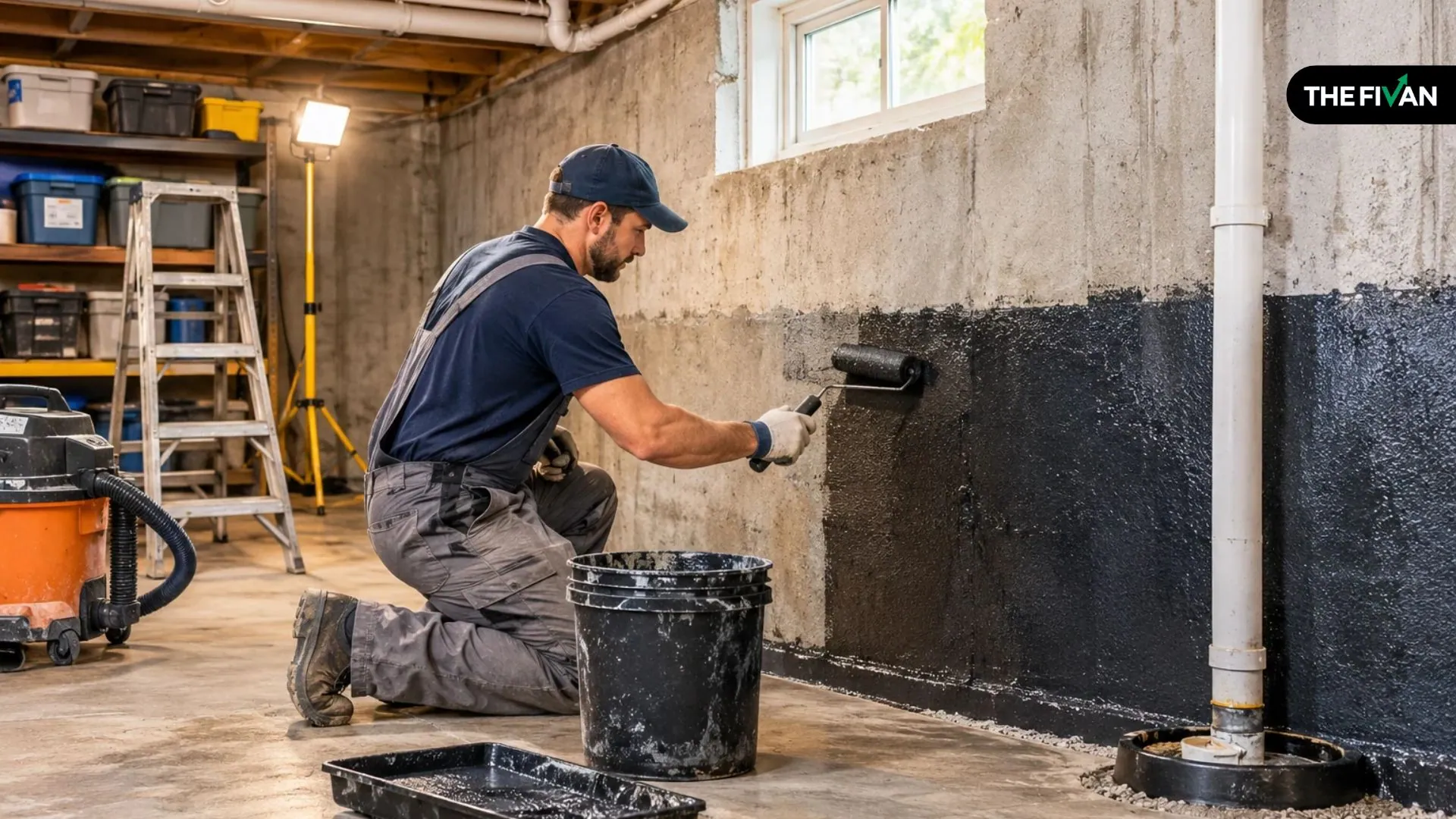
Starting a basement waterproofing business in the United States requires more than tools and a work vehicle. You need a clear service plan, business registration, any required contractor licenses and permits, suitable insurance, and enough money to cover startup and operating costs.
The exact requirements depend on your state, city, and the services you plan to offer. Interior drainage work may require different equipment and qualifications from exterior excavation or structural foundation repairs. Before spending money on expensive tools, confirm which services you can legally and safely provide.
A practical approach is to start with a manageable range of services, confirm customer demand, and expand as your skills, cash flow, and customer base grow. This guide explains how to plan each step.
Direct Answer
Starting a basement waterproofing business means choosing your services, registering the business, checking local contractor and permit rules, arranging suitable insurance, buying service-specific tools, and budgeting for operating costs. Requirements vary by location.
What Do You Need to Start a Basement Waterproofing Business?
Most new businesses need to prepare for these eight areas:
- A business plan and a defined service area.
- Business registration and the appropriate legal structure.
- An Employer Identification Number (EIN) and tax setup, where applicable.
- Required contractor licenses, registrations, and project permits.
- Suitable insurance and any required surety bonds.
- Waterproofing tools, safety equipment, and transportation.
- A budget for materials, operating expenses, and unexpected costs.
- A way to attract customers and manage jobs.
Not every item creates the same legal obligation. For example, an LLC is a business structure you may choose, while a contractor license may be mandatory for particular work in your location.
The U.S. Small Business Administration (SBA) explains that registration, licensing, zoning, and business costs vary by location and activity. Its business launch guide is a useful starting point for checking your general requirements.
Before buying equipment, decide which services you will offer, where you will work, and whether you will operate alone or hire a crew. These decisions affect nearly every other startup expense.
Choose the Right Waterproofing Services for Your Business
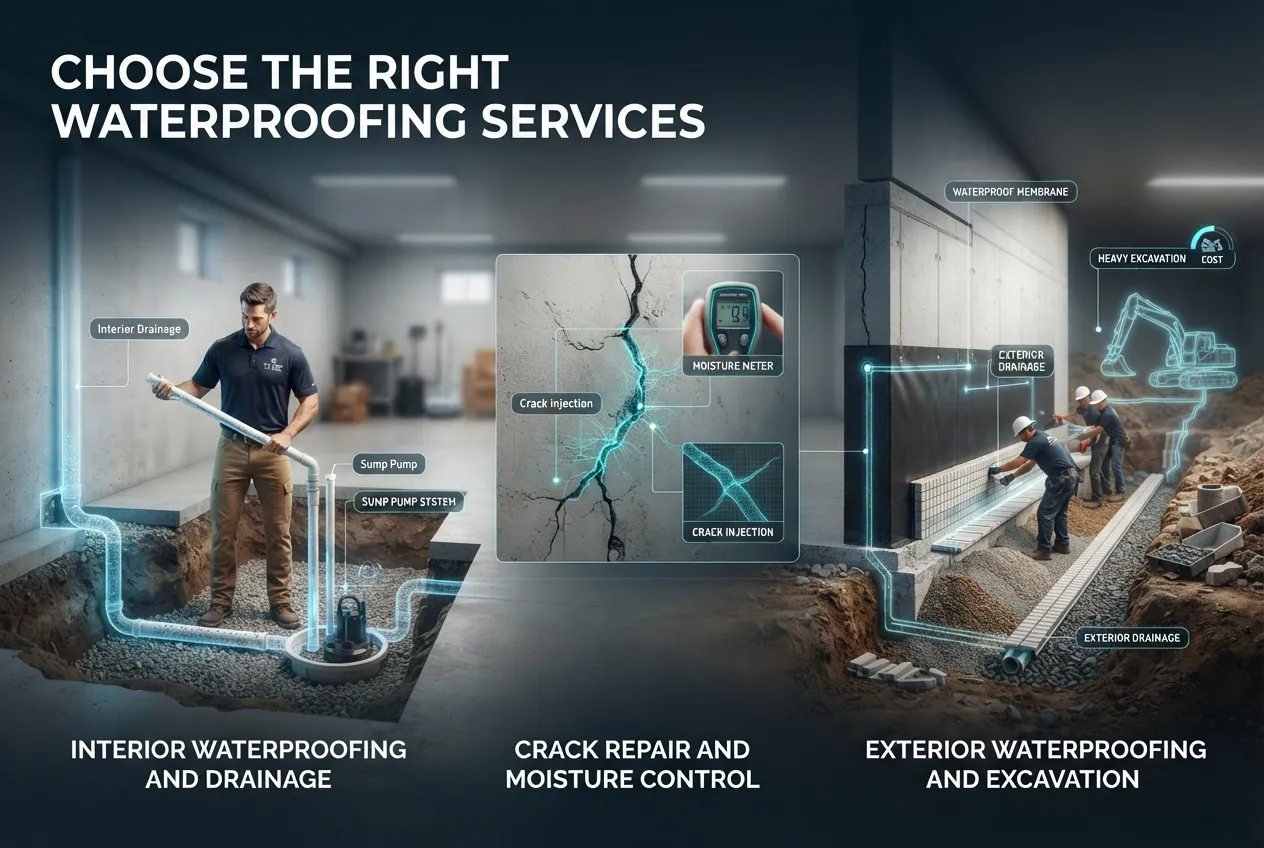
Your service range determines the skills, equipment, insurance, and working capital you need. You do not have to offer every waterproofing service from the beginning.
Interior waterproofing and drainage
Interior work can include installing drainage channels, fitting sump pumps, sealing suitable foundation cracks, and helping control basement moisture.
A sump pump removes collected water and directs it away from the building through an appropriate discharge system. Interior drainage systems manage water that reaches the foundation or basement area.
This service model may suit a smaller startup because it can avoid some of the heavy excavation equipment needed for exterior work. However, trenching inside a basement can still involve concrete cutting, dust control, waste removal, and safety risks.
What to prepare: Diagnostic tools, suitable concrete-working equipment, drainage materials, sump pump installation tools, personal protective equipment, and a reliable way to transport supplies.
Crack repair and moisture control
Some customers need help with visible foundation cracks, damp walls, condensation, or localized water entry.
Depending on the problem, the work might include suitable crack-injection systems, moisture-control measures, ventilation improvements, or dehumidification. These services require you to understand the difference between surface moisture and water entering through the foundation.
A crack should not automatically be treated as a simple sealing job. Its size, movement, location, and surrounding wall condition may indicate a structural problem that needs a qualified specialist.
What to prepare: Moisture meters, inspection tools, suitable repair materials, clear documentation procedures, and training in the methods you offer.
Exterior waterproofing and excavation
Exterior work can involve exposing foundation walls, preparing surfaces, applying waterproof membranes, installing drainage systems, and backfilling excavated areas.
This approach may address water entry at the outside of the foundation. However, excavation can raise costs substantially because it may require machinery, a larger crew, soil removal, utility checks, and protective systems.
Do not enter the excavation side of the business simply because customers ask for it. First confirm the required qualifications, permits, safety procedures, equipment, and insurance coverage.
For a new operator with limited resources, a smaller interior-focused service range or partnerships with established excavation contractors may be easier to manage. The right starting point depends on local demand, your training, and available capital.
Research Local Demand and Build a Practical Business Plan
Before registering, buying equipment, or hiring workers, check whether the business has a realistic path to customers.
Identify your potential customers
Likely customer groups include:
- Homeowners dealing with basement leaks, damp walls, or standing water.
- Property investors who need moisture problems assessed before renovating.
- Real estate professionals who encounter basement concerns during property transactions.
- General contractors who need waterproofing work completed as part of a larger project.
- Property managers responsible for maintaining buildings.
These groups have different needs. A homeowner may want a fast inspection and clear estimate. A general contractor may care more about scheduling, documentation, insurance limits, and reliable subcontracting.
Choose a starting customer group rather than trying to serve everyone.
Check competitors and local demand
Search for waterproofing contractors serving your proposed area. Compare their services, service areas, customer reviews, estimate processes, and stated warranties.
You can also speak with local property professionals to learn which problems customers report most often. Treat these conversations as useful feedback, not proof that enough paying customers exist.
Ask three practical questions:
- Which waterproofing problems occur most often in the area?
- What services do existing contractors offer, and where are their limitations?
- Can you reach potential customers at a cost that your business can afford?
Write a simple business plan
Your plan does not need to be lengthy. It should identify your target customers, service area, initial services, expected expenses, pricing method, and customer acquisition plan.
It should also explain what you will do when a job requires specialist skills or equipment you do not have.
A written plan is useful when comparing funding options, insurance quotations, equipment purchases, and potential partnerships. Most importantly, it helps prevent you from spending money before you understand what the business needs.
Register Your Business and Handle Tax Setup
Business registration establishes your business under the applicable state and local rules. Your tax obligations and personal liability depend partly on the business structure you choose.
Choose a business structure
Two common starting options are a sole proprietorship and a limited liability company (LLC).
| Business structure | Main benefit | Important limitation |
| Sole proprietorship | Simple ownership and administration in many situations | The owner generally remains personally responsible for business debts and obligations |
| LLC | Can provide liability protection for owners and offers flexibility in federal tax treatment | State fees, filing duties, and ongoing compliance apply; protection is not unlimited |
An LLC may be worth considering because waterproofing involves risks such as property damage, worker injuries, and disputes over repairs.
However, forming an LLC does not replace insurance, safe work practices, or sound contracts. It also does not automatically provide complete protection from personal liability.
The IRS explains that LLCs are created under state law and may receive different federal tax classifications depending on ownership and elections. Review its LLC guidance before discussing tax treatment with an accountant.
Register the business and obtain an EIN
Once you select a structure, check your state’s official business registration process. You may also need to register a trade name, obtain a state tax account, or complete local registration requirements.
An Employer Identification Number (EIN) is a federal tax identification number for a business. It is required in certain situations, including many businesses with employees, and can help separate business administration from personal finances.
The IRS provides direct EIN applications at no charge. Avoid paying a third-party website simply to obtain an EIN that you can apply for yourself. Check the official IRS EIN application page for eligibility and application instructions.
Internal Revenue Service
Open a dedicated business bank account when appropriate and keep clear records of customer payments, materials, fuel, insurance, equipment purchases, and other expenses.
Good records help you understand whether jobs are profitable and make tax reporting easier.
Check Contractor Licenses and Local Permits

This is one of the most important steps because construction-related rules vary by jurisdiction and the type of work involved.
A general business registration does not necessarily give you permission to perform every waterproofing or foundation-related service.
Which licenses might you need?
Depending on the state and locality, you may need some combination of:
- A general contractor license.
- A home improvement contractor registration.
- A specialty contractor license or trade qualification.
- Local contractor registration.
- Building or excavation permits for particular projects.
- Other approvals connected to plumbing, drainage, electrical work, or structural changes.
These are possibilities to investigate, not a list of universal requirements. Some locations regulate particular construction trades closely, while others rely more heavily on local registration and permits.
How to verify your requirements
Follow this sequence before advertising a service or accepting a job.
Step 1: Define the work. Write down exactly what you plan to perform, such as installing a sump pump, cutting an interior drainage channel, injecting foundation cracks, or excavating outside a foundation.
Step 2: Check the state authority. Use the official state licensing or contractor-registration website to identify the rules that apply to your work.
Step 3: Contact the local building department. Ask whether the city or county requires additional registration, permits, inspections, or contractor information.
Step 4: Confirm trade-specific limits. Ask whether plumbing, electrical, structural, or other regulated work requires separate qualifications.
Step 5: Record the answer. Keep copies of licenses, registrations, permit documents, renewals, and written guidance that applies to your business.
For example, a business planning to operate in Texas should verify both state-level rules and the requirements of its specific city and service area. Do not assume that a rule found for one Texas city applies everywhere in the state.
The SBA’s licensing and permit guidance explains why requirements need to be checked against the actual business location and activity.
Get the Right Insurance and Bonding
Waterproofing contractors work in customers’ homes and may handle water systems, concrete, excavation, heavy equipment, and foundation-related repairs. Insurance helps manage some of the financial risks.
Common insurance policies
General liability insurance: Can cover certain third-party bodily injury and property damage claims, subject to the policy’s terms, exclusions, and limits.
Commercial auto insurance: Covers eligible vehicle-related risks when you use vehicles for business. A personal auto policy may not provide the business coverage you need.
Workers’ compensation: Provides benefits for qualifying work-related injuries and illnesses. Requirements depend on the applicable state rules and workforce circumstances. The U.S. Department of Labor provides links to state workers’ compensation agencies.
Tools and equipment coverage: May help protect eligible business tools against covered theft or damage.
Commercial umbrella coverage: May offer additional liability limits above certain underlying policies.
Surety bond: A bond may be required by a licensing authority, contract, or project owner. It is not the same as ordinary liability insurance.
How much might insurance cost?
Costs vary with location, coverage limits, revenue, claims history, employees, and risk level.
As one current planning reference, Insureon reports a median general liability cost of $83 per month among contractors who purchase coverage through its service. That is a broad contractor benchmark, not a quote for a basement waterproofing startup. Higher-risk work may cost more.
Request quotations that describe your actual work, including excavation, foundation repairs, subcontractors, and completed operations. Ask about exclusions, deductibles, coverage limits, and whether your required work is covered.
The cheapest policy is not a good choice if it excludes the work that creates your main business risk.
Estimate Your Startup Costs and Working Capital
There is no dependable single startup price for every basement waterproofing business. A solo operator who already owns a suitable truck and begins with selected interior services has different needs from a company that buys excavation equipment and employs a crew.
Build a budget from actual quotations and separate initial purchases from recurring expenses.
One-time startup costs
Plan for the following categories:
| Expense | What to check |
| Business registration | State formation fees and any local registrations |
| Licensing and permits | Fees for applicable contractor requirements and project approvals |
| Initial equipment | Diagnostic tools, installation tools, protective equipment, and service-specific supplies |
| Vehicle | Existing vehicle suitability, used vehicle purchase, or required modifications |
| Website and branding | Domain, website setup, business signs, and vehicle identification |
| Training | Required qualifications, safety instruction, or service-specific training |
| Initial materials | Pumps, drainage components, repair materials, and other job supplies |
The SBA notes that state and local registration costs vary by business structure and location. Its startup planning guidance is useful for preparing expense categories, but you should obtain local figures before committing funds.
Recurring operating costs
Your budget should also include monthly or annual expenses such as:
- Insurance premiums.
- Fuel, vehicle maintenance, and repairs.
- Replacement tools and equipment maintenance.
- Waterproofing materials and job supplies.
- Employee wages and payroll expenses, if applicable.
- Marketing, phone service, website costs, and software.
- Accounting, tax preparation, and other professional services.
- Storage, equipment rental, waste disposal, and subcontractor payments.
A business can have profitable jobs on paper and still struggle if bills become due before customers pay.
Match the budget to your business model
A lean, interior-focused startup may be able to use an existing suitable vehicle, purchase essential tools first, and rent specialized equipment when needed. This reduces the initial cash commitment, although rental fees can become expensive when the equipment is used frequently.
An exterior excavation business may need machinery, trailers or larger vehicles, a crew, additional safety systems, and greater insurance coverage. It may also face higher costs when projects are delayed by weather or difficult site conditions.
Do not buy heavy equipment solely because you hope to win larger jobs. First verify the likely demand, the cost of ownership, and whether renting or subcontracting can meet the need.
Calculate working capital
Working capital is the money available to pay operating bills as they fall due. It helps bridge the gap between spending money on a job and receiving payment from the customer.
For example, imagine a project requires you to buy materials and pay workers before the customer makes the final payment. Your working-capital plan should cover those expenses without relying on an unconfirmed payment date.
Estimate the first few months of regular expenses, expected material purchases, and the timing of customer payments. Keep a separate reserve for unexpected repairs or delayed projects.
Buy Essential Tools and Prepare for Daily Operations
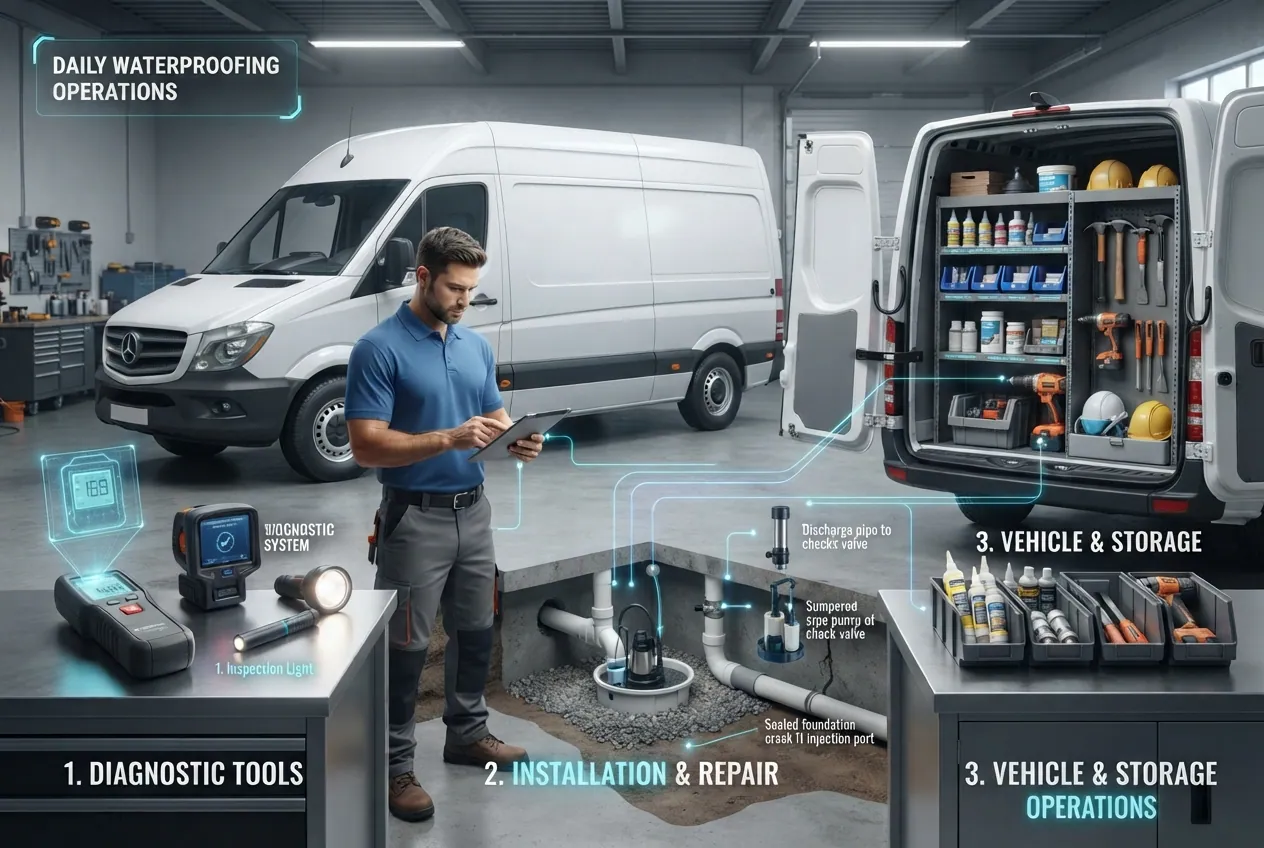
Equipment should match the services you plan to offer. A new business does not need to own every machine used by a large waterproofing company.
Diagnostic tools
Depending on the work, useful items may include moisture meters, inspection lights, measuring tools, laser levels, and suitable cameras. These help document conditions and prepare accurate estimates.
Tools support an inspection, but they do not automatically identify every cause of water intrusion. Learn when a problem requires further testing or specialist assessment.
Installation and repair equipment
Your equipment may include:
- Concrete breakers, chisels, and dust-control equipment for suitable interior drainage work.
- Pipe cutters and drainage installation tools.
- Sump pump basins, pumps, discharge components, and backup systems.
- Suitable injection equipment and repair materials.
- Protective equipment and safe material-handling tools.
The exact list depends on your services. Buy equipment only after confirming its suitability, required training, maintenance needs, and the work you are permitted to perform.
Vehicle and storage
You need a reliable way to transport workers, materials, and tools. An existing pickup or van may be sufficient for some services, while larger projects can require a different vehicle or trailer.
Keep tools secured and organize materials so crews can find them quickly. Protect repair products according to the manufacturer’s storage instructions.
Prepare a repeatable job process
Create a standard workflow for inquiries, inspections, estimates, scheduling, material orders, job completion, and payment collection.
For each project, document the existing conditions, proposed method, exclusions, customer approval, and completed work. This gives you a record if questions arise later.
Set Prices, Write Estimates and Protect Cash Flow
Your price needs to cover more than the cost of materials. It must also account for labor, overhead, travel, equipment, and the risk of doing the job again if something goes wrong within the agreed scope.
Calculate the cost of each job
Start by identifying:
- Materials and supplies.
- Labor, including a reasonable cost for your own working time.
- Vehicle and travel expenses.
- Equipment rental or usage costs.
- Waste removal and site preparation.
- A fair share of ongoing business overhead.
Suppose a job uses $500 in materials, $600 in labor, $100 in travel and disposal, and $200 in allocated overhead. Its estimated cost is $1,400.
If you quote the customer $1,800, the projected amount remaining before other uncounted expenses and taxes is $400.
That is not the same as guaranteed profit. Unexpected conditions, callbacks, payment fees, or missing cost items can reduce the result.
Understand the difference between revenue and profit
Revenue is the money your business earns from its work. Profit is what remains after the relevant expenses are deducted. Cash flow describes when money enters and leaves the business.
These measures answer different questions. A company may record a sale but still lack cash to buy materials for its next project.
Use clear written estimates
A written estimate should describe the problem observed, the work included, materials, price, payment terms, and important exclusions. Explain what might require a change order—written customer approval for additional work and cost.
Do not promise that one method will solve every water problem. State what the planned system is intended to address and explain any limitations.
For major structural concerns, seek qualified help before quoting work that exceeds your skills or legal authority.
Find Your First Customers and Build Local Referrals
A good startup plan needs a repeatable way to reach customers. Start with a small service area and a few marketing methods you can maintain consistently.
Build a useful website
Your website should clearly explain your services, service area, contact details, inspection process, and how customers can request an estimate.
Use real project photos only when you have permission to publish them. Describe warranties accurately and avoid unsupported claims such as guaranteed permanent dryness.
Set up local search visibility
A Google Business Profile may help an eligible service-area business appear in local search results. Google says service businesses that visit customers can use a service-area profile and should hide their address when they do not serve customers at that location. Review Google’s business representation guidelines before creating your profile.
Keep your business name, phone number, service descriptions, and service area accurate. Ask satisfied customers for honest reviews without offering misleading incentives.
Build referral relationships
Consider contacting local home inspectors, real estate professionals, property managers, remodelers, and general contractors.
Explain which jobs you handle, what qualifications you hold, and when you refer work to another professional. Consistent communication and reliable scheduling can make these relationships more valuable than broad advertising alone.
Track incoming calls, inspection requests, estimates, accepted jobs, and completed payments. This will help you understand which marketing channels produce suitable customers.
Avoid Common Startup and Job-Site Mistakes
A few mistakes can create costs far beyond the original job.
Buying too much equipment too early: Test demand and compare renting, buying used equipment, and subcontracting before making a large purchase.
Ignoring contractor rules: A registered business may still lack permission to perform a particular service. Verify local requirements before accepting regulated work.
Underpricing estimates: Include labor, overhead, travel, materials, disposal, and realistic allowances for uncertain conditions.
Using unclear warranties: Explain what the warranty covers, its duration, exclusions, and the process for reporting a problem. Make only commitments your business can support.
Accepting work outside your skills: Structural cracks, foundation movement, and difficult excavation conditions may require a qualified specialist. Referring a job can be less costly than attempting work you cannot safely complete.
Treat excavation safety as essential
Before digging, arrange underground utility locating and confirm the applicable local notification requirements. The OSHA trenching and excavation guide identifies cave-ins, unsafe access, water accumulation, and underground utility hazards as serious risks. It also explains the need for appropriate protective systems and competent-person inspections.
Do not let a deadline or customer pressure replace required safety precautions. Workers need suitable training, protective equipment, and safe procedures for the tasks they perform.
Frequently Asked Questions
How much does it cost to waterproof a 1,000-square-foot basement?
The cost depends on the method, site conditions, labor, and local market. Angi’s October 16, 2026 cost guide estimates professional waterproofing for a 1,000-square-foot basement at approximately $3,000 to $10,000. This is a homeowner project-cost estimate, not the startup cost of a waterproofing business.
Is waterproofing a basement a tax write-off?
Not usually as an immediate deduction for a personal residence. The IRS explains that ordinary repair costs generally cannot be deducted, while qualifying home improvements may be added to the property’s tax basis. Business and rental property rules can differ, so consult a qualified tax professional about your specific situation.
Is waterproofing your basement a good investment?
It can be worthwhile when it addresses a real water problem, reduces the risk of damage, or helps make the basement usable. The value depends on the condition of the home, the cause of the water entry, and the effectiveness of the solution. No waterproofing project guarantees a particular increase in resale value.
Can a general contractor do waterproofing?
That depends on the applicable state and local rules, the contractor’s qualifications, and the exact work involved. Some services may fall within a contractor’s authority, while other tasks can require additional licenses, permits, or specialist qualifications. Confirm the rules with the relevant licensing authority and building department.
What insurance does a basement waterproofing business need?
Common options include general liability, commercial auto, and tools and equipment coverage. Workers’ compensation may be required depending on state rules and staffing, while certain contracts or licensing authorities may require a surety bond. Ask an insurance professional for coverage that matches your actual services, including excavation and foundation work where applicable.
Choose Your First Practical Next Step
Start by choosing your service area and deciding which waterproofing jobs you can legally and safely perform. Verify licensing and permit requirements, obtain insurance quotations, and prepare a budget based on actual equipment and operating costs.
Then test customer demand before committing to expensive machinery or a large crew. A focused startup with clear prices, reliable documentation, and appropriate qualifications can build a stronger base for future growth than a business that expands before its finances and operations are ready.
Disclaimer
Business costs, licensing rules, insurance needs, and results vary by service model and location. This article provides general educational information, not legal, tax, insurance, or safety advice. Confirm local requirements and consult qualified professionals for decisions specific to your business.