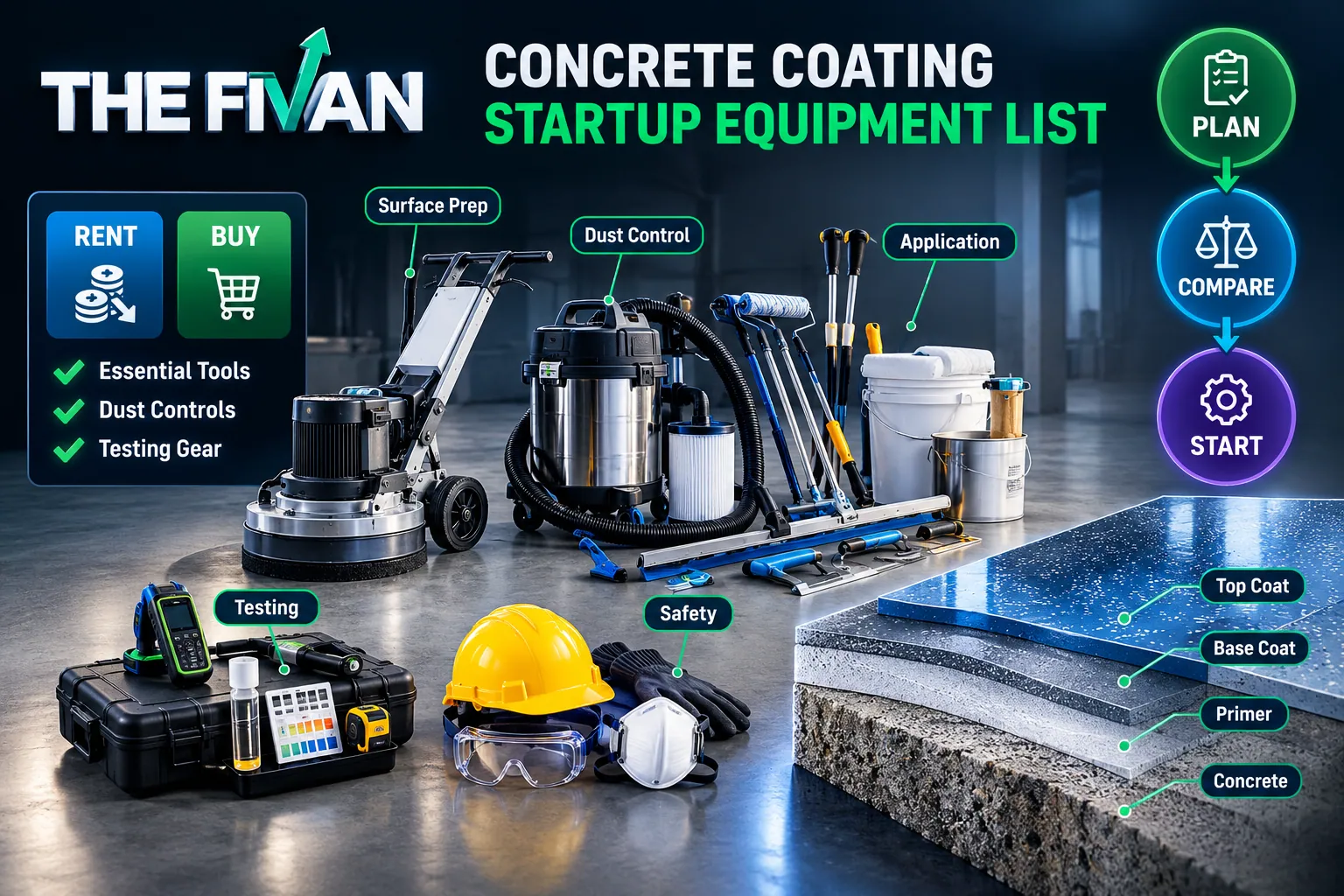
Starting a concrete coating business requires the right equipment to prepare concrete, control dust, repair surface damage, mix coating materials, and apply a smooth finish. You do not need to buy every machine on your first day. Your equipment needs depend on the jobs you plan to take, the condition of the concrete, and the coating system you use.
For most beginners working on residential garage floors, the essential setup includes a concrete grinder, an edge grinder, suitable diamond tooling, a compatible dust extractor, crack-repair tools, moisture-testing supplies, mixing and application tools, and appropriate safety equipment. You may be able to rent the expensive floor grinder and extractor while buying smaller tools you will use on every job.
Your first goal is to build a safe, workable setup without spending money on machines your business does not yet need. Here is how to choose the equipment, estimate the costs, and prepare for your first jobs.
Short Definition
A concrete coating business needs surface grinders, compatible dust extraction, diamond tooling, repair supplies, moisture-testing equipment, mixing and application tools, and suitable safety gear. Beginners can rent major machines to reduce upfront equipment costs.
Experience
Practical Business Tip: Plan your first equipment setup around the jobs you intend to accept, not the largest supplier package. Renting major machinery can limit upfront spending, but always check equipment, tooling, and dust-control compatibility before booking.
1. What Equipment Do You Need to Start a Concrete Coating Business?
A concrete coating contractor needs equipment for four main tasks: surface preparation, concrete testing, coating application, and job-site safety.
The following checklist covers the main categories for a beginner-focused residential setup. Some items may be essential for one coating system but unnecessary for another.
| Equipment | Main purpose | Buying priority |
| Walk-behind concrete grinder | Prepare larger floor areas | Rent or buy, depending on workload |
| Handheld or edge grinder | Reach corners and edges | High |
| Diamond tooling | Grind concrete or remove existing coatings | High |
| Dust extractor and grinder shrouds | Capture dust during preparation | Essential for the selected dry-grinding control method |
| Crack-repair tools and materials | Prepare damaged areas | High |
| Moisture-testing supplies | Check whether the slab meets coating requirements | High |
| Mixing drill and paddle | Mix coating components | High |
| Measuring tools and buckets | Measure and prepare materials accurately | High |
| Squeegees and rollers | Spread and apply coatings | High |
| Suitable PPE | Protect against task-specific hazards | Essential |
| Temperature and humidity instruments | Check job-site conditions | As required by the coating system |
| Generator or trailer | Support power and transport needs | Conditional |
A basic setup is not just a collection of tools. The equipment must work together. For example, a powerful grinder is of limited use if its dust collector cannot support the required airflow or its tooling cannot produce the surface profile your coating needs.
2. Surface Preparation Equipment: Grinders, Diamond Tooling, and Repair Tools
Surface preparation is one of the most important stages in a concrete coating job. The coating needs a suitable surface to bond to. Applying expensive material over poorly prepared concrete can lead to peeling, weak adhesion, or premature failure.
Walk-behind concrete grinder
A walk-behind concrete grinder prepares larger floor areas by grinding the surface and removing unwanted material. Depending on the machine and tooling, it can remove old coatings, smooth high spots, and create the surface profile required by a coating manufacturer.
Grinding creates a surface profile, meaning a certain level of roughness that helps the coating bond to the concrete.
For residential garages, contractors may use compact planetary or multi-head grinders. Larger machines can make sense for bigger jobs, frequent grinding, or certain commercial projects.
Before buying or renting one, check:
- The grinding width and whether it suits the floor size.
- The machine’s weight and whether you can transport it.
- The power supply and connection requirements.
- The available diamond tooling and its compatibility with the machine.
- The manufacturer’s recommended dust collection system.
For a beginner with uncertain demand, renting a floor grinder can limit the initial cash commitment. However, you must confirm that the rental machine can handle the existing floor condition and the required preparation method.
Handheld grinder and edge grinder
A handheld grinder, often fitted with a suitable diamond cup wheel, helps prepare areas the larger machine cannot reach. These include wall edges, corners, narrow spaces, and sections around fixed obstacles.
A seven-inch grinder with an appropriate dust shroud is one possible choice for this type of work. The correct size depends on the job, tooling, and required dust-control setup.
Budget for the grinder itself, a compatible shroud, suitable diamond tooling, and any necessary extraction connections. Buying the tool without the accessories needed to use it properly can leave you with an incomplete setup.
Diamond tooling and coating-removal accessories
Diamond tooling contains industrial diamonds that grind concrete. Different tools suit different surfaces and removal tasks.
Common options include:
- Diamond grinding segments: Used for grinding concrete and preparing a suitable surface profile.
- PCD tooling: Polycrystalline diamond tools that can help remove certain adhesives, mastic, and existing coatings.
- Cup wheels: Commonly used with handheld grinders for edges and smaller areas.
- Specialized tooling: Selected for particular coating-removal needs, concrete hardness, and machine types.
Tooling is not one-size-fits-all. The wrong bond or tool design can cut too slowly, wear too quickly, or produce a surface that does not meet the coating system’s requirements.
Before purchasing, tell the supplier what material you need to remove, what machine you have, and what finish or profile the new coating requires. This helps you avoid paying for tooling that cannot do the planned job.
Crack-repair and cleanup tools
Most concrete floors need at least an inspection before coating. Some also need crack repairs, patching, or the removal of loose material.
Useful supplies may include:
- Crack-chasing or V-shaped grinding tools.
- Putty knives and scrapers.
- Small grinders and suitable repair accessories.
- Mixing tools for patch materials.
- Manufacturer-approved joint fillers and repair compounds.
- Scrub brushes and cleanup tools.
Not every crack should be treated the same way. A surface crack, a moving joint, and a structural crack can require different responses. Do not simply fill every crack and cover it with coating. Investigate signs of movement or significant damage before proceeding.
Practical check: After preparation, inspect the entire floor for remaining coating, loose concrete, contamination, and areas that still need repair. Follow the preparation and inspection instructions for the selected coating system.
3. Dust Extraction and Safety Equipment You Should Not Skip
Grinding concrete can release respirable crystalline silica, a fine dust that can damage the lungs. Dust control must be part of your equipment plan, not an accessory you add when the budget allows.
Dust extractor and grinder shrouds
A dust extractor collects dust near the point where the grinder creates it. A shroud helps capture particles around the grinding tool and directs them toward the collection system.
Choose a system that matches the grinder and the applicable exposure-control requirements. Check its airflow capacity, filtration, filter-cleaning method, hose compatibility, and manufacturer’s instructions.
A household vacuum is not an automatic substitute for a suitable industrial dust collector.
The OSHA construction silica standard specifies exposure-control methods for different tasks. For walk-behind floor grinders, Table 1 identifies the manufacturer’s recommended dust collection system as one permitted method. Specific handheld grinding tasks have different requirements, including airflow and filtration criteria.
These distinctions matter. Do not assume that any vacuum marked for dust collection will meet the requirements for every grinder and task.
You also need a plan for emptying the collector and handling collected dust safely. Follow the manufacturer’s instructions and applicable workplace rules rather than blowing accumulated dust into the air.
Respirators and personal protective equipment
Your safety equipment may include:
- Safety glasses or goggles.
- Suitable hearing protection.
- Chemical-resistant gloves selected for the materials being handled.
- Work clothing that protects exposed skin.
- Appropriate safety footwear.
- Respiratory protection selected for the actual dust, vapors, and other hazards.
- Knee protection where appropriate.
Grinding dust and coating chemicals create different hazards. A particulate filter designed for dust does not automatically protect against organic vapors, and an organic-vapor cartridge does not replace the filtration needed for particulate hazards.
Read the coating product’s safety data sheet (SDS), which explains its hazards and handling precautions. Follow applicable respiratory-protection requirements. Where an employer is required to maintain a respiratory-protection program, simply buying a respirator is not enough.
For more information, consult the NIOSH guidance on respirators used for construction dust.
Ventilation and safe material handling
Some coating products require controlled ventilation or other precautions during mixing and application. Check the SDS and the technical data sheet for each product rather than assuming all epoxy or polyaspartic coatings have the same requirements.
Keep suitable protective equipment available before work starts. If the selected coating system calls for specific gloves, protective clothing, or respiratory protection, include those items in the job budget.
4. Mixing, Measuring, and Concrete Coating Application Tools
Once the surface is ready, you need tools to prepare the coating accurately and apply it evenly.
Heavy-duty mixing drill and paddle
Many professional coatings use two or more components that must be mixed in a specific ratio. A suitable mixing drill and paddle help combine these components consistently.
Choose equipment that matches the product’s mixing instructions. Some materials require a particular mixing speed, paddle style, or mixing time.
Mixing too quickly may introduce excess air into some products. Incomplete mixing or incorrect ratios can also create problems with curing and final performance.
Measuring buckets, scales, and related supplies
A useful application kit may contain:
- Graduated mixing containers.
- Clean mixing buckets.
- Measuring tools.
- A suitable scale when accurate weighing is permitted by the product instructions.
- Stirring and scraping tools.
- Disposable application supplies where appropriate.
Follow the manufacturer’s instructions for component ratios and batch sizes. Do not assume that every product can be divided into smaller batches by weight or volume.
Keep mixing equipment clean and organized. Contaminated buckets or tools can affect a new batch, and rushed measuring can waste expensive coating material.
Squeegees and spreaders
Squeegees help distribute coating across the floor. Some jobs use notched squeegees or other spreaders to help control the applied material.
The correct tool depends on the coating’s thickness, the manufacturer’s instructions, and the desired finish. A tool intended for a thin coating may not suit a thicker system.
Rollers, frames, and extension poles
Rollers help distribute material, finish the surface, and work coating into the areas required by the application method. You may need suitable roller covers, durable frames, extension poles, and brushes for edges.
Buy roller covers that are compatible with the coating product. Ordinary painting supplies do not always perform well with professional floor coatings.
Spike shoes and other application accessories
Cleated or spiked shoes can allow installers to walk across certain wet coatings during specific application stages. They are useful only when the coating system and method call for them.
Other supplies may include painter’s tape, plastic sheeting, brushes, scrapers, and disposable mixing accessories. These small items are easy to overlook, but they can add to the cost of every job.
Practical Business Tip: Make a reusable equipment checklist for each coating system you plan to install. A checklist helps you confirm that the right mixer, measuring tools, rollers, protective equipment, and cleanup supplies are ready before leaving for the job.
5. Concrete Testing Tools and Job-Site Requirements
Good preparation does not end with grinding. You also need to confirm that the concrete and the working conditions meet the coating manufacturer’s requirements.
Moisture testing equipment
Concrete can contain moisture even when its surface looks dry. Excess moisture may affect adhesion or cause other coating problems, depending on the product.
Moisture-testing options include calcium chloride test kits and in-situ relative humidity testing equipment. They use different methods, so they are not interchangeable in every situation.
Choose a method that the selected coating manufacturer accepts. Read the product documentation carefully, including the required test locations, number of tests, and acceptable limits.
A basic surface check should not be treated as proof that the slab meets every moisture requirement. If readings exceed the permitted limit, investigate the manufacturer’s approved options before coating the floor.
Temperature, humidity, and dew point tools
A digital thermometer and humidity meter can help you measure the conditions around the job. Some projects also require checking concrete surface temperature and dew point.
The dew point is the temperature at which moisture begins to condense from the air. If the surface is too close to that temperature, condensation may interfere with coating application.
Temperature and humidity limits vary by product. For example, Sherwin-Williams’ resin flooring technical documents include product-specific conditions for concrete preparation, moisture, and application. Follow the technical documents for your actual product instead of applying one set of limits to all coatings.
Power, lighting, and ventilation
Before a job, confirm that the site can support the machines and tools you intend to use.
Check the voltage and amperage requirements, available outlets, circuit capacity, and any other electrical needs specified by the equipment manufacturer. Do not use improvised electrical connections to make incompatible equipment work. Get qualified electrical help if necessary.
Adequate lighting helps reveal cracks, surface defects, and missed areas during inspection. Ventilation may also be necessary, depending on the materials and work environment.
A generator can be useful at sites without suitable power, but it adds cost, transport needs, and its own operating requirements. Confirm that it can safely support the equipment load before purchasing or renting one.
6. Optional Equipment for Larger or Specialized Jobs
Some machinery is useful for particular projects but unnecessary for a beginner focused on residential garages.
Scarifiers and shot blasters
Scarifiers remove material through a mechanical cutting or impact action. Shot blasters use propelled abrasive media to prepare concrete surfaces.
These machines may suit certain heavy-removal or commercial projects. Their usefulness depends on the existing surface, the removal depth, the required profile, and the coating system.
Do not buy either machine simply because it appears on a professional contractor’s equipment list. Rent one for a suitable job or work with a specialist when the need arises.
Larger grinders and additional extraction equipment
A business handling large floors regularly may benefit from greater grinding capacity and additional extraction equipment. More capacity can improve productivity, but it also increases purchase, maintenance, storage, and transport costs.
Trailer and generator
A trailer can help move heavy equipment, while a generator can support jobs without suitable electrical service.
Before investing in either, confirm vehicle towing capacity, trailer weight, loading arrangements, storage needs, and local vehicle requirements. The right equipment is only useful when you can transport it safely and operate it at the job site.
7. How Much Does Concrete Coating Business Equipment Cost?
The amount you need depends heavily on whether you rent major machinery or buy a complete setup.
A published equipment guide from Epoxy Business School, updated October 11, 2026, provides three useful illustrative budgets. These are source-specific estimates, not guaranteed quotes for every US location.
| Setup | Published equipment estimate | What it covers |
| Rental-first setup | 872–1,248 owned tools, plus approximately 315–367 in major-equipment rental per job | Application tools, edge grinder kit, respirators, and moisture tests; floor grinder and extractor rented |
| Partial-ownership setup | 2,772–3,648 in owned equipment, plus grinder rental | The rental-first owned kit plus an extractor |
| Full setup | 16,405–19,166 | Owned tool kit, floor grinder, diamond tooling, larger extractor, and enclosed trailer |
The rental-first estimate assumes a particular grinder-and-extractor rental arrangement. Diamond tooling, coating materials, insurance, training, and other operating expenses may be additional. Rental shops and suppliers can charge different rates, so obtain current quotes for the equipment you plan to use.
For another point of comparison, Xtreme Polishing Systems lists a Concrete Genie surface preparation and polishing package at $14,999. Its listed components include a floor grinder, dust vacuum, squeegee kit, hardness testing kit, and grinding accessories. This package is focused on preparation and polishing; it is not automatically a complete concrete coating business setup.
Budget for costs beyond equipment
Your full startup budget may also need to cover:
- Initial coating materials and job-specific consumables.
- Equipment maintenance and replacement filters.
- Business insurance and vehicle expenses.
- Training and manufacturer-specific product education.
- Business registration or applicable licensing fees.
- Marketing and customer acquisition.
- Working capital, meaning cash available to pay business expenses while waiting for customer payments.
Keep equipment costs separate from recurring operating expenses. Also remember that customer deposits or advance payments may have restrictions under applicable law or contract terms; do not assume future customer money is guaranteed.
A useful first step is to list the jobs you expect to do, price the required equipment, and estimate how many times you will need each rental machine. That gives you a more useful budget than a single generic startup figure.
8. Should You Rent, Buy Used, or Buy New Equipment?
There is no single correct choice for every new contractor. Compare the options using expected workload, repair risk, and the cash your business needs for other expenses.
Rent major equipment
Renting can make sense when you have only a few suitable jobs or are still learning which equipment best fits your market.
You avoid a large purchase, but rental charges recur, equipment may not be available when you need it, and tooling may cost extra. Confirm the rental period, damage terms, transport arrangements, and required accessories before booking.
Buy used equipment
Used equipment may reduce the initial purchase cost. Before buying, inspect the machine’s operating condition, wear parts, electrical components, dust connections, and parts availability.
Ask for the machine’s model and specifications, then confirm that the correct tooling and extractor can be obtained. A low purchase price may not be worthwhile if the machine needs expensive repairs or cannot handle your planned work.
Buy new equipment
New machinery may offer warranty coverage, manufacturer support, and a more predictable starting condition. The trade-off is a larger initial payment and possible financing costs if you borrow.
Read the complete quote. Check what tooling, accessories, tax, delivery, warranty limits, and service costs are included.
A practical rule: Buy the smaller tools you will use on nearly every job first. Rent expensive machinery until your actual workload gives you a stronger reason to own it. Revisit that decision when rental expenses, availability problems, or lost working time begin to justify a purchase.
Before financing expensive equipment, test your budget against a slower month as well as a busy one. A machine should support your business, not leave you short of cash for materials, repairs, or essential bills.
9. Common Equipment-Buying Mistakes and a First-Job Checklist
Many early mistakes happen because contractors focus on the machine price instead of the complete work process.
Avoid these common problems:
- Buying a grinder without confirming compatible tooling and dust collection.
- Choosing a dust extractor based only on its advertised filtration label.
- Using the wrong diamond tooling for the concrete or existing coating.
- Skipping moisture tests or ignoring readings that fall outside product limits.
- Forgetting measuring tools, PPE, repair materials, or small consumables.
- Buying a large machine before confirming transport, storage, and power needs.
- Treating every crack as a simple cosmetic repair.
- Assuming one coating product’s application limits apply to another.
Before your first job, confirm the following:
- The equipment is suitable for the planned floor and preparation method.
- All required grinder accessories and dust controls are available.
- The concrete has been inspected and repaired as needed.
- Required moisture and environmental checks meet the selected system’s specifications.
- Mixing ratios, application methods, and cure instructions are understood.
- Safety equipment is appropriate for the actual hazards.
- The site has suitable power, lighting, access, and ventilation where required.
- Materials, consumables, transportation, and cleanup arrangements are ready.
If a test fails or a surface still appears unsuitable, pause and investigate. Covering the problem with another coating layer may waste both material and labor.
10. Do You Need a License to Install Epoxy Floors?
There is no single nationwide licensing answer that covers every concrete coating contractor in the United States. Requirements can depend on the state, city, county, type of work, project value, and business activity.
The US Small Business Administration’s launch guidance explains that licensing and permit requirements depend on business activity and location. Before accepting work, check with your state’s contractor licensing authority and relevant local government offices.
Also distinguish business registration from contractor licensing and insurance. These serve different purposes, and satisfying one does not automatically satisfy the others.
If you plan to hire workers, check the applicable workplace safety requirements as well. For concrete grinding, consult OSHA’s silica standard and determine which controls apply to the work being performed.
Frequently Asked Questions
Can you start a concrete coating business by renting equipment?
Yes. Renting major machines while owning smaller application tools can reduce the upfront equipment cost. Compare rental rates, tooling charges, transport, and equipment availability with the cost of ownership before deciding.
What is the most important piece of concrete coating equipment?
For many floor-coating jobs, the grinder is a central piece of surface-preparation equipment. But it cannot do the job alone. Suitable diamond tooling, compatible dust collection, concrete testing, and the correct application tools are also important.
Is a concrete grinder and dust extractor enough to start?
No. They cover important parts of surface preparation, but you will also need appropriate safety equipment, repair supplies, mixing and application tools, and the testing instruments required by your coating system. The complete list depends on the work you plan to perform.
What should you check before buying a used concrete grinder?
Check the machine’s condition, operating performance, electrical requirements, tooling compatibility, parts availability, and any expected repairs. Also confirm that a suitable dust extractor and accessories can be connected and used in accordance with the applicable requirements.
Do you need a license to install epoxy floors?
It depends on the location and work involved. Verify the rules with your state contractor licensing authority and local government before accepting projects. Do not assume another contractor’s license covers your own business.
Choose Your Equipment Based on Your First Jobs
Start by deciding which jobs you want to take, such as residential garage floors or larger commercial spaces. Make an equipment checklist for that work, obtain current rental and purchase quotes, and set aside money for materials, safety supplies, and operating expenses.
You can expand your setup as demand becomes clearer. The most useful first purchase is not necessarily the biggest machine; it is the equipment that helps you complete your planned work safely, correctly, and within a budget your business can support.
Disclaimer
Business costs, equipment needs, legal requirements, and operating conditions vary by business model, location, and circumstances. This information is for general educational purposes and does not guarantee business success or profitability. Verify applicable safety and licensing requirements, and seek qualified professional advice when needed.