
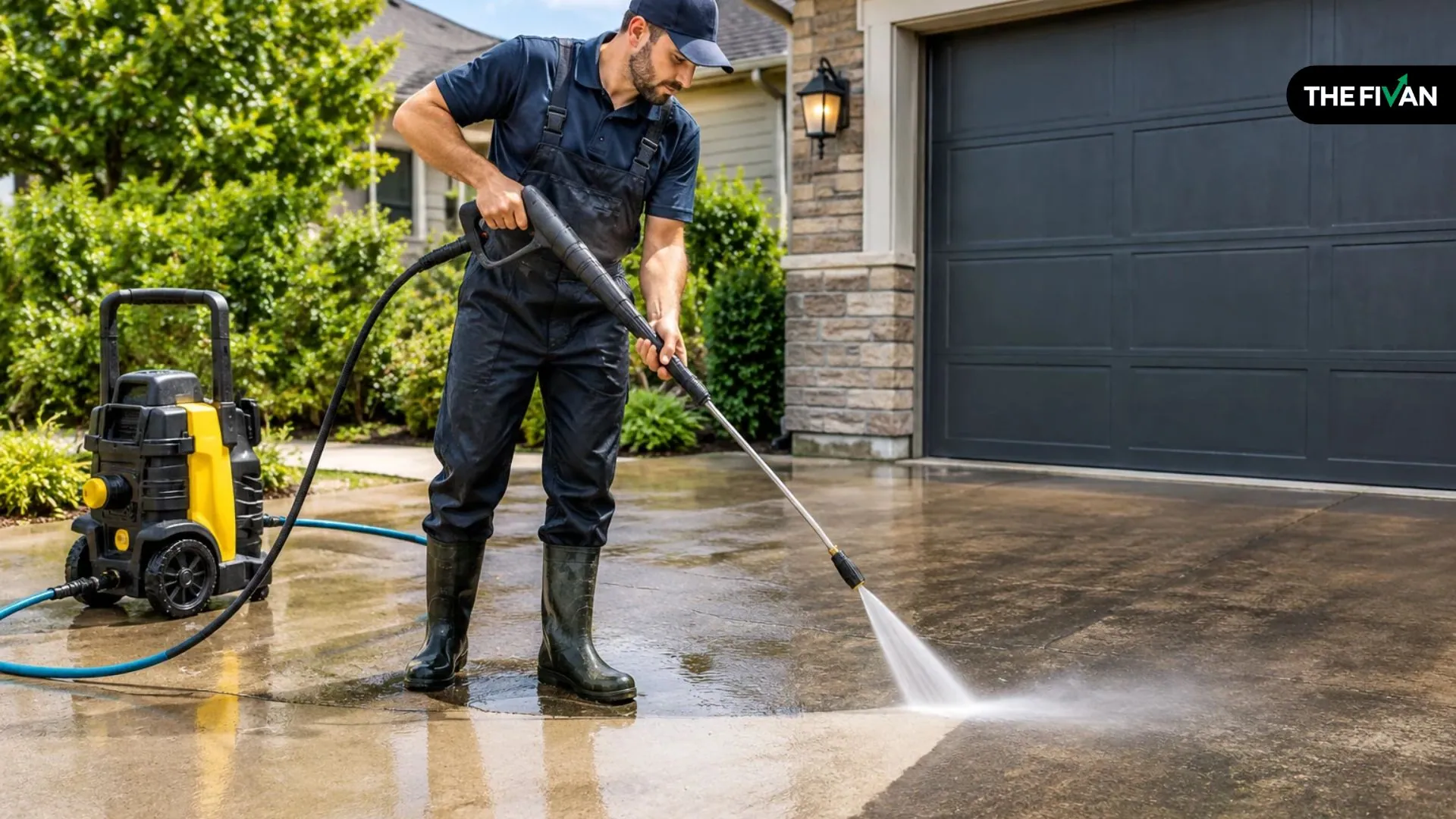
Choosing a pressure washing business name is an important first step, but you also need the right equipment, a realistic budget, and a plan to find customers. A good name should be easy to remember, clearly connect with your services, and leave room for your business to grow.
You can start by choosing a small group of services, checking your preferred name, and learning which business registration, insurance, and local rules apply. Published industry estimates put a lean pressure washing startup at about 2,000–6,000 or more, while buying a truck can raise the total considerably. Your actual costs will depend on your location, equipment, transportation, and business model.
Direct Answer
A pressure washing business provides exterior cleaning services using suitable water pressure and cleaning methods. Starting one involves choosing a name, checking legal requirements, buying suitable equipment, setting prices, and finding customers.
Pressure Washing Business Name Ideas for Different Styles
The right business name helps customers understand what you do and gives them something easy to remember. Before choosing a name, think about the customers you want to serve and the services you plan to offer.
Here are some ideas to help you get started. These are suggestions, not verified available business names.
Professional and commercial business names
These names may suit a business that wants to serve homeowners, commercial property owners, offices, or property managers.
- Precision Exterior Cleaning
- Apex Pressure Solutions
- Metro Power Wash Co.
- ClearView Exterior Services
- ProLine Pressure Washing
- Summit Surface Cleaning
A professional name can help present your business as organized and service-focused. However, a name alone will not earn customer trust. Reliable work, clear quotes, suitable insurance, and good communication matter just as much.
Local and friendly business names
Local names can be useful when you plan to focus on a particular community or service area.
- Hometown Pressure Washing
- Neighborhood Softwash
- Main Street Power Wash
- Friendly Flow Exterior Cleaning
- Local Shine Pressure Washing
- Community Clean Exteriors
A local name may help customers connect your business with their area. Before including a city or neighborhood, consider whether you may want to serve nearby communities later.
Names focused on clean results
These names emphasize the result customers want: clean surfaces and better-looking properties.
- Sparkle & Shield Wash
- DeepClean Exteriors
- FreshStart Pressure Washing
- BrightPath Surface Cleaning
- PureFlow Pressure Wash
- ShineRight Exterior Care
Result-focused names can be memorable, but avoid promising outcomes you cannot guarantee. Some stains, surface damage, and discoloration cannot be removed safely or completely.
Names for a broader exterior-cleaning business
You may eventually want to offer gutter cleaning, surface cleaning, or other exterior maintenance services. A broader name can give you more flexibility than one tied to a single cleaning method.
Examples include:
- ClearView Property Care
- AllSide Exterior Cleaning
- Complete Exterior Solutions
- FreshSurface Property Services
- Prime Exterior Care
- BlueSky Property Cleaning
Choose a name that fits the services you realistically intend to offer. You can expand later without making your branding confusing.
How to Choose and Check Your Business Name
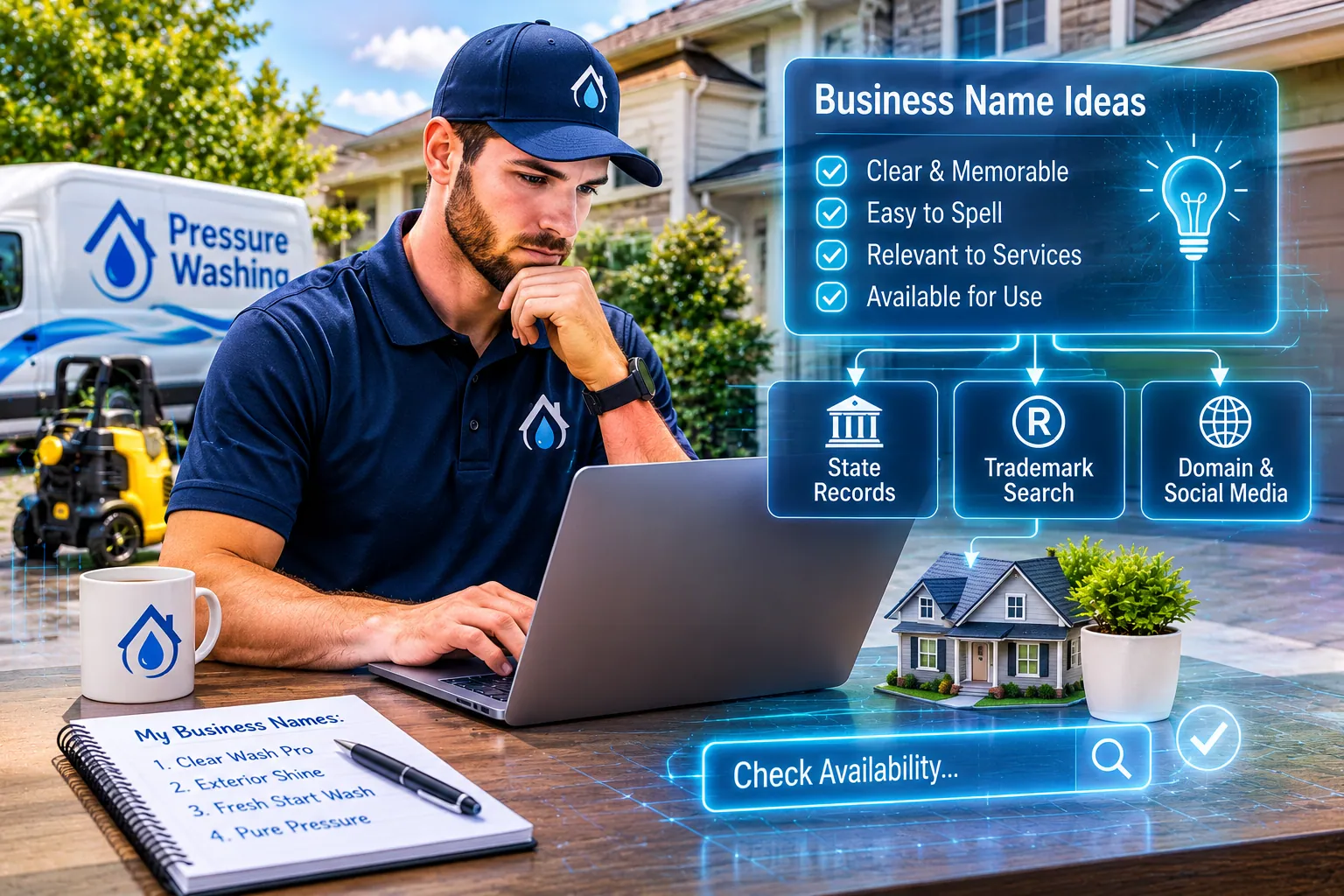
A strong name should be clear, memorable, easy to spell, and appropriate for your customers. It should also be available for the way you intend to use it.
Follow these steps before paying for a logo, website, uniforms, or truck graphics.
1. Make a shortlist
Choose three to five names that fit your services. Say each one aloud and imagine a customer hearing it over the phone.
Ask yourself:
- Can a customer spell it after hearing it once?
- Does it suggest exterior cleaning or pressure washing?
- Does it sound suitable for my target customers?
- Will it still fit if I add services later?
- Does it look clear on a small screen, invoice, or vehicle?
Avoid unusual spelling that makes it difficult for customers to search for your business. You also do not need to put every service you offer into the name.
2. Check state business records
Search the relevant state’s business registry to see whether a similar legal business name is already registered. The rules for name availability and registration differ by state and business structure.
A name that appears available in one state may already be used elsewhere. Also, state registration does not automatically give you nationwide trademark rights.
The U.S. Small Business Administration’s business-launch guidance explains the different roles of business registration, trade names, and trademarks.
3. Search federal trademarks
Use the United States Patent and Trademark Office’s trademark search guidance to look for existing marks that could conflict with your name.
Do not check only exact matches. Similar names that sound alike or suggest similar services may also create problems, depending on the circumstances.
For a name you plan to invest in heavily, consider getting legal advice before committing to it.
4. Check your domain and social media names
Look for a suitable website domain and consistent social media usernames. A matching domain is helpful, but you do not need to delay every other business task while searching for a perfect name.
Check whether customers might confuse your business with an existing company. A slightly different spelling may not be enough to avoid confusion.
Important: Do not assume that a name is legally available just because its website domain or social media username is available.
What Do You Need to Start a Pressure Washing Business?
You need more than a pressure washer. A workable startup also needs transportation, safety supplies, a way to quote jobs, and a basic plan for legal and financial responsibilities.
Use this checklist to identify your starting requirements.
| Item | Why you need it |
| Pressure washer | Provides the water pressure and flow suited to your initial services |
| Hoses and connections | Move water safely between the supply and equipment |
| Surface cleaner | Helps clean suitable flat surfaces more evenly |
| Chemical application supplies | Apply suitable cleaning solutions when the job requires them |
| Safety and property protection supplies | Help protect the operator, plants, customers, and surrounding surfaces |
| Transportation | Carries the equipment and supplies to each job |
| Business registration and records | Help you meet applicable rules and track business activity |
| Insurance | Helps manage certain financial risks from accidents and property damage |
| Quoting and invoicing process | Makes job prices, scope, payment terms, and records easier to manage |
| Marketing basics | Help potential customers find and contact you |
You do not need every possible accessory on day one. Start by deciding which services you intend to provide and purchase equipment that can handle those jobs safely.
For example, someone starting with suitable concrete driveways and sidewalks may need a different setup from someone who wants to clean roofs or delicate exterior surfaces. The latter work may require additional training, equipment, and precautions.
Complete the Legal and Business Setup
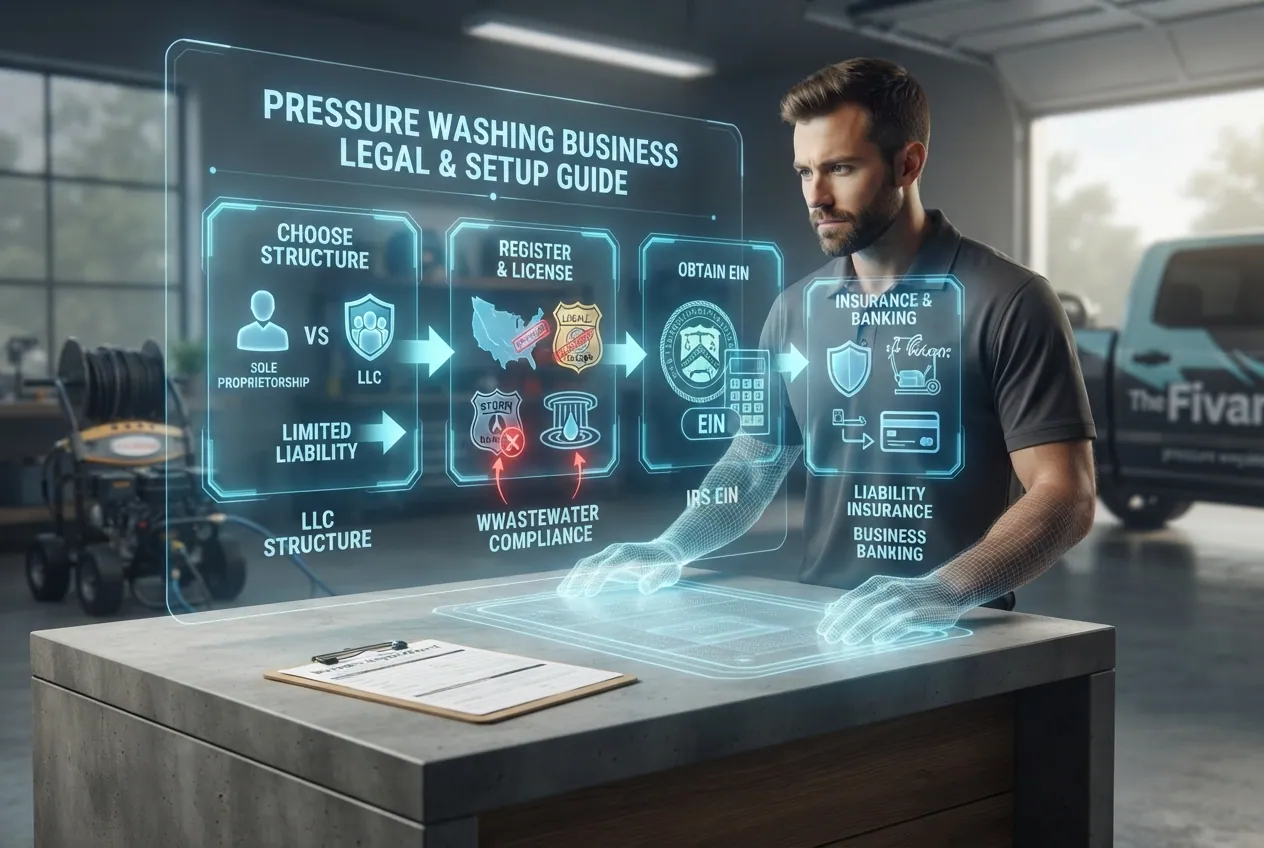
US business requirements vary by state, county, city, business structure, and the services you provide. Use the steps below as a planning guide, then confirm the requirements for your operating location.
Choose a business structure
Some beginners operate as sole proprietors, while others form a limited liability company, commonly called an LLC.
A sole proprietorship can be simpler to establish, but it generally does not separate the owner’s business liabilities from personal liabilities. An LLC may provide a degree of liability protection, depending on the circumstances and applicable law. It does not protect you from every claim or replace appropriate insurance.
Compare the options before deciding. The SBA’s business structure guidance can help explain the basic differences.
Check registration and licensing requirements
Depending on your location, you may need state business registration, a local business license, a permit, or a registered trade name known as a DBA. Do not assume that every pressure washing business needs the same set of licenses.
Contact the relevant state and local authorities and describe the services you intend to provide. Ask specifically whether rules apply to residential work, commercial jobs, chemical use, or wastewater disposal.
Water from cleaning jobs can contain detergents, oil, dirt, and other pollutants. Do not allow washwater to enter a storm drain unless the applicable rules permit it. Check local stormwater and sewer requirements before starting work. The EPA’s pollution-prevention guidance explains why washing runoff can require careful management, although the specific rules for your business must be verified locally.
Obtain an EIN when needed
An Employer Identification Number (EIN) is a federal tax identification number used for certain business tax and reporting purposes. Depending on your business structure and circumstances, you may need one.
The IRS provides an official application route at no charge for eligible applicants. Apply through the IRS EIN page rather than paying a third party simply to submit your application.
Arrange insurance and business banking
Ask an insurance provider about general liability coverage, which may help cover certain claims involving property damage or bodily injury. Equipment coverage may also be useful. Policy limits, exclusions, and prices vary, so compare actual quotes.
A dedicated business bank account can help separate personal and business transactions. Keep records of customer payments, equipment purchases, supplies, fuel, insurance, and other expenses.
How Much Does It Cost to Start a Pressure Washing Business?
Your startup cost depends mainly on your equipment, transportation, intended services, insurance, and cash reserve.
Jobber’s published 2026 guide estimates a lean startup at 2,000–6,000 or more. Its truck-inclusive estimate is 12,000–36,000. These are planning estimates, not guaranteed costs or universal industry averages. Your actual total may fall outside these ranges.
The following table shows the main expenses to investigate.
| Expense | What to check |
| Pressure washer | Capacity, suitability for your services, warranty, and maintenance needs |
| Surface cleaner and hoses | Compatibility with your machine and the jobs you intend to take |
| Chemicals and supplies | Product instructions, safe handling, and how much each job requires |
| Safety gear | Eye protection, gloves, suitable footwear, and other task-specific protection |
| Transportation | Whether your existing vehicle is suitable or you need to buy or rent one |
| Registration and permits | Current fees and requirements in your jurisdiction |
| Insurance | Actual quotes for the work and risks involved |
| Marketing | Website, signage, printed material, and local outreach |
| Working capital | Cash available for operating costs while customer income is uncertain |
Separate startup expenses from ongoing costs
Equipment and certain registration expenses may be one-time or occasional costs. Fuel, cleaning solutions, maintenance, insurance, advertising, and vehicle expenses can continue throughout the year.
Working capital is money reserved for bills and operating costs. It matters because you may need to pay expenses before you have a steady flow of customer payments.
For a lean launch, using an existing suitable vehicle could reduce the upfront investment. The trade-off is that you must check payload, storage, water access, and whether the vehicle can carry your equipment safely. Do not purchase a truck or specialized trailer until the cost and actual need are clear.
Before committing to expensive equipment, list the services you intend to sell, check local demand, and price the required setup. This makes it easier to distinguish essential purchases from upgrades you can postpone.
Pressure Washing vs. Soft Washing: Which Method Fits the Job?
Pressure washing uses a pressurized stream of water to remove dirt and buildup from suitable surfaces. Soft washing uses lower water pressure with appropriate cleaning solutions to clean certain more delicate materials.
The right method depends on the material, its condition, the type of buildup, and the product instructions.
| Job type | Key consideration |
| Concrete driveways and sidewalks | A suitable pressure washer and compatible surface cleaner may help clean broad, durable areas |
| Vinyl siding | Lower-pressure cleaning and an appropriate method can help avoid forcing water behind panels or damaging the surface |
| Painted wood and delicate surfaces | Surface condition and cleaning method matter; high pressure can cause damage |
| Asphalt-shingle roofs | Do not use high-pressure washing as a routine cleaning method; follow the roofing manufacturer’s guidance and recognized roof-care recommendations |
The Asphalt Roofing Manufacturers Association warns against high-pressure washing of asphalt shingles because it can damage the roof. Roof cleaning should not be treated as an ordinary driveway job.
Cleaning chemicals also require care. Follow the label, use appropriate protective equipment, and never mix cleaning products unless their instructions explicitly allow it. Workers using hazardous cleaning chemicals may also need appropriate training and safety information under applicable workplace rules. See OSHA’s cleaning-chemical safety guidance.
If you are unfamiliar with a surface or cleaning method, learn the correct approach before accepting the job. Property damage can cost more than the job earns.
Choose Equipment for Your First Services
You do not need the largest machine you can afford. You need a suitable setup for the work you plan to sell.
Two specifications are particularly useful:
- PSI (pounds per square inch): A measure of water pressure.
- GPM (gallons per minute): A measure of water flow.
Both affect cleaning performance. Higher pressure is not automatically better, and a machine must be matched to the task and compatible accessories.
For suitable driveway work, you may need a pressure washer, a surface cleaner, pressure hoses, a dependable water supply, and appropriate safety supplies. Other services may need different tools or chemical application equipment.
Check these points before you buy:
- Does the machine fit the surfaces and service types you plan to clean?
- Is the surface cleaner compatible with the machine’s flow rate?
- Can your water supply support the equipment?
- Can your vehicle transport the machine and accessories safely?
- Are parts, repairs, and maintenance reasonably accessible?
Read the manufacturer’s instructions and keep suitable spare connections and basic maintenance supplies. A machine that is powerful on paper may still be a poor choice if it does not match your jobs or is difficult to maintain.
Start with the equipment required for your first service mix. Expand when customer demand and job requirements justify the added cost.
How to Price Pressure Washing Jobs
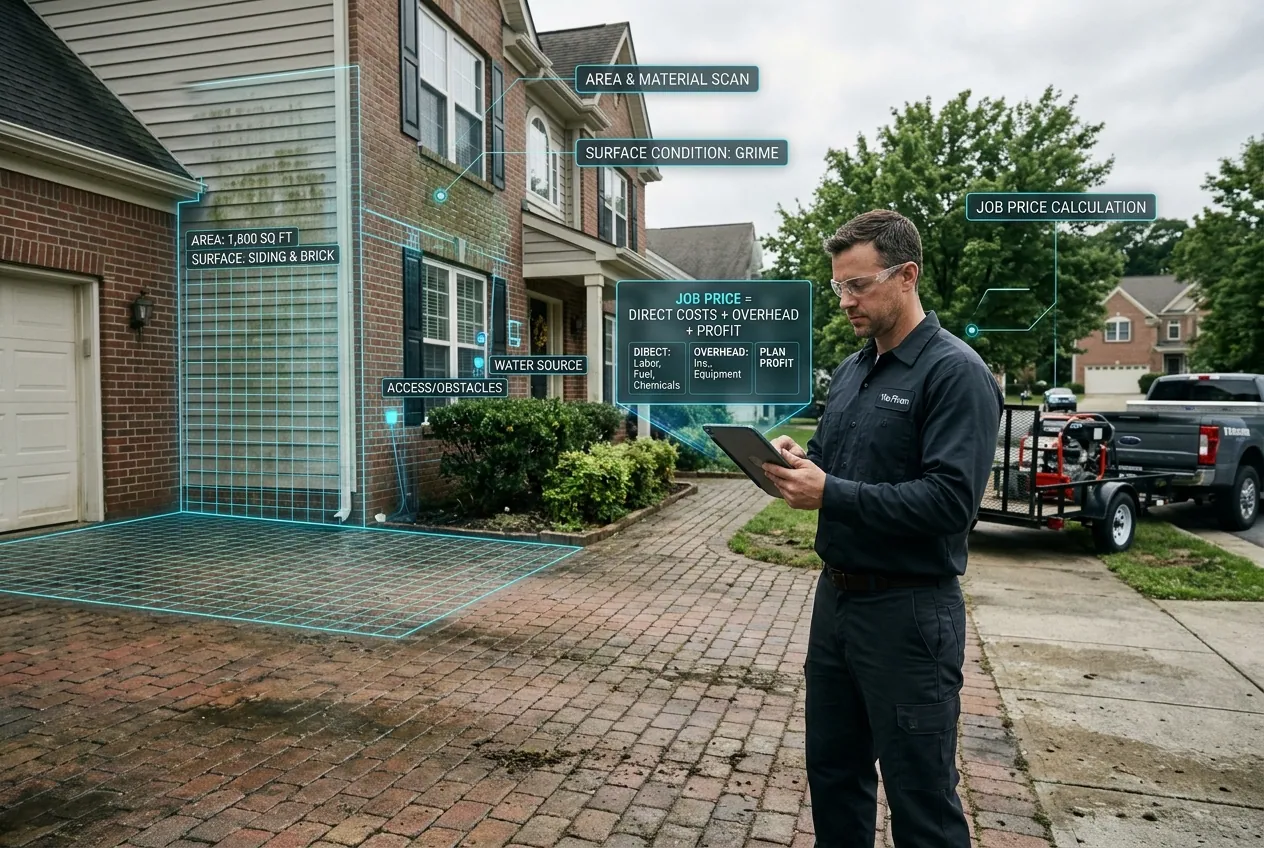
Your prices need to cover the cost of doing the work, not just the time spent holding the pressure washer.
Pressure washing businesses may use flat-rate prices, per-square-foot estimates, or hourly rates. Each approach can suit different jobs, but the quote should reflect the actual work required.
A basic pricing calculation is:
Job price = direct job costs + allocated overhead + planned profit
Direct costs may include labor, fuel, cleaning solutions, and travel. Overhead means business expenses that are not tied to only one job, such as insurance, software, and some equipment costs.
For example, imagine a hypothetical driveway job. If labor, fuel, and supplies cost $70, and you allocate $30 for overhead, the job costs $100 before profit. A $150 quote would leave $50 after those estimated costs, before any other costs or taxes not included in the example. These figures are illustrative, not a suggested market rate.
Published customer-price estimates provide context, but they do not automatically tell you what to charge. Housecall Pro’s 2026 pricing guide reports a whole-house washing range of approximately 213–449, with an average around $312. These figures vary by property, market, and job scope. They are not guaranteed prices for your area or your business.
When preparing a quote, consider:
- Surface material and condition.
- The actual area to be cleaned.
- Access, obstacles, and setup time.
- Water availability and travel distance.
- Chemical use and property-protection needs.
- The expected labor and time involved.
A home’s advertised size is not the same as the area of its exterior walls. Make sure you understand what the customer wants cleaned before giving a firm quote.
Explain what your service includes, what is excluded, and how payment will work. If a job has uncertain conditions, inspect the property or gather enough information before committing to a fixed price.
How to Find Your First Pressure Washing Customers

You do not need a large advertising budget to begin reaching local customers. Start with a few practical methods that you can maintain consistently.
Create a Google Business Profile
Eligible businesses can create or claim a Google Business Profile for free. It can help customers find your business information, service area, contact details, and reviews. Follow Google’s eligibility and verification requirements in the official Business Profile help guide.
Keep your service description accurate. Do not claim that you offer roof cleaning, commercial services, or other work until you can safely and properly provide it.
Show the quality of your work
With the customer’s permission, take clear before-and-after photos. Use genuine images of work you completed, and do not imply that another company’s results are yours.
Describe what you cleaned and avoid promising that every stain will disappear. Clear expectations can prevent disputes.
Build local relationships
Consider contacting suitable property managers, real estate professionals, or local businesses that may need exterior cleaning. Ask satisfied customers for referrals and reviews without pressuring them.
Door hangers and local community outreach may also help, provided you follow relevant local rules. Keep a record of where inquiries come from so you can see which methods are worth repeating.
An account published by UpFlip describes how Chase Lille of Wizard Wash reported obtaining an early customer through Nextdoor and later learning the importance of keeping marketing active. This is one business’s reported experience, not proof that the same approach will produce similar results for every startup.
The useful lesson is simple: keep looking for customers even when current jobs make you busy. A quiet marketing pipeline today can mean fewer inquiries later.
Common Mistakes to Avoid Before You Launch
A few early checks can help prevent wasted spending and avoidable problems.
- Paying for branding before checking the name: Verify relevant business-name, trademark, domain, and social availability first.
- Buying too much equipment: Choose tools for your initial services, then upgrade when demand supports the expense.
- Pricing without counting costs: Include labor, travel, fuel, cleaning products, equipment wear, and overhead.
- Assuming the rules are the same everywhere: Check the relevant state and local authorities for registration, licensing, and wastewater requirements.
- Using high pressure on every surface: Select the method based on material, condition, manufacturer instructions, and safety.
- Stopping marketing when you become busy: Keep a manageable routine for referrals, follow-ups, and local visibility.
Avoiding these mistakes will not guarantee success, but it can help you make decisions with better information and fewer unnecessary commitments.
Frequently Asked Questions
What’s a good name for a pressure washing business?
A good name is easy to say, spell, and remember, and it clearly fits the services you offer. Examples include Precision Exterior Cleaning, Hometown Pressure Washing, and PureFlow Pressure Wash. Check state registration records, federal trademarks, domains, and social handles before choosing a name.
How much does it cost to pressure wash a 1,000-square-foot house?
The price depends on the exterior surface, material, condition, access, location, and cleaning method. Published 2026 house-washing estimates from Housecall Pro range from about $213 to $449, but this is not an exact quote for a 1,000-square-foot home. Floor area and exterior wall area are different measurements, so define the job before setting the price.
What do I need to start a pressure washing business?
You generally need suitable pressure washing equipment, hoses and accessories, transportation, safety supplies, a way to quote and invoice jobs, and a plan for registration, insurance, and local requirements. The exact setup depends on your intended services and location. Start with essential equipment for your first jobs rather than buying every available accessory.
Can I pressure wash without a license?
There is no single answer for every US location and service. Requirements can vary by state, county, and city, and wastewater or chemical-use rules may apply separately. Check with the relevant local authorities before accepting work, and confirm whether your intended services require registration, a license, or additional permits.
Take Your First Practical Steps
Start by shortlisting three to five business names and checking whether you can use them. Next, define your first services, verify the requirements for your operating location, and build a budget that includes ongoing expenses and cash reserves.
Buy equipment only after you know which jobs you intend to take and what those jobs require. A clear name helps customers recognize your business, but safe work, sensible pricing, honest marketing, and consistent customer service will help you build a stronger foundation.
Disclaimer
Business requirements, startup costs, equipment needs, and customer demand vary by location and business model. This article provides general educational information, not a guarantee of income or business success. Verify local legal requirements and consult an appropriate qualified professional when you need specific legal, tax, accounting, or financial advice.