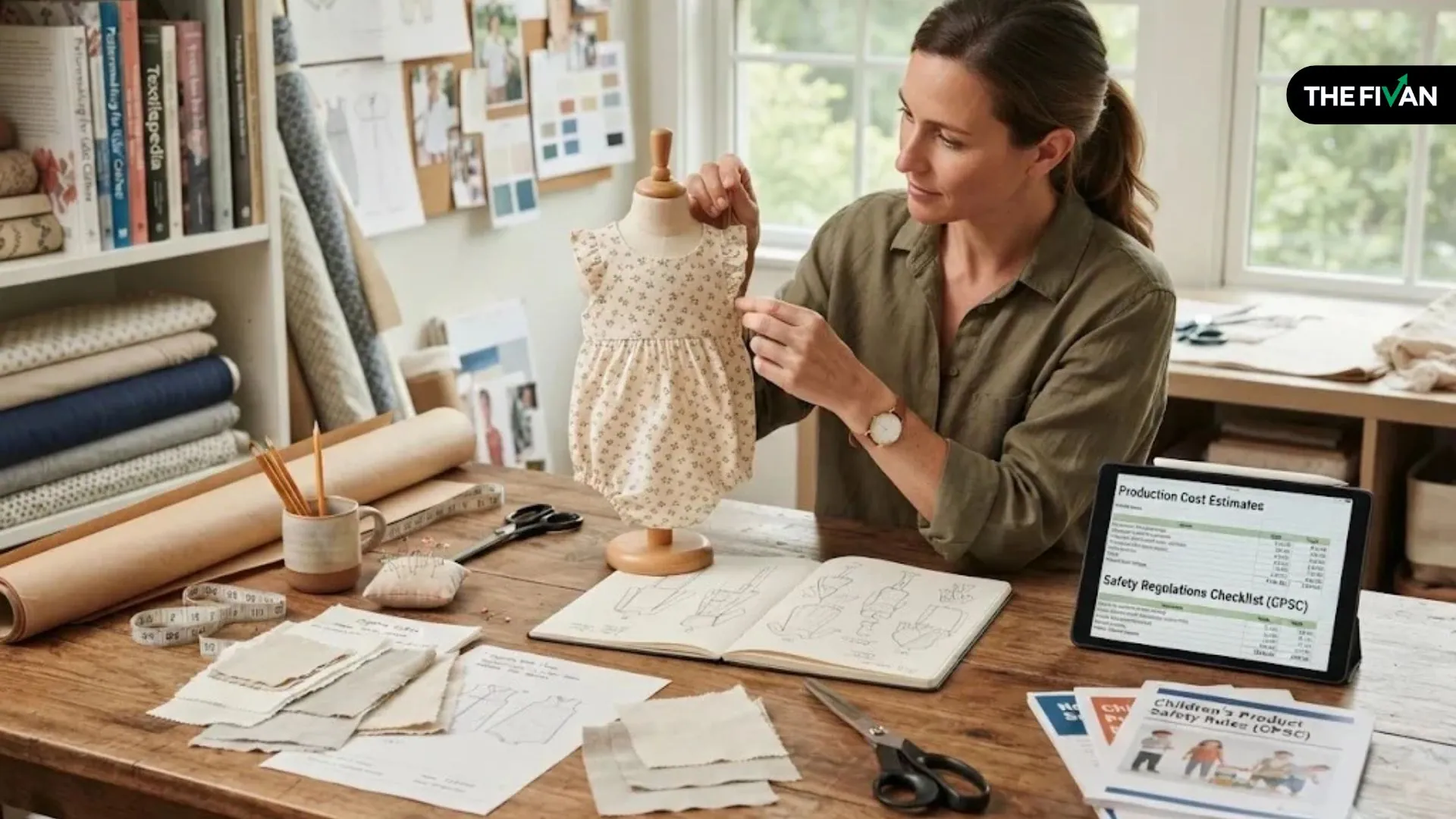
Starting a children’s clothing line from scratch begins with one clear idea, a specific customer, and a plan you can afford to test. You do not need to launch a large collection or open a physical store on day one. You can start with a few carefully chosen products and learn what parents want before investing in large amounts of inventory.
The practical approach is to choose a clothing niche, research potential buyers, compare production methods, and calculate your costs. You also need to check U.S. clothing-label and children’s product safety requirements before selling. These steps help you build a business around real customer needs rather than spending money on products that may not sell.
Direct answer
Start with a clear customer group and one focused clothing niche. Test demand, compare production options, calculate full selling costs, and verify applicable U.S. labeling and children’s product safety rules before committing to a large order.
Start With a Simple Plan for Your Children’s Clothing Line
Before designing clothes, decide what kind of business you want to build. A children’s clothing brand that sells everyday basics has different needs from one that creates personalized birthday outfits or adaptive clothing.
Use this simple starting sequence:
- Choose a customer. Decide which age group and type of buyer you want to serve.
- Select a clothing niche. Focus on a specific need, style, material, or occasion.
- Research demand. Look at competing products, customer reviews, prices, and unmet needs.
- Choose a production method. Compare print-on-demand, handmade clothing, private-label products, and custom manufacturing.
- Calculate costs. Include product development, production, shipping, platform fees, and marketing.
- Check product requirements. Confirm the applicable safety, labeling, and business rules before placing a production order.
- Test a small collection. Start with a manageable range and use customer feedback to guide your next move.
The goal is not to make the biggest collection. It is to find a product that customers want, that you can produce reliably, and that leaves enough money to cover business expenses.
Seven Children’s Clothing Line Ideas Worth Testing
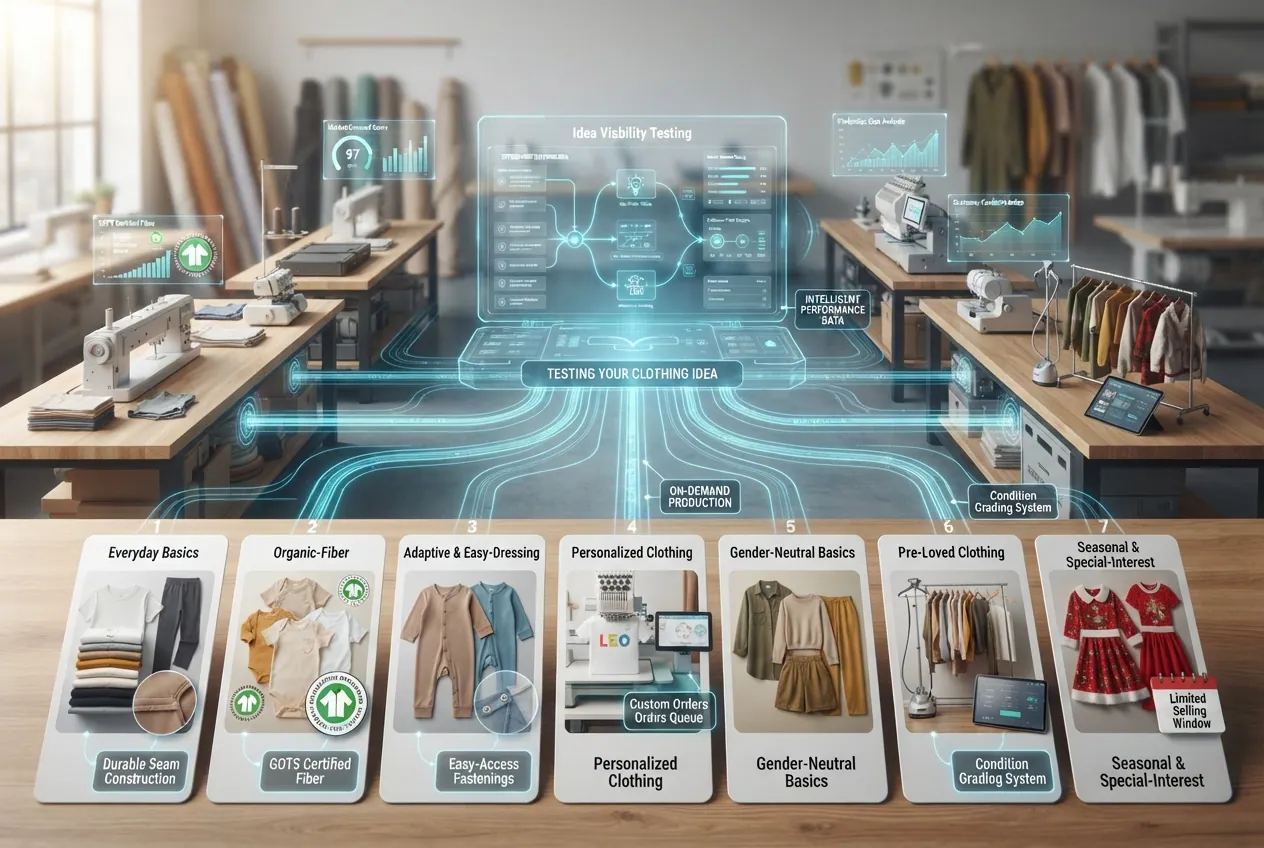
A good clothing idea solves a clear customer need. Consider these seven options, then choose the one that best matches your skills, resources, and potential buyers.
1. Everyday Basics and Durable Children’s Clothing
Parents regularly need T-shirts, leggings, pajamas, shorts, sweatshirts, and other everyday garments. A brand can focus on simple designs, comfortable fits, useful colors, and clothes that are easy to wash.
Your difference could be better size information, practical multipacks, consistent quality, or designs that work across several outfits.
The challenge is competition. Basic clothing is widely available, so you need a clear reason for customers to choose your products instead of a familiar store brand.
2. Organic-Fiber and Material-Focused Clothing
Some customers look for clothing made with particular fibers or produced under specific material standards. You could focus on documented organic cotton products, simple baby basics, or garments with clear information about fabric and care.
Start by checking whether you can obtain the right materials at a price your customers will accept. Request product specifications and any relevant certification documents from suppliers.
Avoid promising that a material is automatically chemical-free, hypoallergenic, or medically safer. Such claims need suitable evidence. Bamboo-derived rayon, for example, should be described accurately rather than marketed as natural bamboo fiber without qualification.
3. Adaptive and Easy-Dressing Clothing
Adaptive clothing is designed to make dressing easier for people with particular needs. Depending on the product and customer, useful features may include wider openings, carefully placed closures, easy-access fastenings, or seams designed with comfort in mind.
This niche requires thoughtful design. Talk with intended users or caregivers, understand their actual challenges, and test garments with appropriate feedback before producing a collection.
The opportunity lies in addressing a specific need, not simply adding unusual features to ordinary clothing.
4. Personalized Clothing and Gift Items
Personalized garments can include embroidered names, milestone outfits, birthday shirts, holiday clothing, and coordinated family designs.
This model may suit entrepreneurs who want to begin with a small product range. Depending on your equipment and supplier, you can create products after customers place orders rather than holding every possible name or design in stock.
However, personalization adds work. Check spelling, garment sizes, production time, and the cost of mistakes. Personalized orders can also be harder to resell when customers return them.
5. Gender-Neutral Mix-and-Match Basics
A gender-neutral clothing line can focus on colors, patterns, and designs that work across different outfits without relying on traditional gender categories.
Earthy colors, simple prints, comfortable basics, and coordinated collections are possible approaches. Some families may also value clothing that can be passed between siblings.
Do not assume every customer wants the same style. Test a small set of designs and compare actual buying interest before expanding the collection.
6. Pre-Loved Clothing, Resale, and Rental Models
You do not have to manufacture new clothes to enter the children’s clothing market. A resale business can offer carefully selected secondhand garments, while a rental model can provide clothing for temporary needs such as special events.
These approaches may interest families who want to control spending or reuse clothing.
The trade-off is operational work. You must check garment condition, manage sizes, clean items where appropriate, photograph actual products, and explain wear accurately. Rental businesses also need a clear system for deposits, late returns, damage, and cleaning.
7. Seasonal, Occasion, and Special-Interest Clothing
You could focus on holiday outfits, birthday clothing, family events, school celebrations, or a particular design theme.
A focused collection can make your marketing easier because customers understand what you sell. However, seasonal products may have a short selling window. Unsold holiday clothing can tie up cash after the event has passed.
Start with limited designs and quantities. Expand when customer orders give you a stronger reason to do so.
Choose Your Target Customer Before Designing Products
A clothing idea becomes easier to plan when you know who will buy it and why.
Begin with an age group, such as newborns, toddlers, preschool children, or school-age children. Then narrow your focus further. For example, a brand might serve parents looking for durable toddler basics or gift buyers searching for personalized newborn outfits.
Research competing brands and products. Look at their size ranges, prices, reviews, materials, product photos, and delivery promises. Read customer reviews for repeated complaints about fit, fabric, washing, or sizing.
These complaints can help you identify a possible opportunity, but they do not prove that customers will buy your version.
Write a simple customer statement:
“My clothing line helps [type of buyer] find [type of clothing] that offers [specific benefit].”
For example, imagine a brand serving parents who want simple toddler clothes with clear size information and easy-care fabrics. This is a starting hypothesis, not a proven business opportunity.
Next, speak with potential buyers, ask about their current choices, and test a few product ideas. Record what people say, but pay particular attention to actions such as sign-ups, purchase requests, and completed orders.
Choose a Production Model That Fits Your Budget
Your production method affects startup spending, workload, product control, and the risk of unsold inventory. Compare the options before choosing a supplier.
| Production model | Main advantage | Main trade-off | Suitable starting situation |
| Print-on-demand | Products are made after orders arrive; bulk inventory may be unnecessary. | Per-item costs can be higher, and garment choices are limited by the supplier. | Testing printed designs with limited inventory risk |
| Handmade or made-to-order | Greater control over customization and small runs | Production takes time and may limit order volume. | Small collections, custom garments, or sewing-based businesses |
| Private label | Existing garments can be sold under your brand, subject to supplier terms | Less control over the original design; minimum quantities may apply. | Entrepreneurs who want to focus on branding and selling |
| Custom manufacturing | Greater control over patterns, construction, materials, and fit | Samples, development costs, production payments, and unsold stock can require substantial capital. | Brands with clearer designs and evidence of demand |
Print-on-demand
With print-on-demand, a supplier produces an item after a customer orders it. Some providers also handle shipping to the customer.
This can reduce the need to buy stock in advance, but it does not make the business free to operate. You may still pay for samples, product production, shipping, a selling platform, marketing, and any optional tools.
For example, Printify’s official pricing page lists a Free plan at $0 per month and a Premium plan at $39 per month or $24.99 per month when billed annually. These are provider plan prices, not the total cost of running a clothing brand. Check the official Printify pricing page for current terms.
Handmade or made-to-order clothing
This model can work when you have sewing skills, access to a reliable maker, or a product that benefits from customization.
You can avoid holding large quantities of finished goods, but you still need materials and time. Before accepting many orders, calculate how long each item takes to make and whether customers will pay enough to cover that work.
Private label and custom manufacturing
Private-label products can help you establish a brand without developing every garment from the beginning. Custom manufacturing offers greater design control but usually requires more planning.
Ask manufacturers about minimum order quantities, sample costs, size options, production lead times, payment terms, labeling, and quality checks. Get the important terms in writing.
Before committing to a large order, approve a physical sample and confirm the product’s applicable safety and labeling requirements. A low quoted price is not useful if the finished garment fails quality checks or cannot be sold as planned.
Validate Demand Before Ordering Inventory
Demand validation means checking whether real customers are interested in your proposed products before you invest heavily.
Start with inexpensive tests.
First, research competitors and note their product range, prices, customer complaints, and the benefits they emphasize. Look for gaps you can realistically address rather than assuming a competitor’s popularity guarantees demand for your brand.
Next, prepare a small selection of designs. These might be digital mockups for early feedback or physical samples for a more realistic test. Show them to people who match your intended customer group.
You can also create a simple landing page, collect email sign-ups, or publish product demonstrations on suitable social channels. If you use preorders, make delivery dates, refund terms, and any production conditions clear before accepting payment.
Track actions instead of relying only on compliments. Record how many people visit the page, ask about sizes, join a list, request a price, or place an order.
Set your own decision rules before the test begins. For example, you might decide to revise a design if intended buyers repeatedly object to its fit or price. If interest is weak, test a different benefit or customer group before ordering more products.
Founder stories can provide ideas, but their outcomes are not reliable forecasts for a new business. The Shopify-published Little Sleepies founder interview describes that company’s particular launch and growth. It should be treated as an example of one business, not proof that another children’s clothing brand will see the same demand.
Design Your First Collection and Work With Suppliers
Keep your first collection focused. Too many designs, colors, and sizes create more products to develop, price, photograph, store, and track.
Choose a small number of products that fit your main customer need. Decide on the intended use, material, size range, color options, and quality standard before requesting production quotes.
Prepare a tech pack
A tech pack is a document that explains how a garment should be made. Depending on the product, it may include:
- Technical drawings or design references.
- Measurements and size specifications.
- Fabric composition and weight.
- Stitching, closures, trims, and construction details.
- Color references, labels, and packaging requirements.
- Quality standards and sample approval notes.
Clear specifications reduce the chance of receiving a garment that differs from your design.
Check samples before approving production
Inspect the sample for fit, stitching, fabric feel, seams, closures, loose components, and general workmanship. Check the garment after appropriate washing to see whether the fabric shrinks, the color changes, or the shape becomes distorted.
For children’s products, also confirm that the design and components meet the applicable safety requirements. Ordinary appearance checks do not replace required testing or certification.
Before placing an order, confirm:
- The total price and what it includes.
- Minimum quantities by style, color, and size.
- Sample charges and any tooling or setup costs.
- Production and shipping timelines.
- Payment dates and quality-dispute procedures.
- Who supplies labels and required product information.
If the sample fails, explain the problem in writing and request a corrected sample. Do not approve a large production run simply because money has already been spent on development.
How Much Does It Cost to Start a Children’s Clothing Line?
There is no single reliable startup figure for every children’s clothing brand. A print-on-demand seller, a home-based maker, and a business ordering custom-manufactured inventory have very different financial needs.
Plan for these cost groups.
Product development: Design work, patterns, tech packs, prototypes, samples, and any required adjustments.
Production: Garment manufacturing or print-on-demand charges, fabric, trims, printing, and applicable testing.
Inventory and fulfilment: Initial stock, freight, storage, packaging, postage, and order handling.
Selling tools: Website or marketplace charges, payment processing, domain registration, and any paid business software.
Marketing: Product photography, sample products for promotion, content creation, paid advertising, and customer outreach.
Business and compliance costs: Applicable registration, insurance, label preparation, testing, and professional advice.
Some expenses occur once; others repeat every month or with every sale.
For example, Etsy’s published fee schedule lists a $0.20 listing fee and a 6.5% transaction fee. U.S. payment processing is listed separately at 3% plus $0.25, subject to the applicable terms. Additional charges or conditions may apply. Check the official Etsy fees page before building your budget.
These platform prices do not tell you how much a complete clothing line will cost. Your manufacturer, product type, sales channel, and operating choices determine the larger picture.
Create a simple budget with three columns: the amount needed before launch, the amount needed for each order, and ongoing monthly expenses. Add a reserve for unexpected costs and delayed sales.
If a manufacturing order would use most of your available cash, consider a smaller test, made-to-order production, or a lower-inventory model. Spending more does not automatically provide better evidence that customers want your products.
Set Prices and Protect Your Cash Flow
A product’s production cost is only one part of its selling cost. You also need to account for packaging, shipping, platform fees, payment processing, returns, marketing, and general business expenses.
Gross margin is the share of sales revenue left after deducting the direct cost of the product sold. It is not the same as final profit, because many other business expenses may remain.
Consider this hypothetical example. Suppose a customer places a $24 order, and the following amounts apply:
| Item | Example amount |
| Order revenue | $24.00 |
| Garment production | $9.00 |
| Shipping paid by the seller | $4.00 |
| Packaging | $0.75 |
| Marketplace transaction fee at 6.5% | $1.56 |
| Payment processing at 3% + $0.25 | $0.97 |
| Listing fee | $0.20 |
| Amount left before other costs | $7.52 |
This illustration uses the cited Etsy fee rates and assumes the percentage fees apply to a $24 fee basis. Actual fee calculations depend on the order, including any shipping charged to the buyer, and the applicable platform terms. The example excludes advertising, labor, returns, monthly expenses, and taxes.
The remaining $7.52 is therefore not guaranteed profit. It shows why a product that looks profitable when compared only with its production cost may leave much less money than expected.
Cash flow matters too. A manufacturer may require a deposit or full payment before finished clothing reaches your store. If inventory sells slowly, the money remains tied up while rent, software, shipping, and other bills continue.
Update your cost calculation whenever a supplier changes prices or you discover a new expense. If your selling price cannot cover the costs at a realistic sales volume, revise the product, production arrangement, or price before increasing inventory.
Understand U.S. Business, Labeling, and Children’s Product Safety Requirements

A children’s clothing business needs more than an attractive brand name. You should check both ordinary business requirements and the rules that apply to the products themselves.
Choose a business structure and check local rules
An LLC is not automatically required for every clothing line. Some businesses begin as sole proprietorships, while others choose an LLC or another structure after weighing liability, taxes, administration, and growth plans.
The right choice depends on your circumstances and location. The U.S. Small Business Administration’s launch guidance explains business structures, registration, permits, tax IDs, and related startup steps.
Check the requirements for the state and locality where you will operate. An EIN, or Employer Identification Number, is a federal tax identification number for eligible business purposes; it does not replace state registration, permits, or other applicable duties. The IRS provides guidance on how to obtain an EIN.
Check clothing labels and care instructions
U.S. textile and apparel rules can require information such as fiber content, country of origin, and the responsible business identity. Applicable clothing also needs care instructions under federal care-labeling rules, subject to the relevant requirements and exemptions.
Review the Federal Trade Commission’s textile and wool labeling guide and care-labeling rule.
Descriptions on your website should agree with the product’s actual materials. If you advertise organic, sustainable, or other environmental benefits, keep appropriate supporting documentation. The FTC’s environmental marketing guidance explains why environmental claims need suitable support.
Check children’s product safety before production
Children’s clothing can be subject to federal safety rules involving flammability, certain components, tracking labels, and other product-specific requirements.
Depending on the garment and its intended use, relevant requirements may include general wearing-apparel flammability standards, more specific children’s sleepwear standards, and restrictions on drawstrings in certain children’s upper outerwear.
Some children’s products subject to applicable rules require third-party testing and a Children’s Product Certificate (CPC). The exact duties depend on the product and the rules that apply; do not assume that every garment has identical testing or certification requirements.
Start with the CPSC’s Children’s Product Certificate guidance, tracking-label guidance, and information on children’s sleepwear.
Before approving production, verify the actual requirements for your garment and age group. Ask the manufacturer for relevant test reports and documents, but do not assume that a supplier’s claims alone establish compliance. Confirm what applies to your product with the relevant official guidance or an appropriate product-compliance specialist.
If you import clothing into the United States, check the current CPSC certificate-filing rules as well as customs requirements. The CPSC announced implementation of mandatory eFiling for covered certificates of compliance beginning July 8, 2026, with applicability depending on the product and entry requirements. See the official CPSC announcement.
These checks belong in your product-development plan, not just in the week before launch.
Set Up Your Online Store and Market the Brand
Choose your sales channel based on your products, customers, workload, and budget.
A marketplace may offer access to people already searching for products, but its fees, policies, and restrictions affect how you operate. A dedicated online store gives you more control over your presentation, but you need a plan to bring potential buyers to it.
Compare total costs and read current terms before choosing. A lower monthly platform charge does not necessarily mean lower total selling costs.
Make product pages useful
Parents need enough information to make confident buying decisions. Include:
- Clear photos showing the garment from useful angles.
- A size chart with measurements, not just age labels.
- Accurate fabric and care details.
- Information about closures and special features.
- Realistic processing and delivery expectations.
- A clear returns and exchange policy.
For children’s clothing, accurate sizing and fabric information are especially useful because customers often cannot inspect a garment before buying.
Market to the right buyers
Use product demonstrations, short videos, useful styling ideas, email updates, and relevant social media content to explain what makes your products useful.
You can also consider partnerships with suitable parenting creators or gift-focused businesses. Start small and track the results. Look at which content brings relevant visitors, product questions, email sign-ups, or orders.
Do not spend heavily on advertising before you understand your product costs and the customers you want to reach. More traffic will not fix a product that is poorly priced or does not meet a clear customer need.
Common Mistakes and a Practical Launch Checklist
New clothing brands can make avoidable mistakes when they move too quickly from an idea to a large production order.
Watch for these problems:
- Choosing too broad a niche: Trying to serve every age group and style can make the brand hard to explain.
- Ordering too much stock: A large collection ties up cash before demand is clear.
- Skipping sample checks: Small problems with fit, stitching, or washing can become expensive across a full order.
- Underpricing products: Ignoring shipping, fees, returns, and labor can leave little money after sales.
- Making unsupported material claims: Marketing language must match the evidence and actual product.
- Ignoring compliance until launch: Applicable labels, testing, or certification may affect garment design and production costs.
Before launch, check that you can answer the following questions:
- Who is my first target customer, and what need am I addressing?
- Have I tested interest in specific products?
- Have I compared suitable production methods and written supplier terms?
- Have I inspected and approved samples?
- Do my prices account for the full costs of selling and fulfilling orders?
- Have I confirmed the applicable labeling and children’s product safety requirements?
- Are my product pages accurate, with clear size and care information?
- Can I handle orders, returns, customer questions, and expected expenses?
If several answers are still unclear, solve the important gaps before ordering more inventory.
Frequently Asked Questions
Is a children’s clothing business profitable?
It can be, but profitability depends on demand, product costs, pricing, sales volume, returns, marketing, and other operating expenses. Calculate the money left from each order after direct costs, then consider the ongoing costs the business must cover. Do not assume that strong sales automatically mean a profitable business.
How much money do you need to start a clothing line?
The amount depends on your production method, product range, samples, inventory, selling platform, and marketing plan. Print-on-demand may reduce the need for bulk inventory, while custom manufacturing usually requires more development and production spending. Build a budget around your actual choices rather than relying on one universal startup figure.
Do you need an LLC to start a children’s clothing line?
Not necessarily. An LLC is one business structure, and the right option depends on your location, risk, taxes, administrative needs, and plans. Review the relevant SBA guidance and applicable state requirements before deciding.
What safety requirements apply to children’s clothing in the United States?
Requirements depend on the garment, its intended age group and use, and applicable federal rules. They may include clothing labels, care instructions, flammability standards, tracking labels, and product-specific testing or certification. Review the relevant FTC and CPSC guidance before approving production, especially for sleepwear or garments with potentially restricted features.
Choose One Product and Test It
Starting a children’s clothing line does not require a large collection or an immediate commitment to custom manufacturing. Begin with one clear customer group, a specific clothing idea, and a small test that helps you learn whether buyers are interested.
Then check the production method, full selling costs, product quality, and applicable U.S. requirements. Once the product has stronger evidence behind it, you can make a more informed decision about expanding the collection.
Disclaimer
Business models, budgets, industries, legal requirements, and individual circumstances vary. This article provides general educational information and does not guarantee profitability or business success. Consult qualified legal, tax, or product-compliance professionals when your specific decisions require expert guidance.