
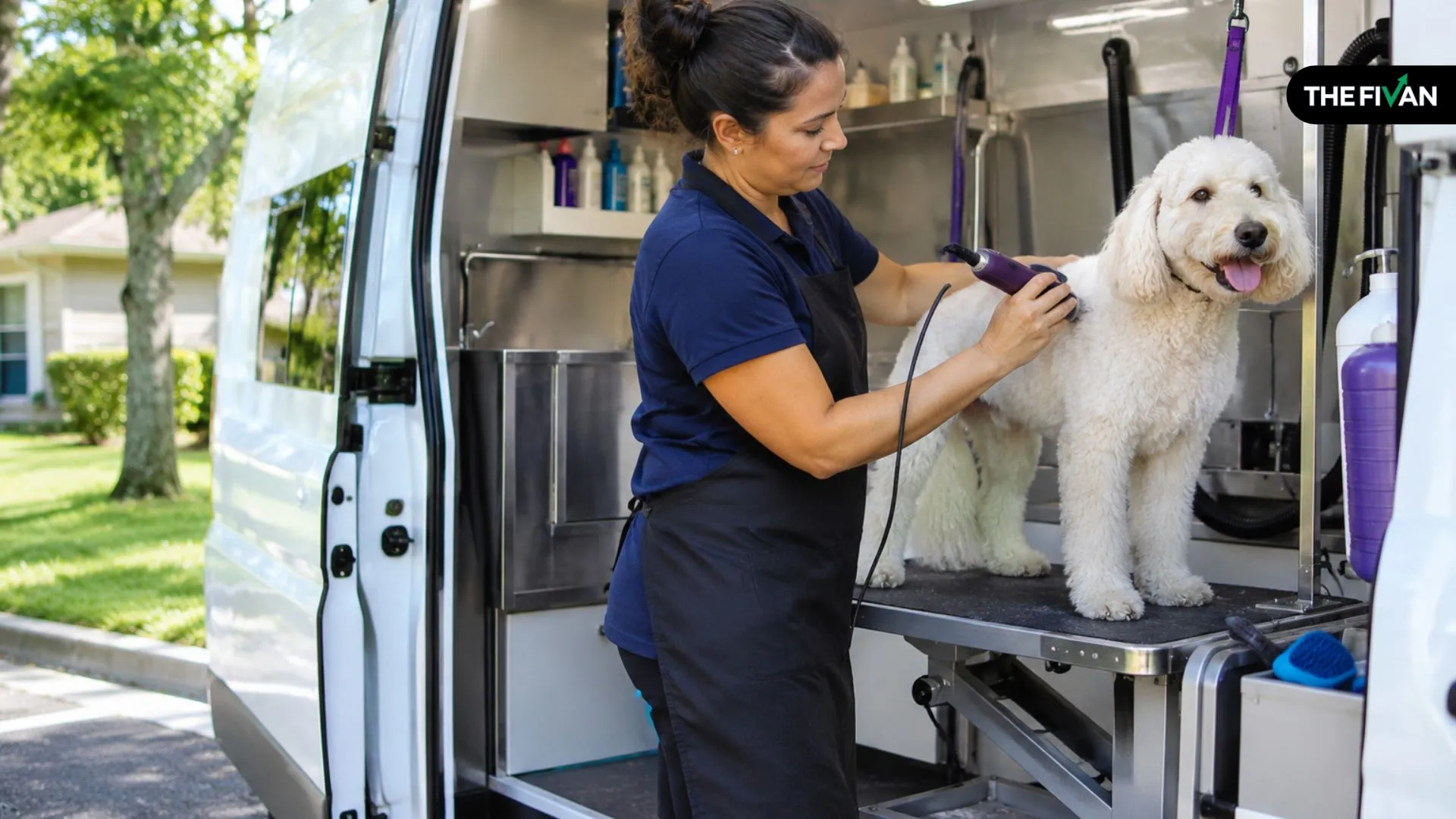
Starting a mobile pet grooming van business in the United States requires more than a van and grooming tools. You need a clear budget, a reliable way to reach customers, suitable equipment, and a plan for covering monthly expenses.
Your starting investment depends mainly on the vehicle you choose. A used or pre-fitted grooming van may cost much less than a new, professionally converted unit. Specialist business guides publish startup estimates ranging from tens of thousands of dollars to much higher amounts, while Hanvey’s current van comparisons show professionally converted models priced at roughly 116,000–135,000 before certain additional fees.
Before making a large purchase, check local demand, compare vehicle options, and calculate how many paid appointments you need each month. This approach can help you avoid taking on more debt than your business can support.
Direct Answer
A mobile pet grooming van business brings grooming services to customers at home. Starting one requires a suitable vehicle, grooming equipment, insurance, local compliance checks, working capital, and a plan for attracting paying customers.
What Does It Cost to Start a Mobile Pet Grooming Van Business?
There is no single startup cost that fits every mobile pet grooming business. Your total depends on whether you buy a used vehicle, purchase a van that already contains grooming equipment, or pay for a complete professional conversion.
You must also budget for equipment, business registration, insurance, marketing, supplies, and working capital. Working capital is the money available to pay business expenses while you build a steady customer base.
| Startup item | What to include |
| Vehicle | Purchase price, inspection, taxes, registration and delivery |
| Grooming conversion | Tub, table, water tanks, electrical system, ventilation and climate control |
| Grooming equipment | Clippers, shears, dryers, brushes and other tools |
| Business setup | Applicable registration, permits and initial professional advice |
| Insurance | Commercial auto and appropriate business liability coverage |
| Launch expenses | Branding, website, marketing and booking tools |
| Working capital | Fuel, supplies, repairs, insurance payments and other early expenses |
These categories matter because an advertised van price may not include everything you need to open for business.
For example, a used vehicle could have a lower purchase price but need repairs, new equipment, or changes to its water and electrical systems. A professional conversion may provide a more complete setup but require a much larger initial investment.
Published estimates should therefore be compared carefully. Grooming Software HQ’s startup guide discusses a broad startup estimate of 25,000–85,000, plus an illustrative working-capital allowance. That estimate should not be treated as a universal quote, particularly when compared with the current prices of complete professional conversions.
Practical rule: Obtain written vehicle and conversion quotes first. Then calculate the additional money you need to launch and operate the business. Do not commit your entire budget to buying the van.
Is a Mobile Pet Grooming Business Right for You?
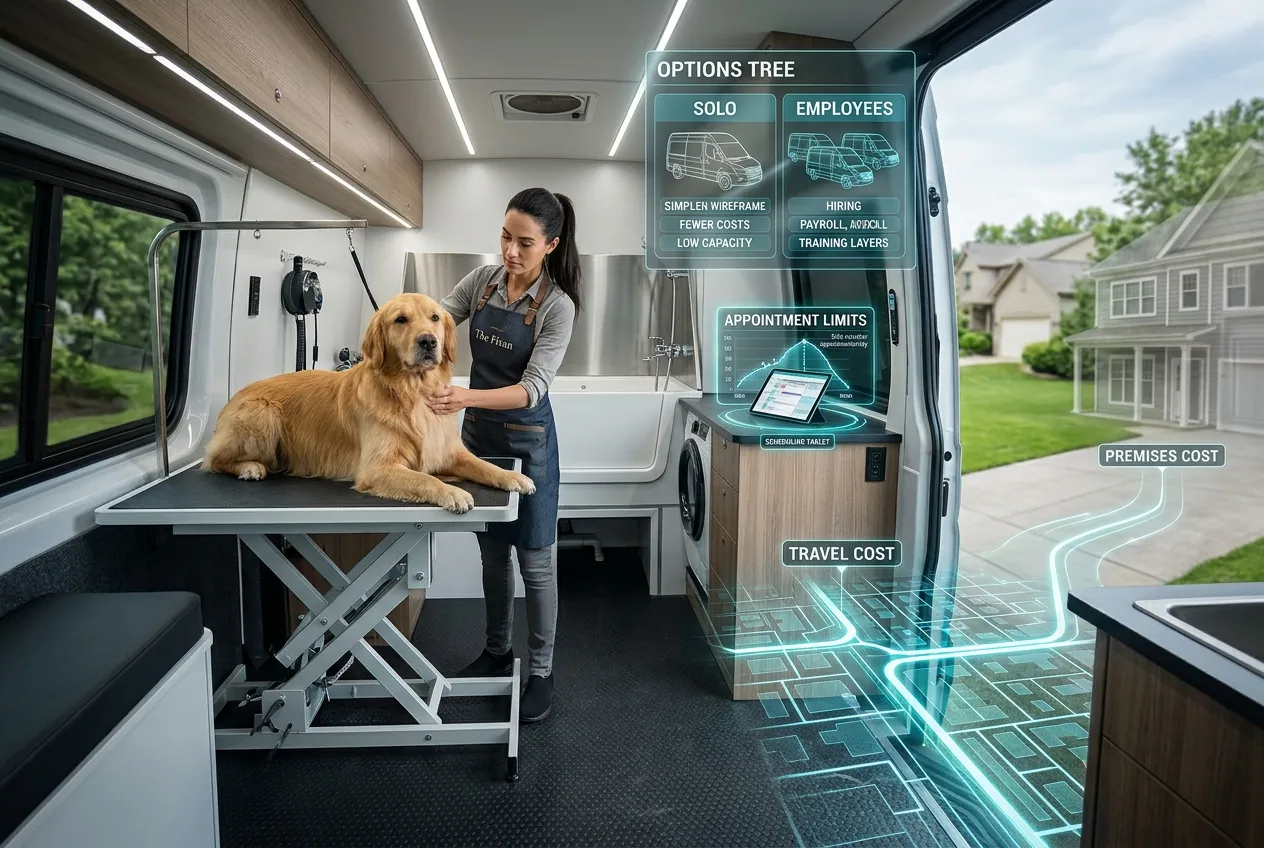
Mobile pet grooming brings grooming services directly to a customer’s home or another agreed location. Depending on your service menu, you might offer bathing, brushing, haircuts, nail trimming, de-shedding and other routine grooming services.
The main benefit is convenience. Customers do not have to drive their pets to a salon and collect them later. A mobile service may also appeal to owners who prefer individual appointments instead of a busy grooming shop.
However, convenience does not automatically produce enough profitable bookings.
What does the business require?
A mobile groomer needs suitable grooming skills, patience with animals, safe handling practices and the ability to manage a vehicle-based workplace. The business also requires scheduling, cleaning, customer communication, bookkeeping and vehicle maintenance.
If you operate alone, you will handle most of these tasks yourself. That reduces staffing costs but places a limit on how many appointments you can complete.
Compare the main options before deciding:
- Solo mobile grooming: You control the schedule and keep the staffing structure simple, but your personal working hours limit capacity.
- Mobile grooming with employees: Additional groomers may increase capacity, but hiring adds payroll, training, supervision and employment compliance duties.
- Fixed-location grooming salon: A salon avoids driving between customers but may involve rent, utilities and other premises costs.
Mobile grooming is most suitable when local customers value the convenience, your service prices cover the cost of travel, and your schedule can support consistent bookings.
How to Test Local Demand Before Buying a Van
Testing demand is one of the most useful ways to reduce your startup risk. You do not need to buy a vehicle before investigating whether customers in your intended area are willing to pay for mobile grooming.
Research competitors and local prices
Start by searching for mobile groomers and traditional grooming salons in the neighborhoods you plan to serve.
Record their advertised services, prices, booking availability, service areas and customer reviews. Look for patterns rather than relying on one competitor.
For example, several groomers may offer basic baths, but fewer may advertise specialized coat care or appointments for customers who have difficulty transporting their pets. That could suggest a service opportunity, but it does not prove that enough customers will pay for it.
Contact potential customers through permitted local research methods. Ask about their current grooming arrangements, the problems they face, and what would make them try a mobile service.
The goal is to learn about actual buying needs, not just collect positive comments.
Estimate a realistic service area
A mobile grooming business loses time and money when the van travels too far between appointments. Start by identifying a compact group of neighborhoods with suitable customer demand.
Track the estimated travel time, parking conditions and likely distance between bookings. A small service area with several appointments close together may be more useful than a much larger area with customers spread far apart.
Before buying the van, aim to establish three things:
- Potential customers exist in the area.
- Local prices could support your costs.
- A workable route can fit enough appointments into your available hours.
You may not be able to confirm demand completely before launch. Treat early customer interest as evidence to investigate, not a guarantee of future sales.
Build Your Mobile Pet Grooming Startup Budget
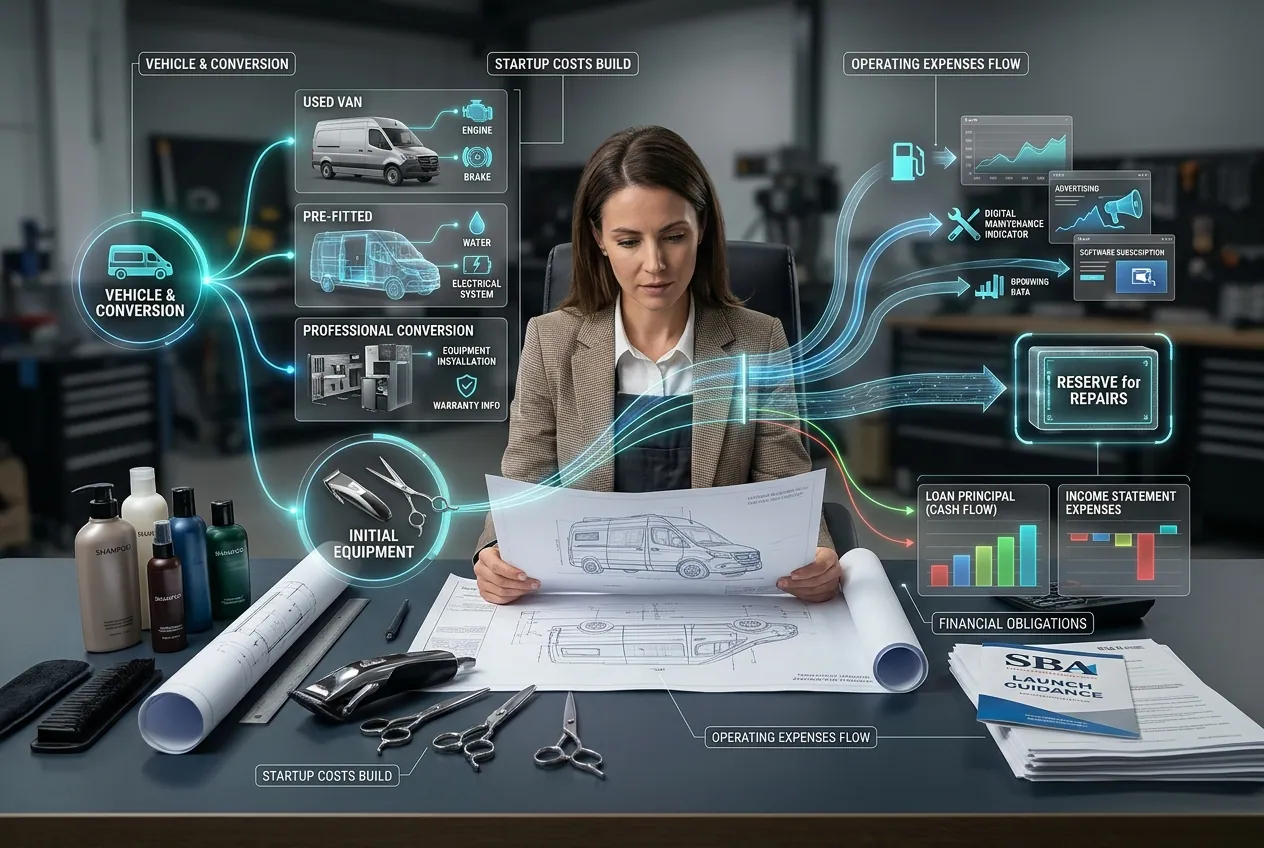
A useful business budget separates the cost of getting started from the money required to stay open.
Vehicle and conversion costs
Your first major decision is the type of vehicle and grooming setup to buy.
Used van: A used vehicle may reduce the initial purchase cost, but its condition matters. Have a suitable mechanic inspect the engine, transmission, brakes, tires and other key systems. Check whether the vehicle’s size and load capacity suit the planned conversion.
Pre-fitted grooming van: A vehicle with existing grooming equipment may shorten setup time. Inspect the water system, electrical installation, tub, table, ventilation and other installed items. Confirm which equipment works and which repairs or replacements are needed.
Professional conversion: A specialist conversion can provide a more complete work area. It may cost substantially more upfront, so compare the included equipment, installation, warranty, delivery terms and extra fees before choosing it.
Ask each seller for an itemized written quote. Check whether the price includes tax, delivery, registration-related charges, equipment installation and any required upgrades. Two vehicles with similar advertised prices may offer very different levels of readiness.
Equipment, setup and launch costs
Even a well-equipped van may need extra supplies. Depending on the services you plan to offer, your initial equipment budget may include:
- Professional clippers, blades, shears and brushes.
- Dryers, grooming tools, towels and shampoos.
- Cleaning and disinfecting products.
- Protective equipment and suitable pet-handling supplies.
- Tools or replacement parts needed for routine maintenance.
You should also budget for business setup, insurance, customer booking arrangements and launch marketing.
For US business registration, begin with the Small Business Administration’s launch guidance. It explains the main setup areas and points readers toward relevant requirements.
If your business needs an Employer Identification Number (EIN), the IRS provides a free application process. Be cautious about paying a third party solely to obtain an EIN that you could apply for directly.
A basic website, accurate service listings, clear contact information and a way to accept bookings may be enough for an initial launch. Avoid buying several paid tools before you know which features your business actually needs.
Plan for recurring monthly expenses
Your monthly budget should include both regular bills and costs that change with the number of appointments.
| Expense type | Examples |
| Regular costs | Vehicle payment, insurance, software and recurring business fees |
| Appointment-related costs | Shampoo, grooming supplies, laundry and payment-processing charges |
| Vehicle operating costs | Fuel, maintenance, tires, repairs and cleaning |
| Customer acquisition | Advertising, printed material and introductory offers |
| Financial obligations | Loan payments, taxes and planned owner compensation, where applicable |
Not every item is treated the same way in accounting. For example, loan principal payments affect cash flow but generally are not operating expenses on an income statement. Taxes and owner compensation also depend on the business structure and the way you measure profitability.
Keep a reserve for repairs and slower months. Without one, an unexpected vehicle problem can force you to cancel appointments while still facing regular bills.
Calculate Revenue, Expenses and Break-Even Sales

A mobile pet grooming business needs enough paid appointments to cover its operating costs. High sales alone do not prove that the business is profitable.
Revenue is the money customers pay you. Profit is what remains after the relevant business expenses are deducted. Cash flow tracks money entering and leaving the business over time, including payments that may not be treated as expenses in the same way.
These measures answer different questions.
Estimate monthly revenue
Suppose, as a hypothetical example, that you complete four appointments per working day, charge an average of $110 per appointment, and work 20 days per month.
Your projected monthly revenue would be:
4 appointments × $110 × 20 days = $8,800 in monthly revenue
This is an illustration, not a market average or an earnings forecast. Your actual results will depend on your prices, customer demand, appointment mix, cancellations, travel time and available working days.
You may complete fewer appointments while building your customer base. Some pets may also require longer appointments than others.
Calculate a simple break-even point
The break-even point is the level of sales required to cover a defined set of costs.
Suppose a hypothetical business charges $110 per appointment and spends $18 on variable costs for each appointment. These variable costs might include grooming supplies and other costs directly tied to the booking.
That leaves $92 per appointment to cover fixed business costs.
If the business has $3,680 in monthly fixed operating costs, the simplified calculation is:
$3,680 ÷ ($110 − $18) = 40 appointments per month
In this example, 40 appointments would cover the stated fixed and variable operating costs. It would not necessarily cover the owner’s personal income needs, income taxes, or costs excluded from the example.
Your actual break-even point should use your own quotes, loan terms and operating expenses. If you borrow money to purchase the van, include the required cash payments in your cash-flow plan. Also decide how much the business must earn to provide an acceptable level of compensation for your work.
Check the result before buying: If the required number of monthly appointments appears unrealistic for your available hours or local demand, reconsider the vehicle cost, service prices, operating area or business model.
Choose a Van, Equipment and Business Setup
After reviewing demand and your budget, compare suitable vehicles. The cheapest option may not be the least expensive to operate over time.
Used van or professional conversion?
A used van may suit an owner who has access to suitable equipment and can verify the vehicle’s condition. A professional conversion may suit an owner who wants an established setup and can support the higher upfront cost.
Compare the complete cost rather than just the purchase price. Include repairs, installation, water and electrical systems, downtime during setup, equipment condition and warranty coverage.
Before signing a purchase or financing agreement, confirm that the vehicle can legally and safely support the intended work. Review the payment obligations, interest and fees, and what could happen if customer bookings fall below expectations. Keep a backup plan for repairs or temporary loss of the vehicle.
Plan a safe grooming setup
The van should support safe movement, effective cleaning and the services you intend to offer.
Check the grooming table, tub, hot-water supply, freshwater and wastewater storage, electrical system, ventilation and temperature control. The equipment must fit the vehicle and suit its expected working load.
Plan where clean tools, used towels, grooming products and waste will be stored. You also need a reliable way to clean and disinfect work surfaces between pets.
Do not assume that a van is ready for commercial use simply because its interior looks complete. Verify that the installed systems function properly and that the arrangement supports safe working conditions.
Register the business and check local requirements
US business requirements can differ by state, county and city. Before opening, confirm which registrations, permits and tax obligations apply to your business and service area.
Use the SBA’s guidance as a starting point, then contact the relevant state and local authorities for specific requirements. Do not assume that one business license covers every municipality where you intend to operate.
Check whether your local area has special rules for mobile businesses, parking, commercial vehicle use or working at customers’ properties. If you sell taxable products in addition to grooming services, ask the appropriate tax authority whether sales-tax registration is required.
You also need insurance suited to the business. Common areas to discuss with an insurance professional include:
- Commercial auto coverage for the vehicle used for business.
- General liability for certain claims involving injury or property damage.
- Coverage for animals in your care, sometimes described through care, custody and control provisions.
- Workers’ compensation and other required coverage if you hire employees.
Ask what each policy covers and excludes. Do not assume that personal auto insurance or a general liability policy automatically covers every risk connected with a grooming van.
Important wastewater check: Grooming produces wastewater that may contain hair, dirt and cleaning products. Before operating, confirm the permitted disposal method with your local wastewater or sewer authority. Do not discharge grooming wastewater into a street storm drain unless the relevant authority has explicitly confirmed that the method is permitted. The EPA’s stormwater guidance explains why preventing polluted runoff matters, but local authorities determine the applicable disposal requirements.
Set Prices and Plan Your Daily Grooming Schedule
Your prices need to cover the service itself and the time spent traveling, preparing the workspace and cleaning between appointments.
A small dog with a straightforward coat may take much less time than a large dog with a thick or tangled coat. A bath-only appointment also differs from a full haircut.
Start by researching the prices charged by local competitors. Compare similar services, including what each price actually covers. Then estimate how much time each service takes and calculate its direct costs.
A simple pricing method is to consider:
- The service and grooming time required.
- Pet size, coat condition and handling needs.
- Supplies and payment costs.
- Travel, setup and cleanup time.
- The share of regular business expenses that each booking must help cover.
Avoid setting prices solely to match the cheapest competitor. A price that does not cover your costs may leave you busy but unable to maintain the vehicle or pay yourself adequately.
Estimate realistic daily capacity
A solo groomer should not plan a full day around grooming time alone. Driving, parking, preparing tools, cleaning, taking payments and handling delays all reduce the number of appointments that fit into the day.
Build a sample schedule using realistic service durations and travel times. Leave enough space between appointments to clean the work area and handle unexpected delays.
Track your actual results after launch. Record the time spent on each service, the distance driven and the revenue from each appointment. If travel consumes too much of the working day, tighten the service area or group appointments by neighborhood.
Scheduling software can help organize customer details, reminders and routes. For example, Time To Pet’s pricing page lists different plans with different intended uses and features. Check the current plan details before paying, and do not assume that every plan includes the route-management or payment functions you need.
Find Your First Customers and Encourage Repeat Bookings
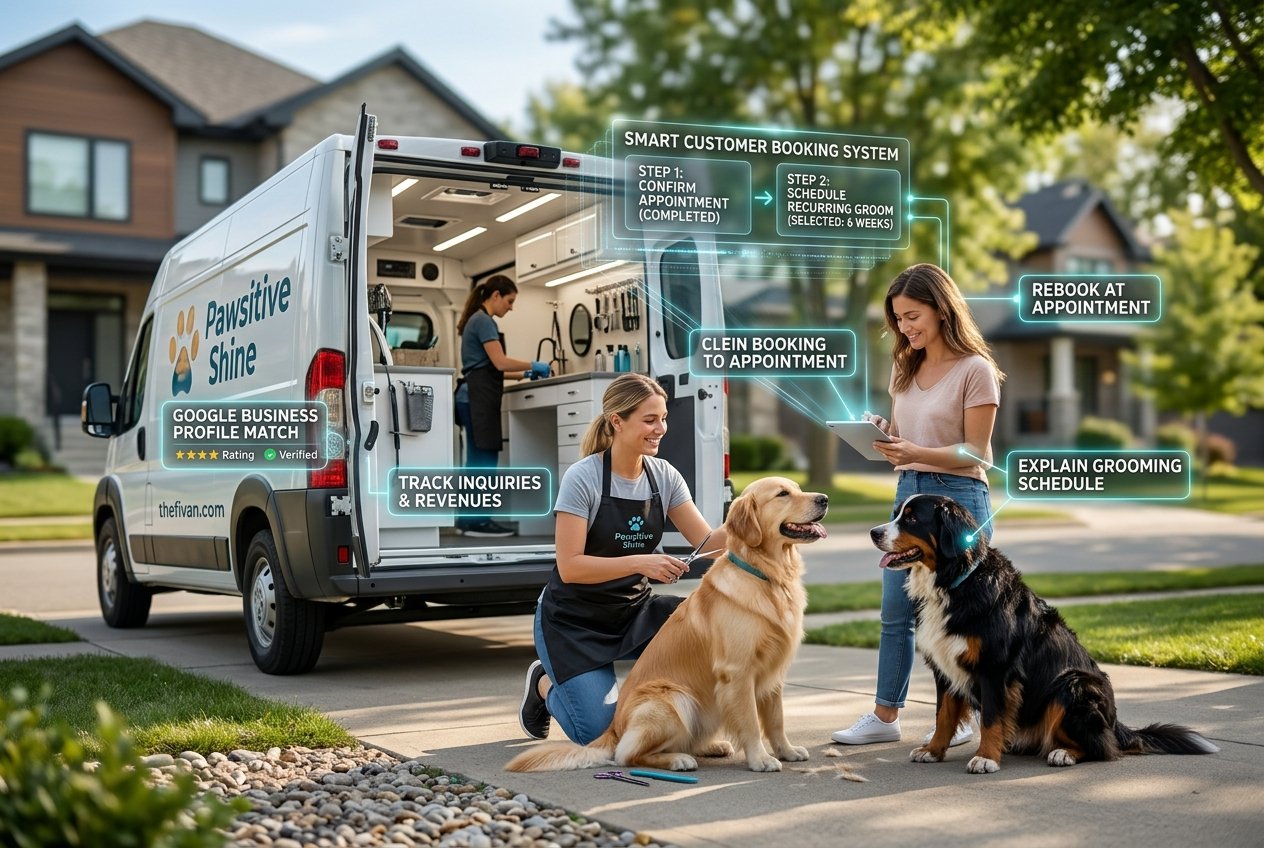
Your first marketing goal is to make it easy for suitable local customers to understand your services, trust your business and book an appointment.
Start with a clear local presence
Create a simple website or business page that explains your service area, services, contact details and booking process. Use accurate photos of your actual van and work setup when available.
A Google Business Profile may help eligible businesses appear in local search results. Follow Google’s current eligibility and representation rules, and keep your address and service-area details accurate.
You can also introduce your business through appropriate local community groups, neighborhood networks and partnerships with pet-related businesses. Where permitted, ask veterinary clinics or other pet professionals whether they accept referrals or partnership arrangements.
Do not rely on discounts alone. Introductory offers reduce the amount collected from each appointment, so check that the price still covers the service’s direct costs and contributes toward overhead.
Encourage repeat bookings
Pet grooming often involves recurring customer needs, but repeat visits are not automatic. Provide clear service information, arrive at the agreed time and communicate when delays occur.
At the end of an appointment, explain a suitable future grooming schedule when appropriate and invite the customer to rebook. Use reminders where customers have agreed to receive them.
Track four useful measures:
- Number of inquiries received.
- Number of inquiries that become paid appointments.
- Number of customers who book again.
- Marketing cost compared with the customers and revenue it brings in.
These figures help identify problems. If inquiries are high but bookings are low, review your prices, service description and booking process. If first-time customers rarely return, review service quality, follow-up communication and whether expectations were clear.
Common Mistakes That Can Put Your Startup at Risk
Several avoidable mistakes can make mobile grooming harder to sustain.
Buying the van before testing demand: A vehicle can create substantial financial obligations before you know whether customers will book. Research the local market and calculate a realistic break-even point first.
Underestimating the full setup cost: Vehicle purchase prices do not necessarily include conversion work, tools, fees, branding, insurance or starting cash. Use itemized quotes and keep a separate reserve.
Planning too many appointments: A schedule that ignores travel and cleanup may look profitable on paper but fail in practice. Build a conservative schedule and adjust it using actual operating records.
Charging too little: Low prices may attract bookings without covering your time and overhead. Review direct costs, local competition and the contribution each appointment makes toward monthly expenses.
Ignoring vehicle downtime: Repairs can cancel bookings and interrupt cash flow. Arrange preventive maintenance, keep a repair reserve and know what you will do if the van becomes unavailable.
Treating regulations as an afterthought: Insurance gaps, unsuitable parking arrangements or improper wastewater disposal can disrupt operations. Verify the rules before launch and keep relevant documents accessible.
Taking on too much debt: A large vehicle payment may be difficult to manage during slow periods. Compare purchase options, read financing terms carefully and plan for a weaker-than-expected start.
Mobile Pet Grooming Business FAQs
1. How much does it cost to start a mobile pet grooming service?
The total varies with the vehicle, conversion, equipment, launch expenses and working capital. A used or pre-fitted van may cost less than a complete professional conversion, which can exceed $100,000 before certain additional fees. Obtain itemized quotes and calculate your full launch budget rather than relying on one national estimate.
2. How profitable is a mobile pet grooming business?
Profit depends on appointment volume, service prices, travel time, operating costs and the amount of work you can complete. High revenue does not guarantee high profit. Estimate your monthly expenses, calculate break-even sales and compare the results with realistic local demand before investing.
3. Do you need a license to start a mobile pet grooming business?
The requirements depend on your state and local jurisdiction. Check business registration, applicable tax rules, mobile-service or parking permits and any other relevant local requirements. Also confirm insurance needs and approved wastewater disposal methods with the appropriate authorities.
4. Is it better to buy a used grooming van or a new conversion?
A used or pre-fitted van may reduce upfront cost, but repairs and equipment limitations can increase the total expense. A professional conversion may provide a more complete setup at a higher purchase price. Compare itemized quotes, vehicle condition, warranties, required repairs and the amount of working cash left after purchase.
5. How many dogs can one mobile groomer handle per day?
There is no universal number. Capacity depends on dog size, coat condition, service type, grooming experience, cleaning time and travel between customers. Build a schedule from realistic appointment durations, leave room for delays and revise your estimate after tracking actual work.
Your Practical Pre-Launch Checklist
Before opening your mobile pet grooming business, confirm that you have:
- Researched local competitors and tested customer interest.
- Compared suitable vehicles and obtained written purchase and conversion quotes.
- Budgeted for equipment, setup costs, insurance, launch expenses and working capital.
- Calculated monthly costs and a realistic break-even target.
- Checked applicable registrations, permits, tax obligations and parking rules.
- Confirmed commercial auto coverage, appropriate liability protection and lawful wastewater disposal.
- Planned realistic prices, routes, daily appointment capacity and a maintenance reserve.
- Prepared a local marketing plan and a clear customer booking process.
The best starting plan is the one your expected bookings can support. Begin with evidence about customer demand, build your budget around actual quotes, and avoid committing more money than the business can reasonably repay. A careful start gives you a clearer way to judge when to launch, when to adjust your prices and when expansion makes sense.
Disclaimer
Business costs, customer demand, licensing rules, taxes, and operating requirements vary by location and individual circumstances. This article provides general educational information, not a guarantee of income or business success; seek qualified legal, tax, accounting, or financing advice when your circumstances require it.