
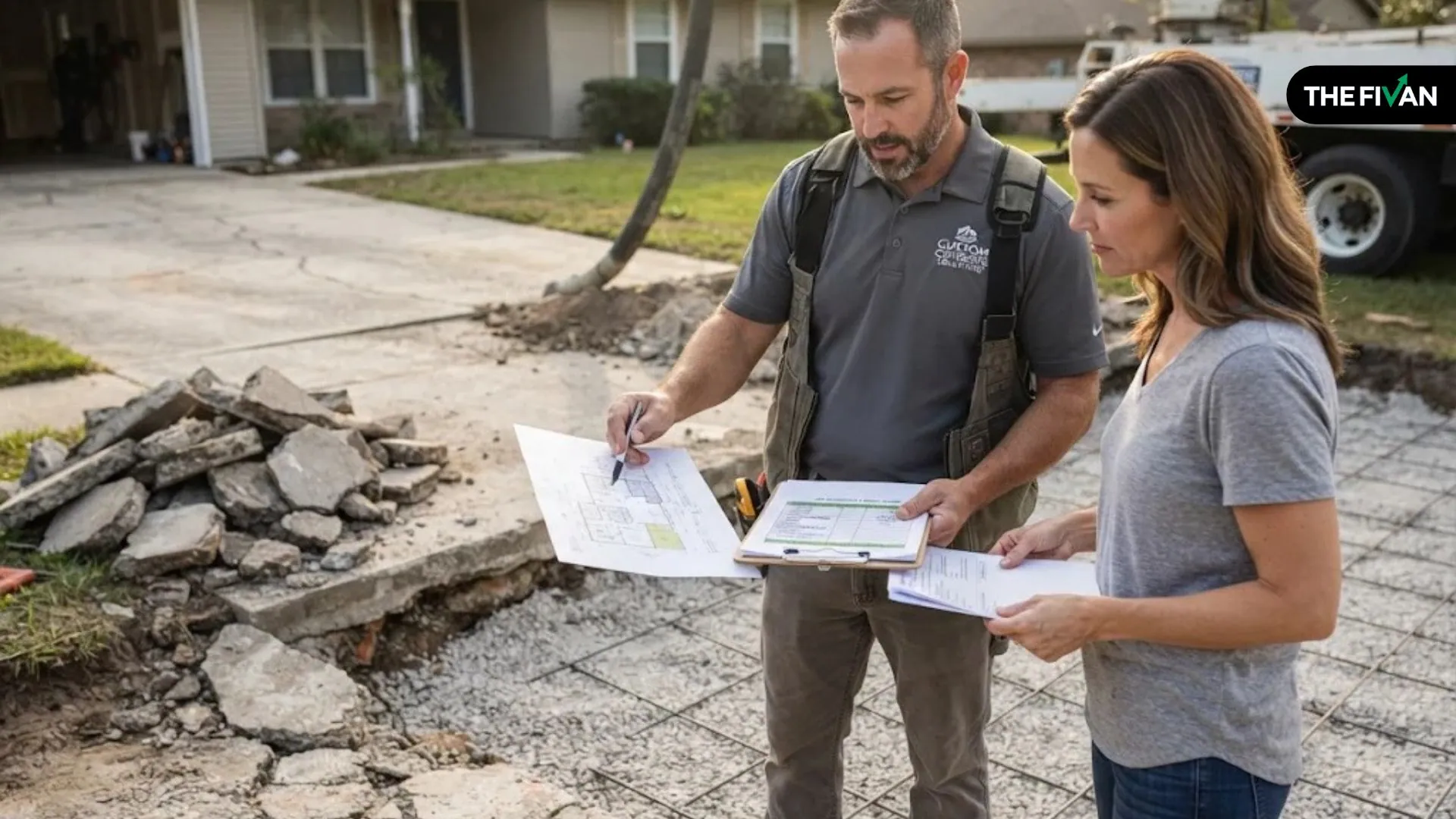
A concrete driveway replacement business can earn a profit, but the amount depends on job pricing, labor costs, equipment expenses, overhead, and how accurately the contractor estimates each project. The most useful way to judge profitability is to compare the money earned on each job with the full cost of completing it and running the business.
A published concrete flatwork benchmark from Run On CFOS reports an average gross profit margin of 22% and overhead equal to 14% of revenue for businesses earning $1 million to $5 million annually. The difference implies about 8% operating profit before interest, other non-operating items, and income taxes. These figures cover concrete flatwork broadly, not driveway replacement businesses alone, so they are useful reference points rather than guaranteed results.
To understand what your business could earn, you need to separate gross profit from operating profit, calculate the real cost of a driveway job, and make sure your prices cover both job expenses and business overhead.
Direct Answer
Concrete driveway replacement business profit margins measure how much revenue remains after costs. Gross margin excludes general overhead, while operating margin accounts for operating expenses. Actual results depend on pricing, labor, materials, equipment, and job conditions.
What Profit Margins Can a Concrete Driveway Replacement Business Expect?
There is no verified nationwide average that applies specifically to residential concrete driveway replacement companies. Available benchmarks cover broader construction or concrete flatwork businesses, while individual contractors face different labor rates, equipment costs, project sizes, and competitive conditions.
The concrete flatwork benchmark provides a useful starting point:
| Financial measure | Reported figure for businesses earning 1M–5M annually |
| Gross profit margin | 22% |
| Overhead rate | 14% |
| Implied operating profit margin | 8% |
These figures come from the published concrete flatwork benchmark. Its operating profit figure is calculated by subtracting overhead from gross margin. It is not an independently measured national average for residential driveway replacement businesses.
Business size matters, too. A contractor working with one crew and rented equipment has a different cost structure from a company with several crews, company vehicles, administrative staff, and owned machinery. Larger operations may spread some fixed costs over more revenue, but they also take on greater management responsibilities and financial commitments.
Your actual results may be above or below these reference figures.
A contractor with accurate estimates, productive crews, controlled equipment costs, and enough suitable work may perform better than one that repeatedly underprices jobs. However, higher sales alone do not guarantee higher profits. A busy company can still lose money when labor, repairs, rework, or overhead consume too much of its revenue.
The best starting point is to use industry figures as context and calculate your own margins from completed jobs.
Gross Profit, Operating Profit, and Net Profit: What’s the Difference?

Understanding these three measures helps you see where your concrete business makes money and where it loses it.
Gross profit margin
Gross profit margin measures how much revenue remains after paying the direct costs of completing a job.
Direct costs typically include concrete, gravel, reinforcement, job-specific labor, demolition, disposal, and equipment used for that project.
Use this formula:
Gross profit margin = (Revenue − Direct job costs) ÷ Revenue × 100
For example, suppose you charge $4,600 for a driveway replacement and your direct job costs are $3,400.
Your gross profit is:
$4,600 − $3,400 = $1,200
Your gross profit margin is:
$1,200 ÷ $4,600 × 100 = 26.1%
This means you retain about 26 cents of gross profit for every dollar of revenue before covering general business overhead.
Operating profit margin
Operating profit measures what remains after you subtract operating overhead from gross profit.
Overhead includes expenses that support the business rather than one specific driveway. Examples include office administration, general business insurance, marketing, vehicle insurance, accounting, and the ongoing cost of maintaining equipment.
Suppose the example job carries $650 in properly allocated overhead.
Your operating profit is:
$1,200 − $650 = $550
Your operating profit margin is:
$550 ÷ $4,600 × 100 = 12%
The company has $550 remaining from the job before interest, taxes, and other non-operating items.
Net profit
Net profit is the bottom-line income remaining after the expenses included in the business’s income statement have been deducted. Depending on the accounting measure being used, this can include interest, taxes, and other non-operating items.
This is why a strong gross margin does not automatically mean the owner takes home a large amount of money. The company may still have vehicle payments, equipment financing, administrative expenses, taxes, and other obligations.
For official business records, the IRS guide to starting a business and keeping records explains how records support income statements and expense tracking.
Markup versus profit margin
These two terms are easy to confuse.
Markup is the amount added to cost. Profit margin measures profit as a percentage of the selling price.
Suppose a job costs $1,000 and you add a 25% markup.
Your selling price becomes $1,250, leaving $250 in profit before any additional costs.
Your margin is $250 ÷ $1,250 × 100, or 20%.
A 25% markup therefore does not produce a 25% profit margin.
This difference matters when pricing concrete jobs. Always calculate the intended margin using the final selling price, and make sure the costs in your calculation include the appropriate overhead.
What Does a Concrete Driveway Replacement Job Cost?
A driveway replacement estimate should cover every expense needed to remove the old driveway, prepare the site, install the new concrete, finish the surface, and complete the job.
Some expenses change with every project. Others continue even during slow periods.
Direct job costs
The main categories include:
| Cost category | What to include |
| Concrete and materials | Ready-mix concrete, gravel, base materials, reinforcement, forms, and finishing supplies |
| Labor | Crew wages, applicable employer payroll costs, preparation, pouring, finishing, and cleanup time |
| Demolition and disposal | Breaking up old concrete, loading, hauling, and disposal charges |
| Equipment | Rental charges or appropriate job costs for saws, breakers, skid steers, compactors, and other machinery |
| Transportation | Job-related fuel, delivery, and equipment transport |
| Other direct expenses | Job-specific subcontractors, required inspections, permits where applicable, and other project expenses |
Concrete quantities deserve particular attention. A larger driveway needs more material, but thickness, base preparation, waste, site conditions, and the required design also affect the order. Use project measurements and the agreed specifications to calculate quantities, then verify the estimate against a current supplier quote.
Labor needs the same care. The hours required to remove an existing slab can differ significantly from the time needed to pour and finish the replacement. A narrow site, poor access, unexpected reinforcement, or difficult hauling conditions may slow the crew.
Do not treat the owner’s labor as free just because the owner works on the job. For internal job costing, assign a realistic labor cost to the owner’s field hours. Otherwise, the estimate may show a profit that disappears when the value of that work is recognized.
Business overhead
Overhead is what it costs to keep the company operating beyond the expenses assigned directly to a particular job.
Common examples include:
- Commercial general liability insurance and applicable vehicle insurance.
- Truck and trailer maintenance, registration, and depreciation.
- Equipment ownership costs, financing interest where applicable, and repairs.
- Office administration, accounting, software, and communications.
- Marketing, advertising, estimating, and sales activities.
Avoid counting the same expense twice. For example, if a specific equipment rental is already included as a direct job cost, do not also charge that same rental amount to overhead.
Allocate overhead consistently. You might use productive crew hours, expected job volume, or another method that fits your business and accounting system. Review the method periodically so that low-volume months or underused equipment do not remain hidden in your bids.
Example: Calculate Profit on a 20-by-20-Foot Driveway
Consider a hypothetical contractor replacing a residential driveway measuring 20 feet by 20 feet.
The area is:
20 feet × 20 feet = 400 square feet
Angi’s 2026 concrete driveway cost guide, updated April 16, 2026, lists a homeowner price estimate of 3,200–6,000 for a driveway of this size, with an average of $4,600.
That figure is a published consumer price estimate, not a contractor’s guaranteed selling price or actual cost. Local prices and the exact project scope can differ. For this illustration, assume the contractor charges $4,600.
Step 1: Estimate the direct costs
The following figures are hypothetical. They demonstrate the calculation and are not verified average costs for a US driveway.
| Job expense | Example cost |
| Concrete, base materials, and reinforcement | $1,350 |
| Crew labor and applicable payroll costs | $950 |
| Demolition, hauling, and disposal | $600 |
| Equipment and job-related fuel | $350 |
| Other direct job expenses | $150 |
| Total direct job costs | $3,400 |
The contractor must confirm these figures using actual material quotes, labor requirements, equipment costs, and disposal arrangements before bidding on a real project.
Step 2: Calculate gross profit
Subtract the direct costs from the selling price.
$4,600 − $3,400 = $1,200 gross profit
Next, divide gross profit by revenue:
$1,200 ÷ $4,600 × 100 = 26.1% gross profit margin
At this stage, the job appears profitable. However, the company has not yet covered its general overhead.
Step 3: Subtract allocated overhead
Suppose the contractor assigns $650 in business overhead to this job using a consistent allocation method.
$1,200 − $650 = $550 operating profit
The operating profit margin is:
$550 ÷ $4,600 × 100 = 12%
The result is a 26.1% gross profit margin and a 12% operating profit margin before interest, taxes, and other non-operating items.
This is an illustrative scenario, not a prediction of what a typical driveway business will earn.
Step 4: See how unexpected costs change the result
Suppose demolition reveals thicker concrete or more material that must be hauled away than the estimate allowed for. The unexpected work adds $400 to direct costs, and the contractor cannot recover that amount from the customer.
The revised operating profit becomes:
$550 − $400 = $150
The operating margin falls to:
$150 ÷ $4,600 × 100 = 3.3%
One unexpected expense has reduced operating profit from $550 to $150, even though the customer still pays the original contract price.
This is why a good estimate must address the condition of the existing driveway, access for equipment, demolition and disposal requirements, and other important assumptions before work begins.
The example also shows why a contractor should review actual job costs after completion. An estimate is useful only when the company compares it with what really happened.
How Should You Price a Driveway Replacement Job?
The goal is not simply to charge more than competitors. Your price needs to cover the cost of doing the work, a fair allocation of overhead, and an appropriate profit allowance while remaining competitive in your local market.
Build the estimate from the job scope
Start with a site inspection and the agreed specifications.
Confirm the driveway’s dimensions, existing concrete condition, access, removal requirements, drainage needs, base preparation, concrete quantities, finish, and cleanup. Ask suppliers for current quotes and check how long those quotes remain valid.
Estimate labor by task rather than relying only on a general price per square foot. Demolition, preparation, pouring, finishing, and cleanup have different time requirements.
Document important assumptions. If hidden conditions could change the work, explain how those changes will be assessed and priced under the agreement. Have clear written procedures for approving additional work before proceeding when appropriate.
Include overhead and a suitable profit allowance
First estimate the direct costs. Then add a consistent share of overhead.
Suppose total estimated job cost, including allocated overhead, is $4,050. For illustration, imagine the business chooses a 15% operating profit margin as a planning target.
The required price would be:
Selling price = Total estimated cost ÷ (1 − Target profit margin)
$4,050 ÷ (1 − 0.15) = $4,764.71
The calculated price is about $4,765, assuming the estimated costs remain accurate.
This is a pricing calculation, not a recommendation that every driveway contractor should target a 15% margin. The right target depends on the company’s cost structure, risk, capacity, and financial needs. The local market must also support the price.
If customers will not accept that price, review your costs, the work scope, production efficiency, and the types of jobs you pursue. Do not automatically cut the price without understanding what it will do to profit.
The US Small Business Administration’s break-even guidance explains how fixed costs, variable costs, and selling prices work together when calculating the sales needed to cover expenses.
Check the bid before sending it
Before submitting the quote, verify the totals and check the assumptions behind them.
Confirm that material quantities, labor hours, equipment, disposal, overhead, and the profit calculation are included. Review exclusions, customer responsibilities, payment terms, and the written process for handling changes.
A simple spreadsheet can help track these items. Record the original estimate before work starts so the final results can be compared against it.
What Can Reduce Concrete Business Profit Margins?
Several problems can reduce profit even when the original selling price looks reasonable.
Inaccurate labor estimates. If the crew takes longer than expected, labor costs increase. Record actual hours for each main task and use that information when estimating similar jobs.
Unexpected demolition and disposal. Thick concrete, reinforcement, limited access, or additional hauling can increase costs. Inspect the site carefully and document any important uncertainty before giving a firm bid.
Equipment downtime. A broken saw, compactor, or machine can cause delays, rental extensions, and extra labor. Track maintenance costs and have a practical backup plan for essential equipment.
Poor scheduling. Concrete work depends on suitable conditions, material delivery, site preparation, and crew availability. Delays may create extra labor or equipment costs, while poorly coordinated work can waste materials.
Rework and quality problems. Mistakes in preparation, finishing, drainage, or agreed specifications can require additional work. Quality control helps protect both profit and the contractor’s reputation.
Prices that stay unchanged while costs rise. Supplier prices, labor costs, fuel, and insurance can change over time. Refresh estimates when costs change rather than relying indefinitely on old bids.
Weak change-order records. If the customer requests extra work or the actual job differs from the agreed scope, unclear written records can lead to disputes or unpaid costs.
Safety must also be part of the operating plan. Cutting and breaking concrete can create respirable crystalline silica dust. Under its construction silica standard, OSHA requires covered employers to control worker exposure and follow applicable protections. The necessary controls depend on the task and applicable standard requirements; do not treat safety equipment and procedures as optional savings.
How to Improve Profit Margins Without Simply Raising Every Price
Before making major changes, find out which costs or processes are causing the largest problems. The following steps help a contractor make decisions based on records rather than guesswork.
Compare estimated costs with actual costs
For each completed driveway, record estimated and actual spending on concrete, base materials, labor, demolition, disposal, equipment, and other direct costs.
Calculate the difference for each category. If labor repeatedly exceeds estimates, investigate whether task times are too optimistic, access is difficult, or the crew needs a different schedule.
If concrete costs are consistently higher than expected, check order quantities, supplier pricing, waste, and delivery conditions.
Review a group of completed jobs before assuming that one unusual project represents the entire business.
Improve scheduling and job selection
Better coordination can reduce avoidable delays. Confirm that the site is ready, required materials are available, equipment is working, and the crew knows the agreed scope.
Also compare job types. A complicated driveway may carry more uncertainty than a straightforward replacement. That does not automatically make it a poor project, but its estimate should reflect the extra time, skills, and risk involved.
Do not accept every job simply to keep a crew busy. Consider whether the expected contribution covers its costs and whether the work fits the business’s capacity.
Review the service mix carefully
Some contractors may offer stamped finishes, coloring, sealing, drainage improvements, or other related services.
These services can create additional revenue opportunities, but they may also require specialist skills, equipment, extra labor, or subcontractors. A higher selling price does not automatically produce a higher profit margin.
Test demand and estimate the added costs before committing to new equipment or long-term expenses. Track each service separately so you can see which work actually contributes to company profit.
Protect cash flow
Profit and cash flow are different. Profit measures financial performance over a period, while cash flow tracks money entering and leaving the business.
A job may look profitable on paper while the company struggles to pay suppliers and workers because customer payments arrive late.
Track invoices, due dates, upcoming supplier payments, payroll, equipment obligations, and expected customer receipts. Use payment terms that suit the work and comply with applicable laws and contract requirements.
For an existing company, this review is often more useful than immediately buying more machinery or hiring another crew. Expansion can increase revenue, but it can also increase fixed expenses and the amount of cash needed before customers pay.
A Practical Checklist Before Accepting a Driveway Job
Use this checklist before finalizing a bid and again when reviewing the completed job.
- Measure the job: Record the dimensions, existing slab condition, site access, and agreed specifications.
- Confirm materials: Estimate concrete and base quantities, obtain current supplier quotes, and check delivery conditions.
- Estimate labor: Allow for demolition, preparation, pouring, finishing, cleanup, and applicable employer labor costs.
- Include other costs: Account for disposal, equipment, transportation, and relevant job-specific expenses.
- Allocate overhead: Include an appropriate share of business operating costs without double-counting direct expenses.
- Review risks: Document assumptions, exclusions, possible additional work, and the written change-order process.
- Check the price: Calculate gross margin and expected operating profit using consistent definitions.
- Compare actual results: After the job, record final costs and identify meaningful differences from the estimate.
The expected result is a clear record of what the job should earn and what it actually earned. If the numbers keep missing the estimate, investigate the specific cost category before changing every price or buying new equipment.
Frequently Asked Questions
What is the average profit margin for a concrete business?
A published concrete flatwork benchmark reports a 22% gross margin and 14% overhead rate for companies earning $1 million to $5 million annually, implying about 8% operating profit before interest, other non-operating items, and taxes. These figures are not a verified national average for residential driveway replacement companies. Your own costs, job mix, and business size may produce different results.
How much would a 20-by-20 concrete driveway cost?
Angi’s April 2026 cost guide lists 3,200–6,000 as the estimated homeowner price for a 20-by-20-foot concrete driveway, with an average of $4,600. Actual prices vary by location, materials, finish, labor, demolition, and site preparation. These figures represent consumer price estimates, not the contractor’s profit or cost.
What is the difference between markup and profit margin?
Markup is the amount added to cost, while profit margin is profit divided by selling price. A 25% markup on a $1,000 cost produces a $1,250 price and a 20% margin before other costs. Contractors should use the correct formula when setting prices to meet their financial targets.
How often should a concrete contractor review job costs?
Record costs as they occur and compare estimates with actual results as soon as practical after each completed job. Review the wider pattern regularly, such as monthly, to identify repeated problems with materials, crew hours, disposal, overhead, and scheduling. Keep records detailed enough to improve future estimates rather than relying on memory.
Make Your Next Pricing Decision With Real Numbers
A profitable concrete driveway replacement business starts with accurate estimates and consistent job costing. Use published benchmarks for context, but rely on your own records to understand what each project contributes after direct costs and overhead.
Start with a few recently completed jobs, compare expected and actual expenses, and identify the largest differences. Then adjust the specific estimates, work processes, or pricing decisions that need attention. This approach gives you a more useful basis for building a sustainable business than relying on one profit-margin percentage alone.
Disclaimer
This article provides general educational information, not individualized financial, legal, tax, or accounting advice. Costs, business models, local requirements, and financial results vary, and profitability is never guaranteed; consult a qualified professional when a significant business decision requires specialized guidance.