

Real estate bird dogging is a way to find potential property deals for real estate investors and earn money for useful leads. A bird dog usually researches properties, identifies possible investment opportunities, and shares the information with an investor who decides whether to pursue the deal.
You can often start this business with limited money because you do not need to buy the properties yourself. However, getting paid legally is not as simple as finding a house and collecting a fee. US state laws may restrict paid referrals and other activities involving real estate transactions. Before accepting payment, check the rules that apply to the property’s location and the work you plan to do.
The practical approach is to understand investors’ needs, find and document suitable leads, agree on payment terms in writing, and verify the legal boundaries before starting.
Direct Answer
Real estate bird dogging means finding and documenting potential property leads for investors. Payment depends on the agreement, the work performed, and applicable state law.
What Is Real Estate Bird Dogging?
In real estate, a bird dog is someone who searches for properties that might interest investors. These properties may be vacant, need repairs, have been listed for sale, or appear to offer an investment opportunity.
The bird dog shares relevant information with an investor. The investor then decides whether to investigate the property, contact the owner, make an offer, or walk away.
For example, imagine an investor who buys older houses in a particular neighborhood, renovates them, and sells them. You notice a vacant-looking house with visible maintenance problems. You record its address, check available public records, and send the information to the investor for review.
That information may be useful, but it does not prove that the owner wants to sell or that the house is a good investment. The investor must verify the facts before making a decision.
Bird dogging is attractive to beginners because it can build market knowledge and investor relationships without requiring the purchase of real estate. It can also involve unpaid research time, ongoing expenses, and inconsistent earnings.
The usual business model is straightforward:
- Find a potential property lead.
- Check whether it matches an investor’s requirements.
- Document the information accurately.
- Share the lead through an agreed process.
- Receive payment only under a lawful arrangement and the agreed terms.
The important distinction is that identifying a possible opportunity is different from representing a seller, negotiating a property transaction, or acting as a real estate broker.
Bird Dogging vs. Wholesaling: Who Signs the Contract?
Bird dogging and wholesaling both involve finding potential real estate deals, but they generally involve different responsibilities.
| Feature | Bird dogging | Real estate wholesaling |
| Main role | Finds and reports potential property leads | Generally contracts to buy a property as a principal |
| Seller purchase contract | Usually does not sign one | Typically signs one |
| Property ownership | Usually does not acquire the property | May assign a purchase contract or complete another permitted transaction structure |
| Capital needs | Often relatively low | May require earnest money, transaction funds, and other resources |
| Main income model | Agreed payment for permitted lead-generation or research services | Potential assignment fee or profit from a separate transaction |
| Main risk | Unpaid work, poor leads, and licensing issues | Contract obligations, financing, deadlines, and transaction risks |
These are general business-model differences, not universal legal classifications. State law and the actual activities performed can change the analysis.
Which model suits a beginner?
Bird dogging may suit someone who wants to learn a local market, build investor relationships, and start with limited capital.
Wholesaling may suit someone who understands purchase contracts, can meet contractual obligations, and is prepared to manage greater transaction risk. It should not be treated as a simple next step without understanding the applicable state rules.
For example, a wholesaler who signs a purchase contract may be responsible for meeting its deadlines even when another investor has not agreed to buy the contract.
A bird dog generally avoids that particular obligation by not becoming a party to the seller’s purchase agreement. However, this does not remove every legal or financial risk associated with the business.
How to Find Property Leads Investors Want

Finding a neglected property is only the first step. A useful lead must also fit an investor’s buying criteria and contain enough reliable information to justify further investigation.
1. Start with the investor’s buy box
A buy box is the set of conditions an investor uses to decide which properties to consider.
Before searching, ask the investor to define:
- Target neighborhoods or ZIP codes.
- Preferred property types, such as single-family homes or small multifamily buildings.
- Desired property condition.
- Approximate purchase-price range.
- Information needed before reviewing a lead.
- Types of properties or situations the investor does not want.
For example, one investor may want older houses that need substantial repairs. Another may only consider smaller properties in established neighborhoods.
These investors need different leads. Without clear criteria, you can spend hours collecting addresses that neither person will pursue.
Start with one manageable area. This makes it easier to learn local streets, compare property records, and understand the types of opportunities your investor values.
2. Use driving for dollars
Driving for dollars means looking for potential property leads while traveling through a target neighborhood.
You might notice signs of neglect, such as an overgrown yard, damaged exterior, visible fire damage, or apparent long-term vacancy.
Record the address and the date of your observation. If photography is lawful and does not invade someone’s privacy, a picture of the visible exterior may help document the lead.
Do not assume the owner is in financial trouble or wants to sell. A property can look neglected for many reasons, and its owner may have no interest in receiving an offer.
Stay on public roads and other places where you have permission to be. Never enter a property or cross private land without authorization.
How to check your results: After reviewing your first batch of leads, ask the investor which properties were worth further investigation and why. Use that feedback to improve your search criteria.
3. Search public property records
Local government records can help you understand basic facts about a property. Depending on the county or city, useful sources may include:
- County assessor or property appraiser records.
- County recorder or clerk records.
- Property tax information.
- Public code-enforcement records.
- Publicly available foreclosure or probate records, where relevant.
These records serve different purposes. An assessor’s record may identify a parcel and its assessed value, while recorded documents may help establish ownership history or show certain recorded interests.
Check the relevant county’s official website rather than relying entirely on third-party lists. Access, fees, available details, and update schedules vary by location.
Public records also have limits. Tax assessments are not necessarily current market values, and a public notice does not prove that a property is available for purchase.
Treat every lead as information to verify, not a confirmed deal.
4. Review existing property listings
For Sale by Owner listings, often called FSBO listings, may help you identify properties being marketed directly by owners. Other public listing sources can also reveal properties that match an investor’s criteria.
A property being listed for sale does not automatically make it an attractive investment. Its asking price, condition, location, estimated repair needs, and other factors still matter.
Do not assume that an owner with a listing wants to bypass agents or accept a quick cash offer. Use only accurate information, respect communication preferences, and follow applicable marketing and licensing rules.
5. Build relationships with investors
Investor relationships help you understand what makes a lead useful.
You can learn about local investment activity through legitimate investor networking groups, business meetups, and real estate education communities. Ask potential investors what they buy, how they evaluate leads, and what information they expect before considering a property.
Avoid promises about guaranteed deals or profits. Your role is to provide accurate information, not to claim that a property will deliver a particular return.
How to Qualify and Document a Property Lead
A raw address has limited value. A well-documented lead helps the investor decide whether further research is worthwhile.
For every lead, maintain a simple record containing:
| Field | What to record |
| Property address | Full address and, where useful, parcel identifier |
| Date found | When you identified or reviewed the property |
| Source | Public record, listing, or personal observation |
| Property details | Relevant facts verified through available sources |
| Visible condition | Factual observations, not assumptions about the owner |
| Investor fit | Why the lead may match the investor’s stated criteria |
| Verification status | What has been checked and what remains uncertain |
| Submission record | Date submitted and whether the investor acknowledged it |
Consider this hypothetical example.
You find a house that appears to need exterior repairs. Its address falls within the investor’s preferred area, and public records identify it as a property of the type the investor buys.
Your report might say that the exterior appears to need attention and that the property matches the investor’s target location. It should not claim that the owner is distressed, the house is vacant, or the property is underpriced unless reliable evidence supports those statements.
Before submitting the lead, check whether the investor already knows about the property. Duplicate submissions can create disagreements about who identified a lead first.
Keep dated records and follow the parties’ agreed submission process. Share only information you are authorized to use, and protect any personal information you collect.
A useful lead is not necessarily a property that closes. Its value begins with accurate, relevant information that allows the investor to make a better decision.
What Should a Bird Dog Agreement Include?
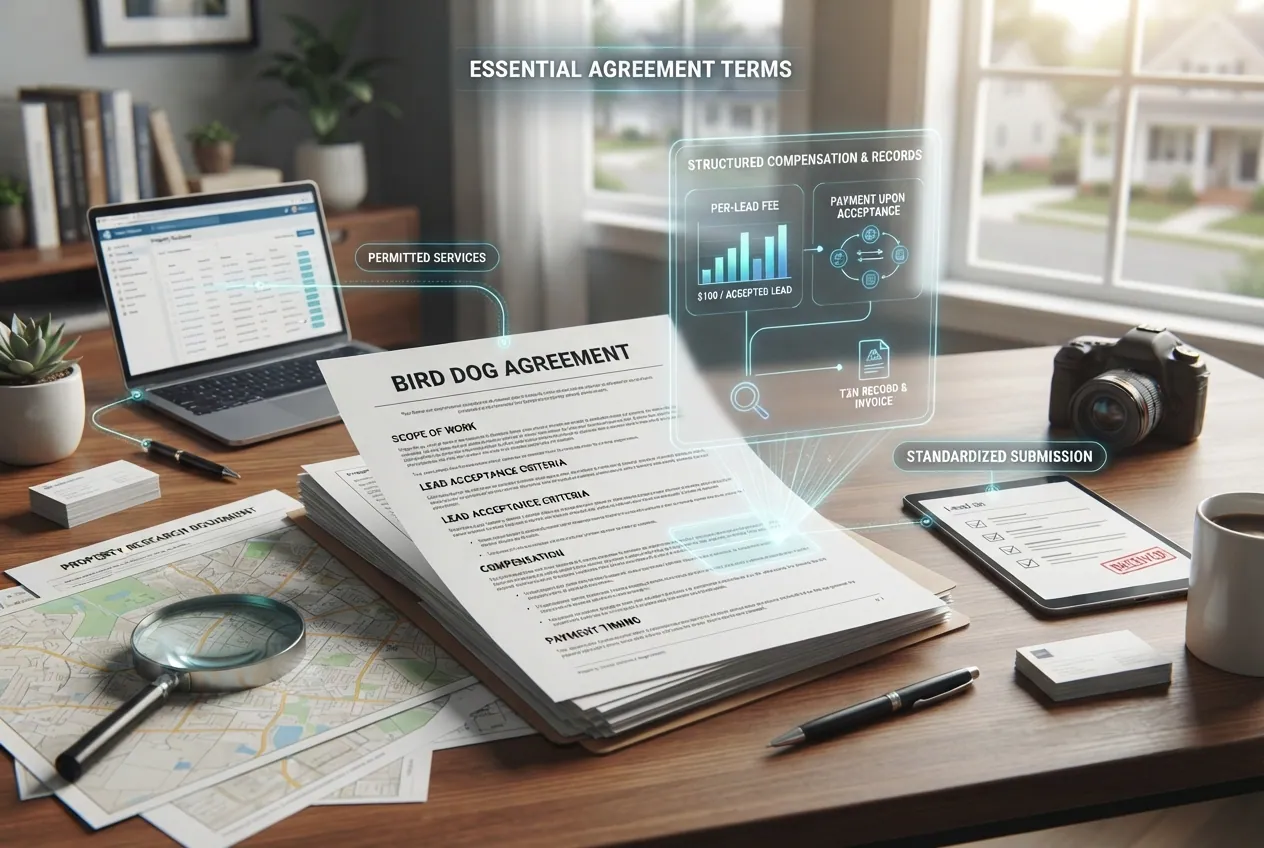
A bird dog agreement is a written arrangement between the person providing property research and the person receiving it. It can clarify the work, payment expectations, and records used to identify a submitted lead.
However, a written agreement does not automatically make the arrangement lawful. Before agreeing to any compensation, verify that your planned activities and payment structure comply with the applicable state law.
Key terms to discuss
- Scope of work
Describe the permitted services, such as collecting specified property information or delivering research reports. Do not assume that calling yourself a lead generator means every activity you perform is unregulated.
- Lead acceptance criteria
Explain what information a submission must contain and how the investor will acknowledge receipt. This can reduce disputes about whether a lead was complete or useful.
- Compensation
State the proposed amount or calculation method, when payment is due, and any conditions that apply. Do not leave the payment trigger unclear.
- Duplicate leads
Explain how the parties will handle properties already known to the investor or submitted by someone else. A dated submission record can help establish what happened.
- Payment timing and records
Identify the process for documenting accepted work, issuing invoices where appropriate, and recording payments. Do not assume a transaction closing automatically creates a lawful right to a referral fee.
- Term and termination
Clarify how long the arrangement lasts, how either party can end it, and what happens to previously submitted work.
- Applicable law and disputes
Identify the appropriate legal framework and how disagreements will be handled, subject to applicable law.
Why the payment structure matters
Suppose an investor proposes paying you only when a property closes. That arrangement may create additional uncertainty because you could perform research without receiving payment. It may also raise licensing questions, depending on the work involved and state law.
A flat fee, a per-lead fee, or an hourly research payment does not automatically solve the legal issue. The actual services and payment arrangement matter, not just the wording on an invoice.
Before signing, ask a local real estate attorney to review the proposed work and compensation structure if licensing or referral-payment rules are uncertain. A template found online should not be treated as a ready-to-sign legal document.
How Much Do Real Estate Bird Dogs Make?
There is no verified nationwide standard fee that every bird dog can expect to earn. Compensation varies with the local market, lead quality, the services provided, investor demand, and the terms of the arrangement.
Published real estate education guides discuss payments ranging from a few hundred dollars to around $1,000 in certain bird-dogging arrangements. These figures are examples from commercial sources, not proof of a national average or a guaranteed payment. See FortuneBuilders’ bird-dogging guide and Rocket Mortgage’s explanation of bird dogging.
Some articles also quote salary estimates for people described as bird dogs. Those estimates may not represent an independent business earning fees for individual leads, so they should not be treated as a reliable income forecast for someone starting out.
Understand the different payment models
- Payment for research services: Compensation is based on specified research work actually performed, where that arrangement is lawful.
- Payment for an accepted lead: The agreement defines the information that qualifies and the payment conditions. This structure is not automatically lawful in every jurisdiction.
- Payment tied to a closing: Compensation depends on a transaction being completed. This can create uncertainty about payment and may raise additional licensing concerns.
The appropriate arrangement depends on the actual work and applicable law. Do not choose a model simply because someone claims it avoids licensing rules.
A simple earnings example
Suppose a lawful research-services arrangement pays $250 per accepted report, and you complete two reports during a period.
| Calculation | Amount |
| Two accepted reports × $250 | $500 |
| Example travel and phone costs | −$75 |
| Amount remaining before taxes and other expenses | $425 |
This is a hypothetical calculation, not a typical bird-dog rate or income prediction. It assumes the compensation arrangement is lawful and payment is actually received.
It also shows why gross payments and profit are different. If you spend many hours researching, recording, and checking leads, your effective hourly earnings may be much lower than the payment initially suggests.
Track the time and costs associated with your work. If the numbers do not justify continuing, improve your targeting or consider another business model before spending more money.
Do You Need a Real Estate License to Be a Bird Dog?

There is no safe nationwide answer that says every bird dog can work without a license. The answer depends on the state, the activities performed, the compensation arrangement, and sometimes the parties involved.
A simple introduction or collection of publicly available property data may be treated differently from soliciting property owners, procuring buyers, negotiating terms, or helping move a transaction toward closing.
Consider these official examples:
- Texas: The Texas Real Estate Commission says a license holder may not pay cash to an unlicensed person for referring a potential buyer or tenant. That guidance specifically addresses referrals in the brokerage context; it should not be expanded into an unsupported claim about every research-service arrangement.
- Florida: The 2026 Florida Statutes, Section 475.01, define brokerage activity broadly, including certain compensated activities involving procuring prospects and negotiating real estate transactions. Section 475.41 also restricts the validity of contracts for compensation for covered services performed without the required licensing.
- California: The California Department of Real Estate explains that unlicensed assistants may not perform activities requiring a real estate license and that licensed acts cannot lawfully be compensated through an unlicensed person.
These examples do not establish a rule for every US state. They demonstrate why a beginner should not rely on general advice from a forum or an investor who says a particular payment structure is always allowed.
What about federal RESPA rules?
The federal Real Estate Settlement Procedures Act, or RESPA, addresses certain payments connected with referrals of settlement-service business involving federally related mortgage loans.
Under Regulation X, Section 1024.14, prohibited referral fees and unearned portions of settlement-service charges can violate the law. The regulation also recognizes specific permitted payments for actual goods, facilities, or services performed.
RESPA does not automatically make every payment for a property lead unlawful. Its application depends on the transaction and services involved. Separate state licensing rules may apply even where a particular payment does not fall under RESPA.
Practical steps before accepting payment
- Identify the state where the property is located.
- Describe exactly what the investor expects you to do.
- Determine whether the proposed payment is linked to a referral, negotiation, procuring a buyer or seller, or another regulated activity.
- Review the relevant state regulator’s current guidance and statutes.
- Ask a real estate attorney about the specific arrangement if the boundary is unclear.
Do not try to solve the problem simply by renaming a referral fee as a marketing payment or research invoice. The substance of the work and payment can matter more than the label.
Common Bird-Dogging Mistakes and How to Avoid Them
Collecting too many unqualified leads
A large spreadsheet is not proof of business value. Start with the investor’s buying criteria and track which submissions receive serious attention.
Assuming a distressed-looking home is available
Visible neglect does not establish the owner’s intentions or financial position. Describe what you actually observe and verify other details through reliable sources.
Starting work without clear payment terms
Unclear agreements make it harder to resolve disputes about duplicate leads, acceptance, and payment timing. Establish the process before committing substantial time.
Ignoring licensing requirements
Do not assume that staying away from purchase contracts eliminates every licensing concern. Confirm the permitted scope of your work and compensation arrangement first.
Entering private property without permission
Do not enter buildings, yards, or restricted areas to collect information. Use lawful observation and public records, and get permission before accessing private property.
Treating every lead as a good deal
Investors assess price, repairs, local demand, and other factors. Your report should provide accurate information, not promise profitability.
Failing to track business costs
Record time spent, transport, phone expenses, and other relevant costs. A fee that looks attractive before expenses may not justify the work.
Frequently Asked Questions About Real Estate Bird Dogging
1. How much can a real estate bird dog make?
Income varies and is not guaranteed. Commercial guides publish different fee estimates, but there is no verified nationwide standard. Actual earnings depend on lawful compensation terms, useful leads, investor demand, payment collection, and operating costs.
2. Do you need a real estate license to be a bird dog?
Not every activity involving property research is necessarily licensed brokerage, but paid referrals and other transaction-related activities can trigger state licensing requirements. Check the law where the property is located before accepting compensation.
3. What should a bird dog agreement include?
It should clarify the services, lead acceptance criteria, compensation, payment timing, duplicate-lead rules, recordkeeping, termination, and dispute handling. The agreement must also fit applicable law; it cannot make otherwise unlawful conduct legal.
4. Can you do real estate bird dogging remotely?
You can perform some research remotely using public records, permitted listings, and other reliable sources. However, remote research still requires accurate verification, investor-specific criteria, and compliance with the rules that apply to the work and payment arrangement.
Your First Bird-Dogging Steps
The most sensible way to approach bird dogging is to start small and verify the important details before committing time or money.
First, choose a local market and understand the applicable licensing boundaries. Next, speak with potential investors to learn their buying criteria. Practice documenting a small number of relevant leads, then evaluate whether the information is accurate and useful.
Before accepting payment, confirm that the work and compensation structure are lawful and put the business terms in writing. Track your time, expenses, accepted leads, and actual payments to see whether the activity makes financial sense.
Bird dogging may offer a low-capital way to learn real estate markets and build business relationships. Its value, however, depends on useful information, clear agreements, realistic expectations, and compliance with the rules that apply where you operate.
Disclaimer
This article provides general educational information, not legal, tax, financial, or investment advice. Business costs, laws, contracts, and earning potential vary by location and circumstances, and results are not guaranteed; consult a qualified real estate attorney about licensing requirements and compensation arrangements in your state.