

If your income is too high to contribute directly to a Roth IRA, you may still be able to fund one through a strategy called a backdoor Roth IRA. Vanguard supports this strategy, which involves making a nondeductible contribution to a Traditional IRA and then converting that money to a Roth IRA.
The process has two main steps, but the tax rules matter just as much as the transfer. In particular, check your existing Traditional, SEP, and SIMPLE IRA balances before converting. The IRS pro-rata rule can make part of your conversion taxable, even when your new contribution was made with after-tax money.
This Vanguard backdoor Roth IRA guide explains the 2026 contribution limits, the account setup process, potential taxes, and the records you need for tax filing. You’ll also see when this strategy may be useful and when another approach deserves a closer look.
Direct Answer
A backdoor Roth IRA lets eligible investors contribute nondeductible money to a Traditional IRA and convert it to a Roth IRA. Existing IRA balances and conversion earnings may make part of the conversion taxable.
Experience
Before converting money at Vanguard, check every Traditional, SEP, and SIMPLE IRA you own, including accounts at other providers. A quick balance check can reveal potential pro-rata tax issues before you complete a conversion.
What Is a Vanguard Backdoor Roth IRA?
A backdoor Roth IRA is a method of moving new retirement savings into a Roth IRA when your income prevents you from contributing directly. It uses two separate transactions:
- You contribute money to a Traditional IRA and treat the contribution as nondeductible, meaning you don’t claim an income-tax deduction for it.
- You convert money from the Traditional IRA to a Roth IRA.
Vanguard provides the accounts and the conversion process. The IRS determines the contribution limits and how much of the conversion is taxable.
A Roth IRA can offer tax-free growth and tax-free withdrawals in retirement when the applicable requirements are met. Unlike a Traditional IRA, a Roth IRA also does not require the original account owner to take required minimum distributions during their lifetime.
However, a backdoor Roth isn’t automatically tax-free. Existing pretax IRA money and earnings before conversion can create a tax bill. Vanguard explains these issues in its official Backdoor Roth IRA guide.
2026 Backdoor Roth IRA Limits and Eligibility
 Before opening accounts or moving money, check whether you qualify to make an IRA contribution and understand the limits for 2026.
What is the 2026 IRA contribution limit?
The IRS sets the combined 2026 contribution limit for Traditional and Roth IRAs at:
| Age | Maximum combined annual contribution |
| Under age 50 | $7,500 |
| Age 50 or older | $8,600 |
These limits are based on the IRS’s official IRA contribution guidance.
The limit applies across your Traditional and Roth IRA contributions combined, not separately to each account. For example, you generally cannot contribute $7,500 to a Traditional IRA and another $7,500 to a Roth IRA for the same year.
Your eligible taxable compensation also limits how much you can contribute. If your compensation is below the applicable annual limit, you generally cannot contribute more than your eligible compensation. Special spousal IRA rules may apply to married couples filing jointly.
A Roth conversion does not count as a new annual IRA contribution. This distinction matters because you may convert eligible IRA money without using additional contribution limit.
What are the income limits for direct Roth IRA contributions?
For 2026, the direct Roth IRA contribution phase-out ranges are:
| Filing status | Modified adjusted gross income (MAGI) |
| Single or head of household | 153,000–168,000 |
| Married filing jointly | 242,000–252,000 |
| Married filing separately, lived with spouse during the year | 0–10,000 |
MAGI means modified adjusted gross income. The IRS uses this figure, along with your filing status, to determine whether you can contribute directly to a Roth IRA and how much you can contribute.
For example, a single filer with MAGI above $168,000 generally cannot make a direct Roth IRA contribution for 2026. A married couple filing jointly generally reaches the end of its direct contribution phase-out at $252,000.
These income restrictions do not apply in the same way to Roth conversions. That is why a person with a high income may use a backdoor Roth IRA.
However, being eligible to make the conversion does not mean the conversion will be tax-free. Your contribution eligibility, existing IRA balances, and tax treatment are separate questions. See the IRS’s 2026 IRA rules in Publication 590-A.
Check Your Existing IRA Balances Before Converting
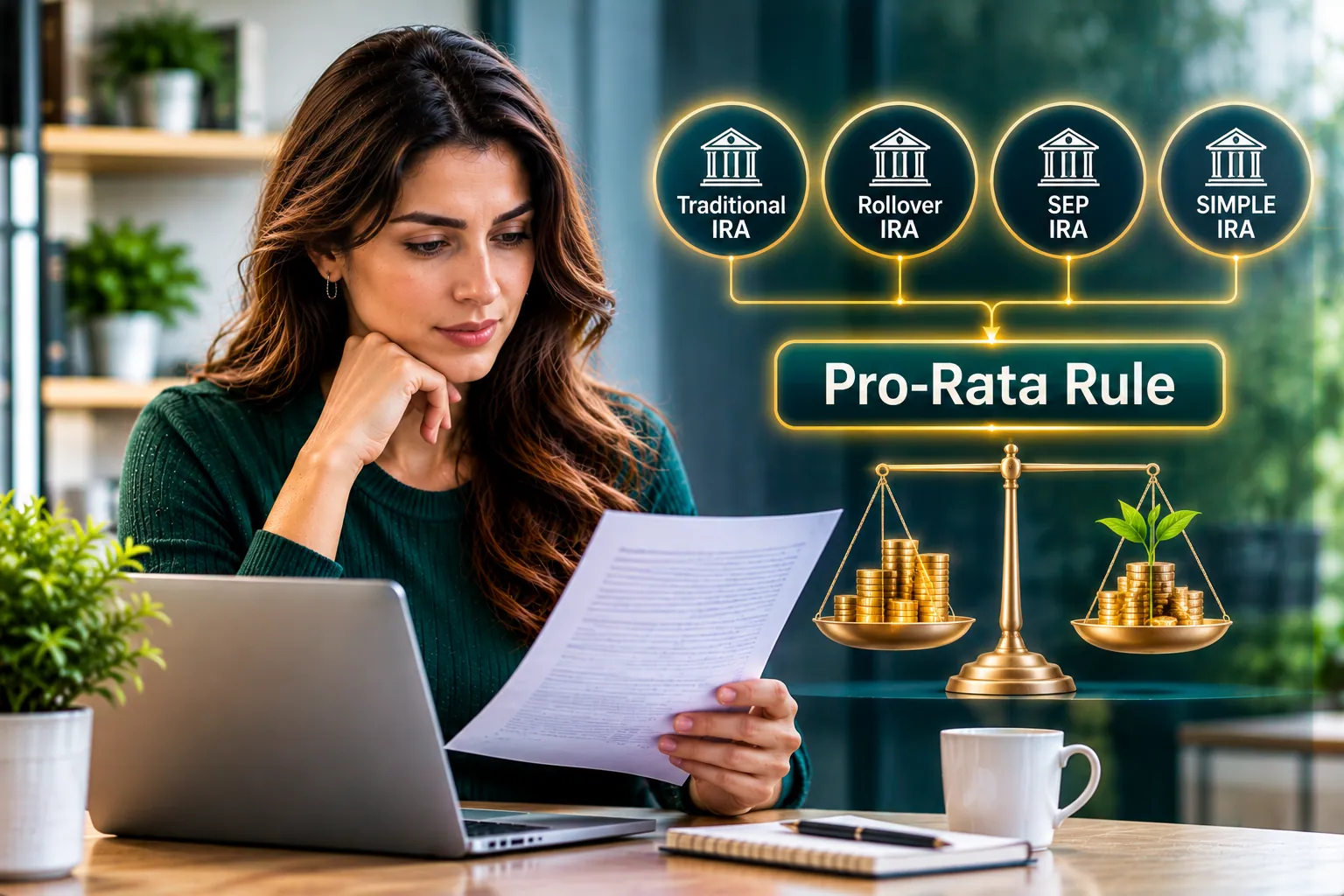 This is the most important preparation step. Before you fund a Traditional IRA at Vanguard, look for pretax money in every relevant IRA you own, including accounts at other financial institutions.
The IRS generally combines your Traditional, SEP, and SIMPLE IRA balances when applying the pro-rata rule to a Roth conversion. Your Roth IRA balance and eligible employer-plan balances are treated differently under these rules.
How does the pro-rata rule work?
The pro-rata rule means a conversion generally includes a proportional share of your pretax and after-tax IRA money. You cannot simply tell the IRS that you converted only the after-tax dollars while leaving all pretax dollars behind.
Consider two hypothetical situations.
In the first, you have no existing pretax IRA money, contribute $7,500 of nondeductible money, and convert the contribution before it earns anything. Assuming no other complicating transactions, the conversion generally creates no additional taxable income from the contribution itself.
In the second, you have $90,000 in pretax IRA money, contribute $7,500 of nondeductible money, and convert $7,500. The result is different because the IRS looks at the combined amounts under its conversion formula.
The exact taxable portion depends on the applicable year-end balances, distributions, conversions, and after-tax basis. The example later in this guide shows how this can work.
What if you have an old rollover IRA?
A rollover IRA often contains money moved from a former employer’s retirement plan. You might have forgotten about it if you changed jobs several years ago.
Before converting, check for:
- Traditional IRAs at Vanguard and other providers.
- Rollover IRAs from former employers.
- SEP IRAs used for self-employment income.
- SIMPLE IRAs connected to a small business.
If your current employer’s 401(k) accepts eligible pretax IRA rollovers, moving qualifying pretax money into that plan may be worth investigating. It can sometimes help reduce the IRA balances included in the pro-rata calculation.
But don’t move money automatically. Check your plan’s eligibility rules, investment choices, fees, and any restrictions first. A rollover can have lasting effects on how you manage your retirement savings.
If you’re unsure how your accounts interact, consider reviewing the situation with a qualified tax professional before making the conversion.
How to Do a Backdoor Roth IRA at Vanguard Step by Step
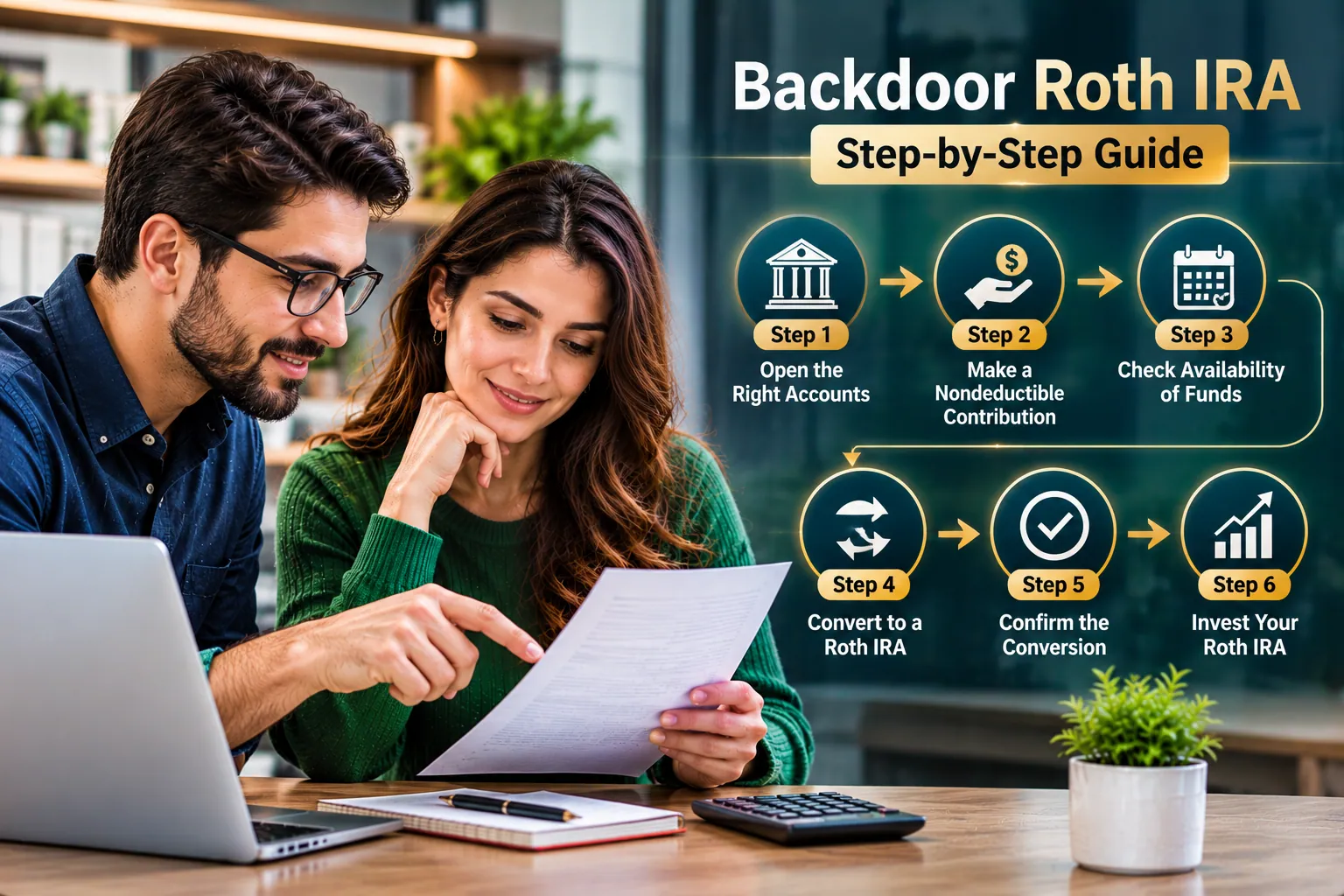 Once you’ve checked your eligibility and existing balances, you can prepare the accounts and complete the process. Vanguard’s screens may change over time, so focus on the purpose of each step rather than relying on a screenshot from an older tutorial.
Step 1: Open a Traditional IRA and a Roth IRA
You need a Traditional IRA to receive the contribution and a Roth IRA to receive the converted money.
If you already have these accounts at Vanguard, confirm that both are active and correctly registered. Otherwise, follow Vanguard’s current account-opening process.
Opening an account does not require you to make the contribution or conversion immediately. Take time to check the account details before moving money.
Step 2: Make your nondeductible Traditional IRA contribution
Transfer your contribution from your bank account or another permitted funding source into the Traditional IRA.
For 2026, the standard contribution limit is $7,500, or $8,600 if you qualify for the age-50-or-older limit. Your contributions to all Traditional and Roth IRAs must remain within the combined annual limit and your eligible taxable compensation.
If you’re making a contribution between January 1 and the tax-filing deadline in the following year, clearly select the correct tax year. For most taxpayers, a 2026 IRA contribution can be made by April 15, 2027, subject to any applicable deadline relief.
Do not claim a tax deduction for the contribution you intend to treat as nondeductible. Your tax return must reflect the contribution’s actual treatment.
Step 3: Check when the contribution is available
After funding the Traditional IRA, check Vanguard’s account status to confirm that the money is available for conversion.
The time required can vary with the funding method and applicable account restrictions. Vanguard notes that a hold of up to seven days may apply before a conversion is allowed.
You do not need to invest the money in a market fund before converting it. Some investors keep the contribution in the account’s settlement fund during this brief period to avoid unnecessary market exposure before the conversion.
Keep in mind that any interest or investment gains earned before conversion may affect the taxable amount.
Step 4: Convert the Traditional IRA money to the Roth IRA
Before submitting the conversion, review your existing IRA balances and understand the possible tax consequences. A conversion is generally permanent and cannot be reversed through recharacterization.
Sign in to Vanguard and open your Traditional IRA. Follow the current transfer or conversion process, select your Roth IRA as the destination, and choose the amount you intend to convert.
Review every detail before confirming the transaction. Make sure the destination is the correct Roth IRA and the amount matches your plan.
The interface may ask whether you want taxes withheld. Do not blindly copy a withholding choice from an online tutorial. Understand how withholding affects the amount transferred and whether it creates a separate distribution with possible tax or penalty consequences.
If the conversion could create taxable income, decide how you will pay the tax. Using money outside the IRA may allow more of the retirement balance to remain invested, but that choice depends on your cash needs and tax situation.
Vanguard’s guide to converting a Traditional IRA to a Roth IRA explains the general process and tax considerations.
Step 5: Confirm the conversion
After submitting the transaction, check Vanguard’s confirmation and both account balances.
Look for the amount removed from the Traditional IRA and the amount credited to the Roth IRA. Save the transaction confirmation with your account statements.
If the conversion does not appear as expected, check the transaction status or contact Vanguard before submitting another conversion. Sending the transaction again without checking could create an unintended duplicate.
Step 6: Invest the money in your Roth IRA
A conversion changes the tax type of the account holding the money. It does not necessarily purchase an investment.
After the converted funds arrive, review your Roth IRA and make sure the money is invested according to your own retirement plan. You might choose diversified funds or other investments suitable for your goals and risk tolerance.
Leaving the balance in cash may be appropriate temporarily, but it is different from having an invested retirement portfolio. Market investments can lose value, so choose them based on your time horizon and ability to handle losses.
How Much Tax Could You Pay on a Backdoor Roth IRA?
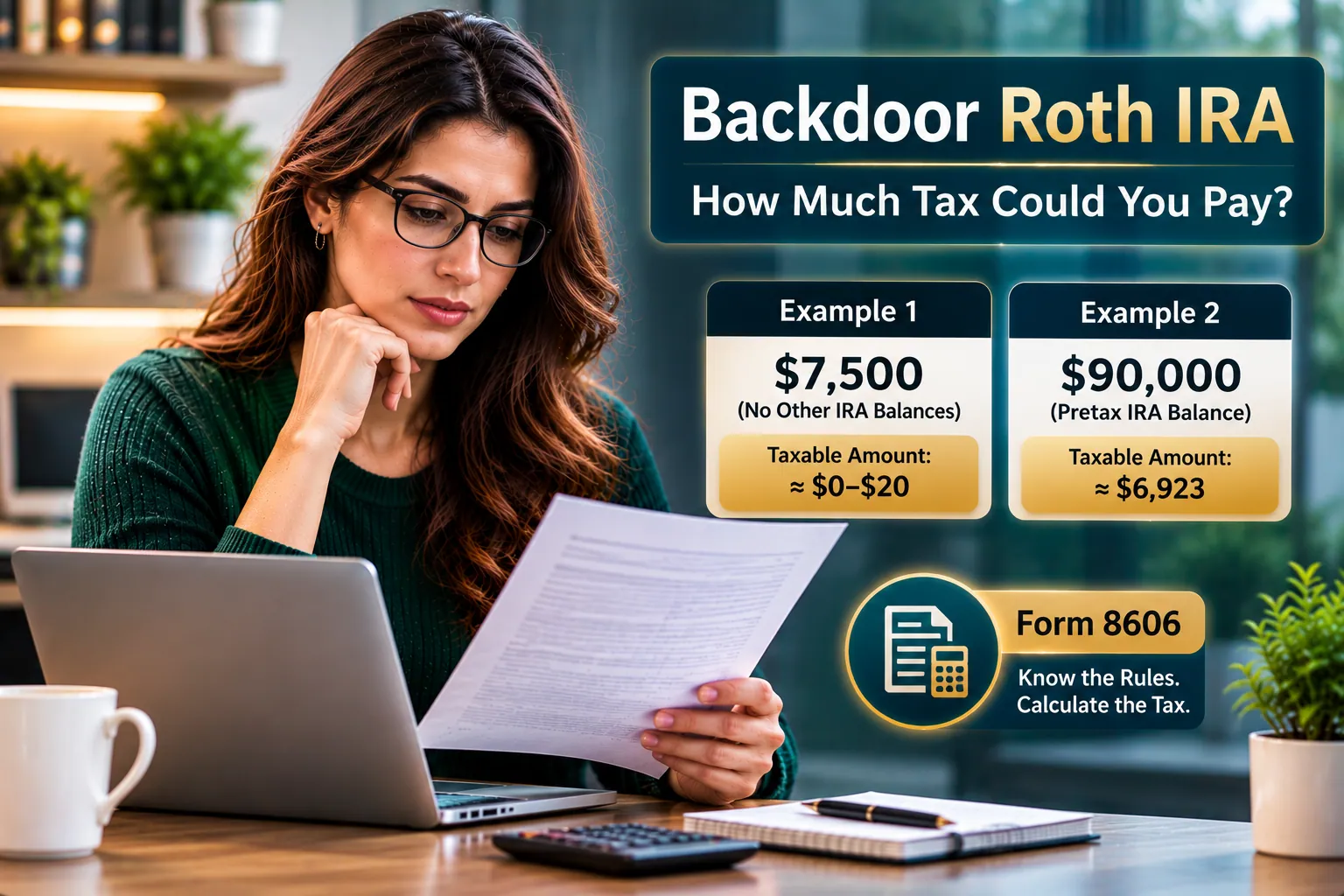 The answer depends on your after-tax IRA basis, existing pretax balances, earnings, and other transactions. There is no universal tax percentage for every backdoor Roth IRA.
The following examples are hypothetical and show how the basic rules can work. They are not estimates of an individual reader’s tax bill.
Example 1: No other pretax IRA balances
Suppose you contribute $7,500 of nondeductible money to a Traditional IRA in 2026. You have no other relevant IRA balances, and the contribution earns nothing before you convert the full $7,500 to your Roth IRA.
In this simplified case, the contribution has already been made with after-tax money. You generally should not have to pay income tax on that same $7,500 again when you convert it, provided the contribution and conversion are reported correctly and no other complicating transactions apply.
If the money earns $20 before conversion and you convert $7,520, the $20 of earnings will generally be taxable. A quick conversion can reduce the time available for earnings to accrue, but it does not guarantee that no earnings or tax will arise.
Example 2: You have $90,000 in pretax IRA money
Now suppose you have $90,000 in pretax Traditional IRA money, contribute $7,500 of nondeductible money, and convert $7,500 to a Roth IRA.
For this simplified example, assume the $90,000 remains in your Traditional IRA at year-end, your only conversion is $7,500, and you have no other relevant distributions, balances, or after-tax basis from prior years.
The calculation uses:
- Nondeductible contribution: $7,500.
- Pretax IRA balance remaining at year-end: $90,000.
- Conversion amount: $7,500.
- Total used in the simplified pro-rata calculation: $97,500.
The nontaxable proportion is approximately:
\[ \frac{\$7,500}{\$97,500}=7.69\% \]
Approximately $577 of the $7,500 conversion would be nontaxable, while about $6,923 would be taxable, subject to the assumptions above and the applicable IRS calculation.
This is why checking all your IRA balances before converting matters. The calculation is not based solely on the new contribution or the account you selected in Vanguard.
The applicable Form 8606 rules determine the actual result. If you have multiple accounts, prior nondeductible contributions, outstanding rollovers, or other IRA transactions, your calculation may differ.
What about a $100,000 Roth IRA conversion?
A $100,000 conversion is not automatically taxed at a single percentage. Some or most of the amount might be taxable, depending on how much is pretax versus after-tax basis and the other relevant facts.
The taxable amount is generally added to the income used to calculate federal income tax for the conversion year. Your filing status, other income, deductions, and state tax rules may affect the final bill.
Do not multiply the full conversion by an assumed tax rate and treat the result as a reliable estimate. Work out the taxable portion first, then apply the relevant tax rules. A large or complicated conversion may justify help from a qualified tax professional before you submit it.
How Form 8606 and Tax-Year Reporting Work
Form 8606 is the IRS form used to report nondeductible IRA contributions and calculate the taxable and nontaxable parts of certain IRA distributions and Roth conversions.
Filing it correctly matters because it records your after-tax basis. Without proper records, you may have difficulty showing that some of the money was already taxed.
Use the IRS’s official Form 8606 page and the final instructions for the tax year you are filing. IRS forms can change, so don’t rely on an older guide’s line numbers without checking the applicable version.
Keep the contribution year and conversion year separate
A contribution and a conversion can happen in different tax years.
For example, you might make a contribution designated for 2026 in early 2027, by the applicable contribution deadline, and complete the Roth conversion in 2027.
The contribution is reported according to the tax-year rules for that contribution, while the conversion is reported for the calendar year in which it actually happens. The fact that both transactions relate to the same retirement strategy does not make them one tax-year event.
Keep records that show the designated contribution year, the amount contributed, and the date and amount of the conversion.
Which tax documents should you keep?
Save your contribution confirmation, conversion confirmation, relevant year-end IRA statements, and any records of previous nondeductible contributions.
Vanguard may issue Form 1099-R to report a distribution or conversion and Form 5498 to report IRA contributions and other information. Review these documents when they become available and compare them with your own records.
Follow the applicable IRS instructions when preparing your return. If you discover that a past contribution was deducted incorrectly or Form 8606 was missed, don’t assume that a new form alone will fix every issue. Check the rules for correcting the prior return or seek qualified tax help.
Common Vanguard Backdoor Roth IRA Mistakes
A few checks can prevent avoidable confusion.
Ignoring an old IRA account: Review all relevant Traditional, SEP, and SIMPLE IRA balances before converting, including accounts at other firms.
Claiming a deduction for a nondeductible contribution: The tax return must not treat the intended after-tax contribution as deductible. Your reporting should match what you actually did.
Assuming the conversion is tax-free: Existing pretax money, conversion earnings, and other IRA transactions can change the taxable amount.
Selecting the wrong contribution year: When funding an IRA near the tax deadline, verify which year the contribution is assigned to.
Choosing withholding without understanding it: Tax withheld from a retirement account can affect how much reaches the Roth IRA and may have separate consequences. Review the transaction and plan for any tax due.
Forgetting Form 8606: Keep the required tax reporting and records, including any basis carried forward from earlier years.
Leaving the Roth IRA uninvested by mistake: Confirm the conversion and then separately review how the funds are invested.
Assuming you can undo a conversion later: A Roth conversion generally cannot be reversed through recharacterization. Check the amount, account, and tax effect before confirming it.
Backdoor Roth IRA vs. Mega Backdoor Roth
These strategies sound similar, but they use different account arrangements.
| Feature | Backdoor Roth IRA | Mega backdoor Roth |
| Main account used | Traditional IRA and Roth IRA | An eligible employer retirement plan and its permitted Roth feature |
| Source of money | Nondeductible IRA contribution | After-tax employee contributions allowed by the employer plan |
| Key requirement | IRA contribution eligibility and tax treatment | Employer plan must support the necessary contributions and Roth conversion or rollover |
| Main concern | Pro-rata rule and IRA conversion taxes | Plan limits, permitted transactions, and employer-plan rules |
A mega backdoor Roth may allow additional Roth savings for employees whose plans offer the required features. It is not available through every employer plan, and its rules are different from an ordinary backdoor Roth IRA.
Check your plan documents before assuming you can use it. If you’re simply trying to make a Roth IRA contribution at Vanguard, the standard backdoor process is the relevant starting point.
Frequently Asked Questions
Is a backdoor Roth IRA a bad idea?
Not necessarily. It may be useful for someone who cannot contribute directly to a Roth IRA and has little or no pretax money in relevant IRAs. But existing IRA balances can make part of the conversion taxable, while the contribution still uses the annual IRA limit. Compare the likely tax cost and long-term retirement benefits before proceeding.
Can I do a backdoor Roth IRA if I earn $500,000 a year?
A high income alone does not prevent you from making a Roth conversion. You must still qualify to make the underlying IRA contribution, stay within the annual contribution limit, and follow the tax rules. Existing pretax IRA balances can make the conversion taxable even when income is the reason you cannot contribute directly to a Roth IRA.
How much tax would I pay on a $100,000 Roth IRA conversion?
There is no single answer. The taxable amount depends on pretax funds, after-tax basis, other IRA transactions, total income, filing status, and applicable state rules. Calculate the taxable portion first, then determine the federal and state tax effects for the conversion year.
Does Vanguard allow backdoor Roth IRA conversions?
Yes. Vanguard describes the backdoor Roth IRA strategy and provides a process for converting Traditional IRA money to a Roth IRA. The exact online screens can change, so use Vanguard’s current instructions and review the tax consequences before confirming the conversion.
Your Final Check Before Converting
Before you begin, confirm the following:
- You are eligible to make the intended IRA contribution.
- Your combined IRA contributions stay within the 2026 limit and eligible compensation.
- You have checked all relevant Traditional, SEP, and SIMPLE IRA balances.
- You understand how the pro-rata rule and conversion earnings may affect taxes.
- You have selected the correct contribution year.
- You know which tax-year records and Form 8606 reporting apply.
- You have reviewed the conversion amount and any withholding choice.
- You will confirm the converted balance and invest it according to your plan.
A Vanguard backdoor Roth IRA can be a useful retirement-saving strategy, but it is not automatically right for every high-income investor. The safest first step is to check your IRA balances and potential tax treatment before moving money. If those checks reveal a complicated situation, resolve it before completing an irreversible conversion.
Disclaimer
This article provides general financial education, not personalized financial, investment, legal, or tax advice. Tax rules, individual circumstances, and financial needs vary, so outcomes are not guaranteed. Consult a qualified tax professional if your IRA balances or conversion tax treatment are complex.