
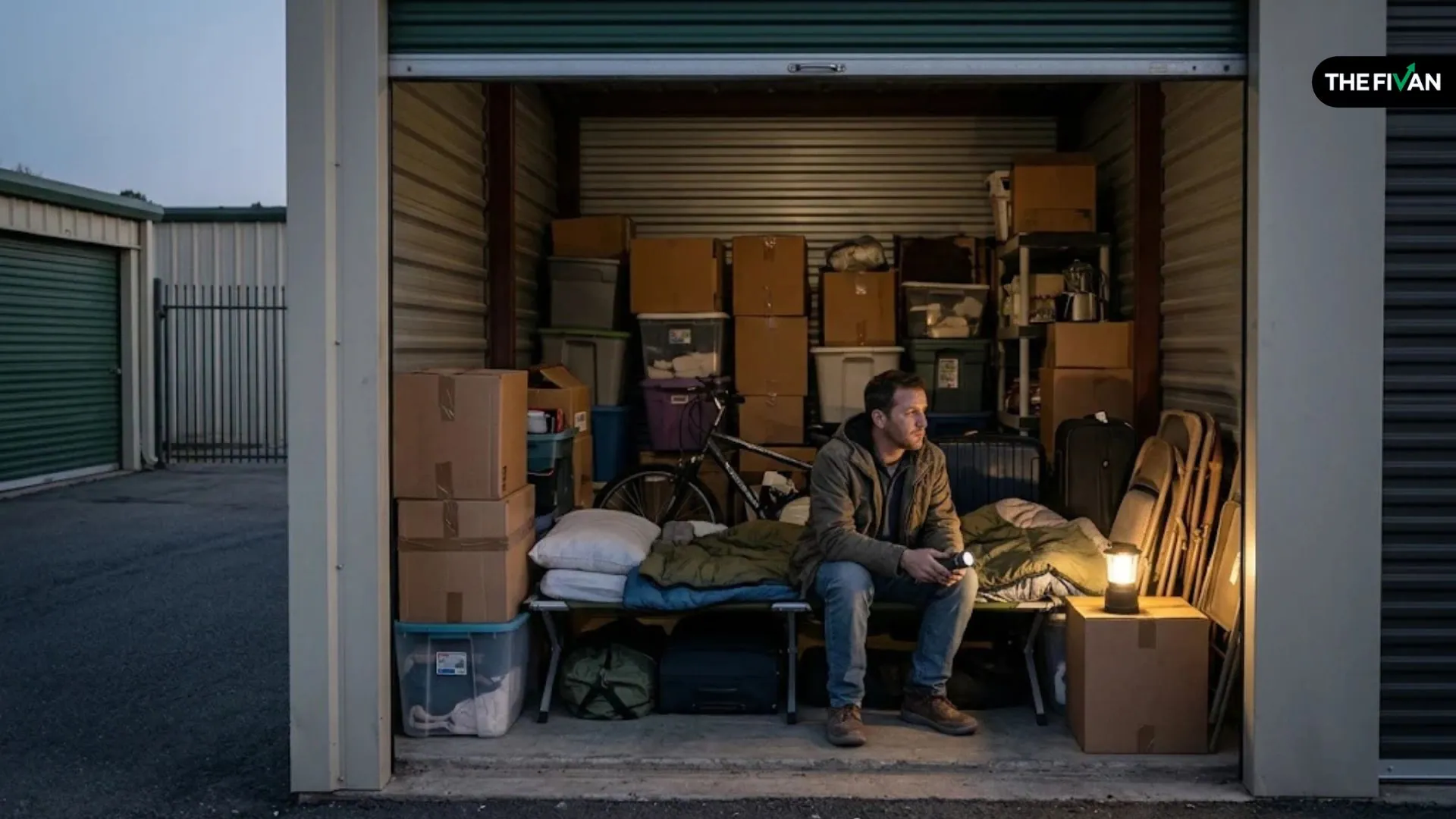
Can you sleep in a storage unit for one night, during the day, or for longer? Generally, no. Ordinary self-storage units are not intended for sleeping or living, and using one as a bedroom can violate state law or your rental agreement. The exact rules depend on where you live and the facility’s terms.
Even if you rent the unit yourself, paying for access does not mean you can use it as a home. Storage units may lack safe living conditions, toilets, running water, suitable temperature control, and reliable emergency access. Sleeping inside can put your health at risk, too.
If you need somewhere to sleep because rent is too expensive or you have nowhere else to stay, there are safer options. You can contact local housing services, look for emergency shelter, or call 211 in most parts of the United States for help finding local resources. This guide explains the rules, possible consequences, and practical steps you can take.
Direct Answer
Generally, no. Ordinary storage units are not designed or approved for sleeping, and doing so may violate state law or the rental agreement. Rules vary by location and facility.
Experience
Before relying on a storage unit, check the permitted-use and termination clauses in your rental agreement; access hours do not automatically allow sleeping. If you need a place tonight, call 211 or consult USAGov’s emergency housing guidance, although local services and availability vary.
Can You Sleep in a Storage Unit?
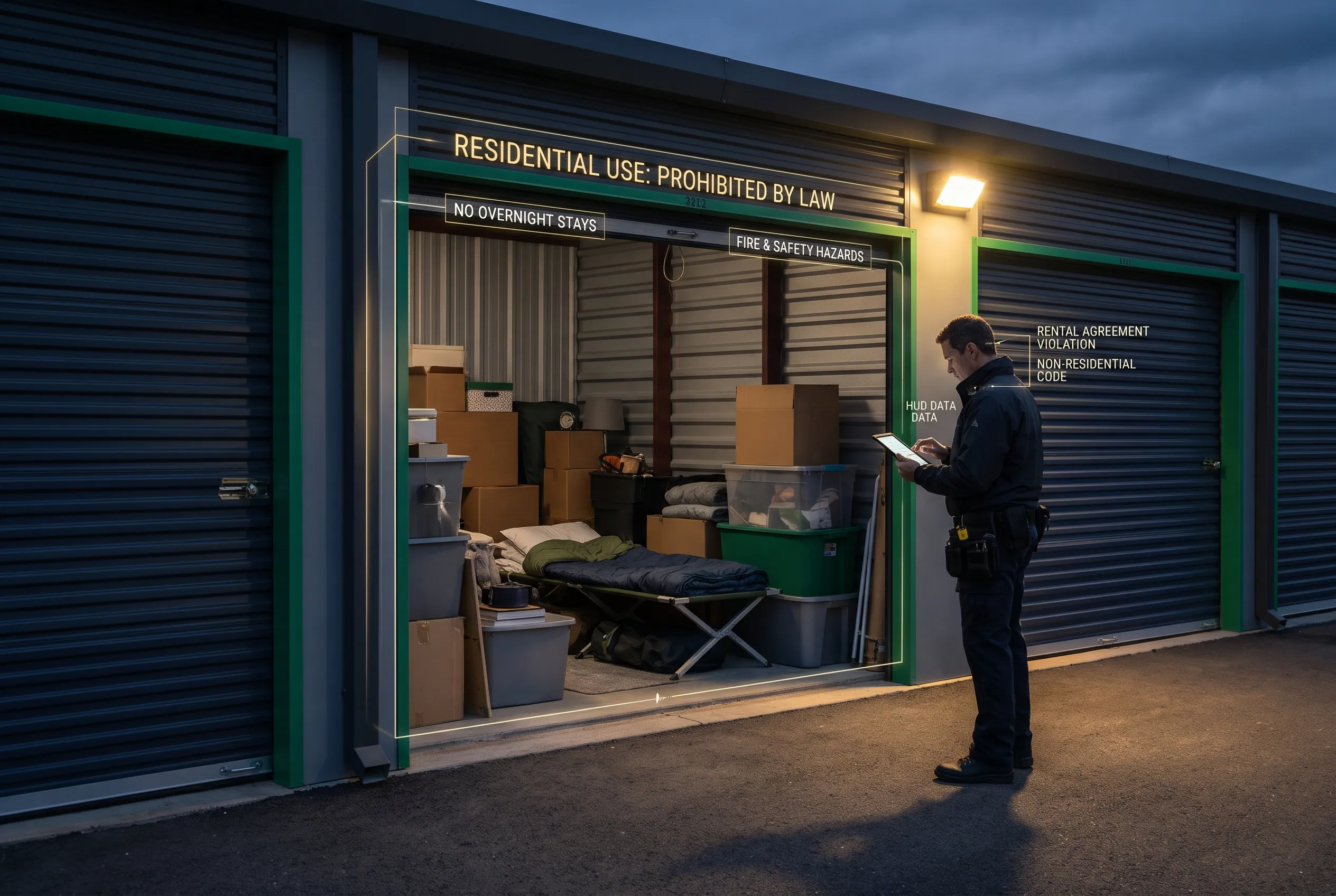 In most ordinary self-storage facilities, sleeping is not allowed. These spaces are designed to hold furniture, boxes, business equipment, seasonal items, and other belongings. They are not designed or approved for people to live in.
For example, Extra Space Storage explicitly prohibits sleeping in its units, including overnight stays. Its published storage policy explains that using a unit as a residence violates the company’s rules.
State laws can also prohibit residential use. Florida’s 2026 Statutes, Section 83.https://www.extraspace.com/self-storage/faq/can-i-live-or-sleep-in-a-storage-unit/803, state that individual storage spaces in a self-service storage facility cannot be used for residential purposes. Other states have their own requirements, so check the rules that apply to your location.
Three things matter when answering this question:
- The law: Does your state or local government allow residential use of this type of property?
- The rental agreement: Does the facility prohibit sleeping, overnight stays, or residential activities?
- Safety: Is the space suitable and approved for people to occupy? An ordinary storage unit generally is not.
A manager might allow you to visit your belongings outside normal office hours. That does not automatically give you permission to sleep there.
If you are considering using a unit as a bedroom because it costs less than an apartment, check these points before making a decision. A low storage fee does not make the space a lawful or safe substitute for housing.
Why Storage Units Are Not Safe Places to Sleep
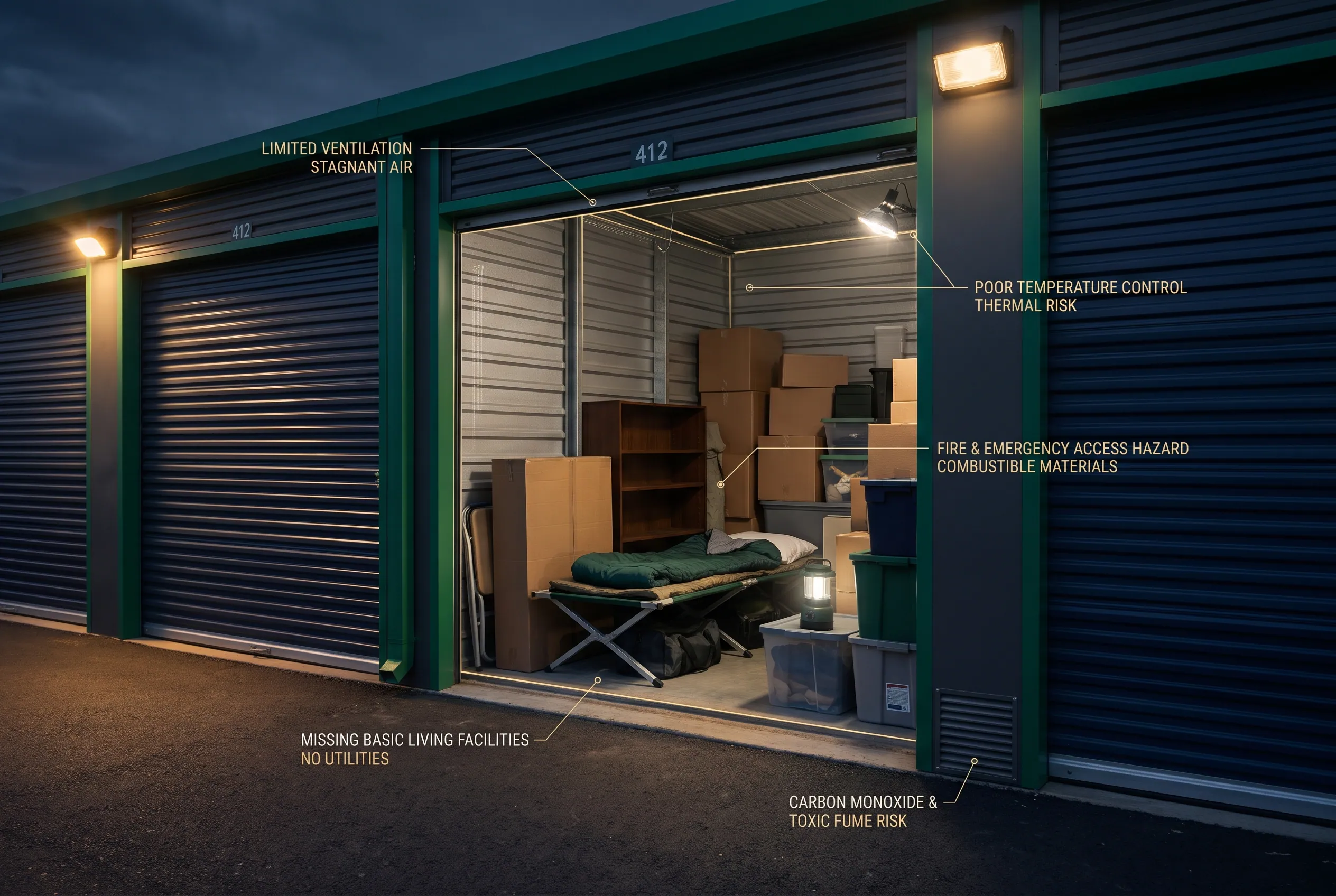 A storage unit may look like a small, private room. But it is built to protect stored belongings, not provide the conditions people need for safe living.
1. Poor temperature control
Many storage units do not have the heating and cooling systems found in homes. Indoor temperatures can become dangerously hot during summer or very cold in winter.
A metal unit can become uncomfortable quickly when exposed to direct sunlight. In cold weather, the temperature inside may also fall enough to create a risk of cold-related illness.
Even a climate-controlled storage unit is not automatically approved for people to sleep in. Temperature control alone does not make a property suitable for residential use.
2. Limited ventilation
Ventilation means the movement of fresh air into a space and stale air out of it. A storage unit’s ventilation may not be suitable for someone spending hours asleep inside.
Opening the door briefly does not ensure that the air will remain safe throughout the night. Adding a household fan also cannot fix every ventilation problem.
Do not assume a space is safe simply because it feels comfortable when you enter it.
3. Carbon monoxide exposure
Carbon monoxide is a poisonous gas that you cannot see or smell. It can come from fuel-burning equipment, vehicle exhaust, generators, and other combustion sources.
A storage unit does not automatically contain carbon monoxide. However, exposure can become a serious risk if exhaust or fumes enter an enclosed space.
The US Consumer Product Safety Commission’s carbon monoxide guidance warns about the dangers of this gas.
Symptoms can include headache, dizziness, weakness, nausea, and confusion. If you suspect carbon monoxide exposure, get outside into fresh air immediately and contact emergency services. Do not stay inside to investigate.
4. Fire and emergency-access risks
Storage facilities may contain furniture, packaging, and other materials that can burn. Electrical equipment, prohibited items, and unsafe activities can add to the risk.
An ordinary storage unit is not designed with the same emergency exits, fire-safety systems, and residential arrangements as approved living space.
A door that opens for ordinary access does not guarantee that you can escape quickly during a fire or another emergency.
5. Missing basic living facilities
Most storage units do not provide private toilets, showers, drinking-water facilities, or a normal place to prepare food. You may also have limited access to electricity and waste disposal.
These limitations become more serious when a person stays for several hours or days.
The key point: A mattress, blanket, fan, or other household item cannot turn an ordinary storage unit into safe housing. A property needs to meet the relevant residential requirements, not just provide enough floor space to lie down.
Does One Night or a Daytime Nap Change the Rules?
No universal rule allows you to sleep in a storage unit simply because the stay is short or takes place during the day.
Some people ask whether they can sleep in a unit for one night between shifts, during a long work break, or while waiting for another place to become available. These situations may be different from someone trying to live in a unit permanently, but the short duration does not automatically make the activity legal or permitted.
Can you sleep in a storage unit overnight?
Usually, you should not. Many storage facilities explicitly prohibit overnight stays. Extra Space Storage, for example, states that overnight sleeping violates its rental agreement.
Check your own agreement rather than relying on another customer’s experience. A facility’s access hours tell you when you may enter to handle your belongings; they do not necessarily permit you to use the space for sleeping.
Can you sleep in a storage unit during the day?
Daytime access does not automatically mean daytime sleeping is allowed.
A facility may let renters enter during business hours to retrieve furniture, organize boxes, or move equipment. Using the unit as a regular place to rest or sleep is a different activity.
If you need daytime rest between shifts, look for a legitimate alternative. Depending on your circumstances, you might be able to use a workplace rest area, a library’s public seating, a community center, or another suitable public space. These places do not all permit sleeping, so check their rules before relying on them.
How long can you sleep in a storage unit?
There is no single nationwide number of hours that makes sleeping permissible.
One hour, one night, and a week-long stay can raise different practical and legal concerns, but a short stay is not automatically allowed. The applicable state law and rental agreement matter more than choosing a duration that seems brief.
Do not treat online stories about people sleeping in storage units without consequences as proof that the activity is allowed.
What Do State Laws and Storage Agreements Say?
The United States does not have one simple rule that describes every storage facility and every possible property arrangement. State law, local requirements, and the rental agreement can all affect the answer.
State laws may prohibit residential use
Florida offers a clear example. Under Section 83.803 of the 2026 Florida Statutes, a self-service storage facility is intended for renting individual spaces to store and remove personal property. The statute states that individual storage spaces may not be used for residential purposes.
This is a state-specific example, not a claim that every US law uses identical wording.
Other states can have their own statutory restrictions. Local building, zoning, and fire-safety requirements may also matter, depending on the property and the proposed use.
If you are in a different state, do not assume Florida’s law answers every question about your location. Check your state’s official legislation and the rules that apply to the property.
Your rental agreement matters
A storage rental agreement is the contract between you and the facility. It sets out the conditions for renting and using the space.
Before using a unit for any purpose beyond storing belongings, check the agreement for:
- Permitted use: What activities are allowed inside the unit?
- Prohibited activities: Does the contract ban sleeping, living, or staying overnight?
- Access hours: When can you enter the property?
- Termination terms: What can the operator do if you break the agreement?
- Access to belongings: What rules apply if the contract ends or access is restricted?
If the wording is unclear, ask the facility manager for a written explanation. Keep a copy of the agreement and any written response.
However, permission from a manager does not necessarily override a state law or building requirement. An activity can remain prohibited even if someone at the facility appears to tolerate it.
Does owning a storage unit make a difference?
Owning the physical unit does not automatically mean you can legally live in it.
For example, someone may own a storage condominium or a unit within a larger storage property. The ownership arrangement may give that person rights over the space, but it does not automatically grant residential-use permission.
A separate storage container on privately owned land can raise different legal questions. In that situation, the owner may need to consider zoning, building codes, permitted land use, sanitation, and fire safety.
If you own a storage space and want to convert it into a home, check with the relevant local building or planning department before spending money on changes. Confirm whether residential use is permitted and what approvals would be required.
Do not assume that installing insulation, electricity, or plumbing will make the conversion lawful.
What Can Happen If You Sleep in a Storage Unit?
The consequences depend on the facility’s contract, the location, the circumstances, and the laws that apply. There is no reliable nationwide answer that says everyone will receive the same penalty.
Possible consequences include the following.
1. The facility may tell you to leave
A manager may discover that someone is using a storage unit for sleeping and ask that person to stop or leave the property.
Facilities may use staff checks, cameras, or access records as part of their normal security arrangements. Their systems and practices differ, so it is not accurate to claim that every facility will detect every overnight stay.
2. The rental agreement may be terminated
If sleeping violates the contract, the facility may take action under the agreement and applicable law. This can include a warning or termination of the rental arrangement.
The exact process, notice requirements, and deadlines vary. Do not assume that every contract can be terminated immediately or that every violation results in the same outcome.
3. Legal consequences may apply
Depending on the jurisdiction and circumstances, there may be local enforcement issues or other legal consequences. A contract violation does not automatically mean that a person has committed a particular criminal offense.
Check the applicable law before drawing conclusions about fines, criminal charges, or other penalties.
4. You may face another housing or storage problem
For someone already struggling to find a place to sleep, losing access to a storage arrangement can create additional problems.
Your belongings may include work tools, clothing, identification documents, or household items. Access restrictions can make it harder to get what you need.
If you have received a notice from the facility, read it carefully and pay attention to any stated deadlines. Ask how you can retrieve your belongings and keep important communications in writing. If you are concerned about your legal rights, seek help from a local legal-aid service.
The practical lesson is that using a storage unit as a bedroom can create a second problem without solving the first.
Where Can You Sleep Instead?
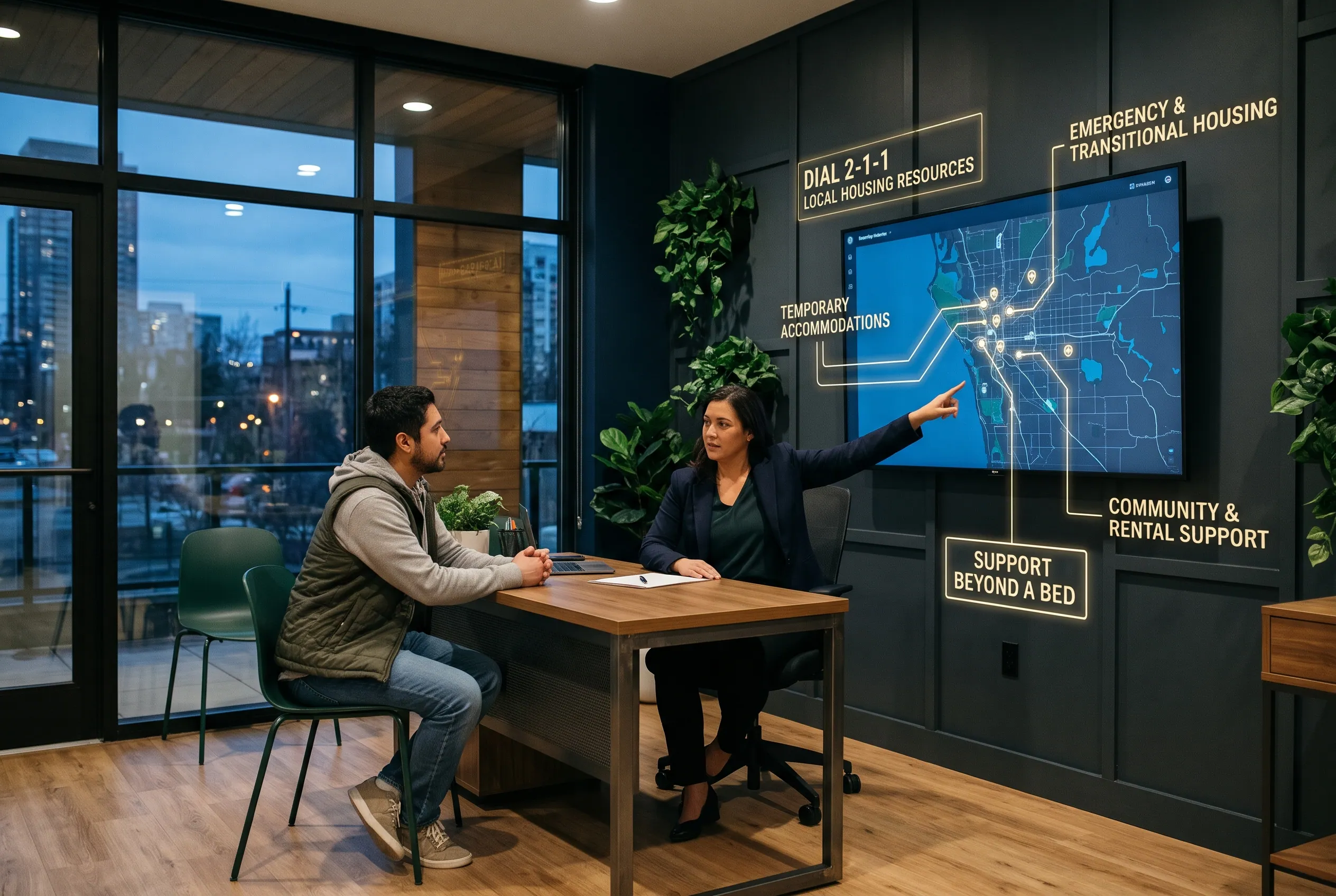 If money is tight or you do not have stable housing, finding another place may not be easy. Still, there are more appropriate options than sleeping in a storage unit.
1. Call 211 for local housing resources
In most parts of the United States, dialing 211 connects people with local social services and referrals for emergency housing.
You can explain that you need somewhere safe to sleep and ask about nearby shelters, emergency accommodation, and housing support.
Availability differs by area. A referral does not guarantee a bed, but it can help you identify services you may not know about.
2. Use USAGov’s emergency housing guidance
The federal government’s Get Emergency Housing page explains how to find shelters and temporary housing resources.
It directs people to housing assistance information, including resources connected with the US Department of Housing and Urban Development. The page also identifies specialized support for certain groups, such as veterans and young people.
Start with the options that match your location and circumstances. Some programs have eligibility requirements, and services may not be available immediately.
3. Contact a local shelter or nonprofit
Local shelters and nonprofit organizations may provide temporary accommodation, referrals, or other support.
The Salvation Army’s emergency shelter resources are one place to start. Local services may differ in their admission rules, operating hours, and available space.
Call before traveling when possible. Ask whether they accept new guests, what documents you need, and whether they can suggest another service if they are full.
4. Check temporary accommodation options
Depending on your budget and circumstances, you may consider a motel, a short-term room rental, or staying with a trusted friend or family member.
Compare the total cost rather than looking only at the first night’s price. Ask about taxes, cleaning charges, deposits, minimum stays, and any other required fees.
If you can afford a room for only a short period, contact local housing services at the same time. This can help you plan for what happens when that temporary arrangement ends.
5. Ask about support beyond a bed
Housing assistance may involve more than emergency shelter. Depending on your location and eligibility, local agencies may connect you with rental assistance, housing counseling, transportation support, or other community services.
You should not assume that any particular program will pay your costs. Ask what is available, who qualifies, and whether there are application deadlines.
If a service cannot help, ask whether it can refer you to another organization.
What to Do If You Need Somewhere to Sleep Tonight
When you need a place to stay urgently, focus on a few practical steps rather than trying to make a storage unit work.
Step 1: Find a safer place to stay. Contact 211, a local shelter, or another housing resource. Explain your immediate need and ask about current availability.
Step 2: Ask for another referral if the first option is unavailable. Shelters may be full, so ask the organization which other local services you can contact. You may need to call more than one place.
Step 3: Keep important belongings accessible. If you already have a storage unit, keep essentials such as identification, medication, phone chargers, work items, and necessary documents where you can retrieve them. Do not assume that you will always have immediate access to everything stored in a rented unit.
Step 4: Check your agreement. Confirm the permitted use, access rules, and any relevant notice terms. If there is a dispute, ask the facility for written clarification.
Step 5: Plan for the next few days. Once you have addressed tonight’s immediate need, ask about longer-term housing services, temporary accommodation, and any assistance for which you may qualify.
You do not need to solve every housing problem at once. Start by finding a safer place to sleep, then take the next practical step.
Frequently Asked Questions
Is it legal to sleep in a storage unit in Florida?
Florida’s 2026 Statutes, Section 83.803, state that individual spaces in a self-service storage facility cannot be used for residential purposes. If you are in Florida, do not use an ordinary storage unit as a bedroom. Other legal and contractual requirements may also apply to a particular property.
Can you sleep in a storage unit during the day?
Daytime access does not automatically authorize sleeping. Many facilities restrict sleeping regardless of the time of day. Check the rental agreement and applicable local rules, and look for a suitable place to rest if you need a daytime break.
What happens if you sleep in your storage unit?
The facility may tell you to stop, enforce its rental agreement, or terminate the arrangement according to the contract and applicable law. Further consequences depend on the location and circumstances. Do not assume that every facility will issue the same warning or penalty.
How long can you stay at a storage unit?
There is no universal number of hours that permits sleeping in an ordinary storage unit. Access hours govern when you can enter under the facility’s rules; they do not automatically grant permission to stay overnight or use the space as housing.
Can you live in a storage unit you own?
Ownership alone does not make residential use lawful. The property may still be subject to land-use rules, building codes, fire-safety requirements, and other restrictions. Confirm the permitted use with the relevant local authority before attempting to convert a storage space into a home.
Final Thoughts
Sleeping in a storage unit is generally not a safe or permitted housing choice. A short stay, daytime visit, or ownership of the space does not automatically change the applicable rules.
If you need somewhere to sleep, start by checking local housing resources, contacting 211, or reaching out to a nearby shelter. If you already rent a storage unit, protect access to your essential belongings and review your agreement.
The goal is not only to avoid a contract problem. It is to find a place where you can rest safely without creating another difficult situation for yourself.
Disclaimer
This article provides general educational information, not personalized financial, investment, legal, or tax advice. Laws, rental terms, housing services, and individual circumstances vary by location, and outcomes are not guaranteed. Seek appropriate local legal or housing assistance when you need help understanding your rights or available options.