
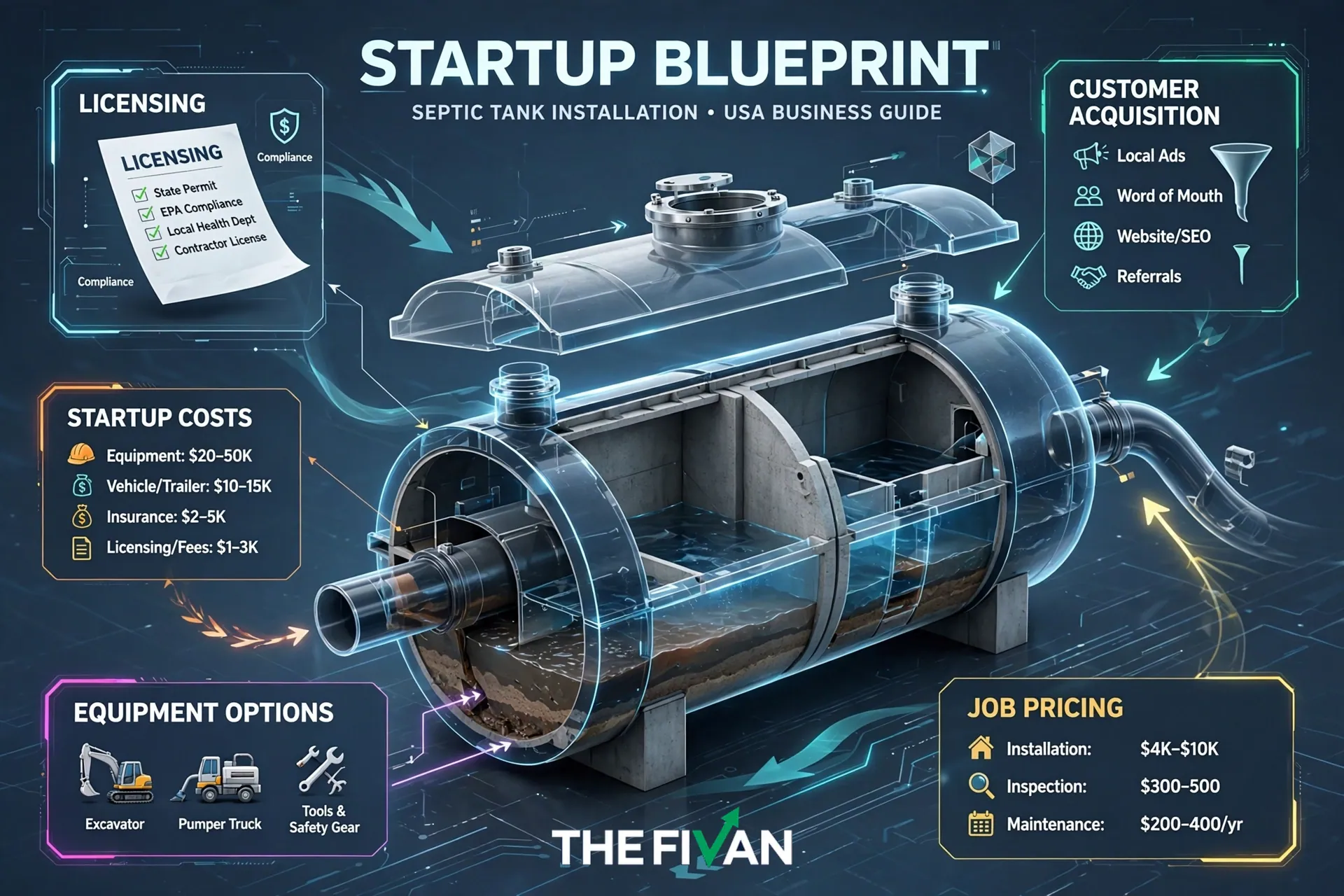
Starting a septic tank installation business in the United States can be a practical opportunity for an entrepreneur who understands construction, equipment, customer service, and local regulations. The key is to build the business around real local demand, qualified workers, and a budget that accounts for the full cost of each job—not simply the price of a septic tank or excavator.
To start, research the properties and customers in your service area, decide which septic services you will offer, confirm your state and local licensing requirements, and prepare a detailed startup budget. Then choose the equipment you can afford, set prices using actual job costs, and build relationships with builders, plumbers, and other professionals who work with property owners.
This guide explains how to start a septic tank installation business step by step, including licensing, equipment decisions, startup expenses, pricing, and customer acquisition. Requirements differ by location and service type, so treat local regulatory checks as an early business task rather than something to handle after accepting your first job.
Short Definition
A septic tank installation business installs, replaces, or repairs onsite wastewater systems for residential and other eligible properties. To start one in the United States, research local demand, confirm state and local licensing and permit requirements, build a realistic startup budget, arrange qualified labor and equipment, and price jobs to cover direct costs and business overhead.
Experience
Before financing an excavator or investing in a fleet, define your service area, speak with local builders and contractors, and confirm which septic services you are authorized to provide. Compare the cost of renting or subcontracting equipment with owning it, and keep enough working capital for labor, materials, insurance, fuel, and delayed customer payments. A smaller, carefully planned operation may be a more manageable starting point than taking on heavy equipment debt too early.
Illustrative business guidance; actual requirements and costs vary by location and business model.
SERP Enhancement Elements
Recommended FAQ content
Q1: Do I need a license to install septic tanks?
Licensing and permit requirements vary by state and locality. Check with the responsible state wastewater agency and local permitting authority before accepting regulated work.
Q2: How much money can you make installing septic tanks?
Earnings depend on job volume, pricing, labor, materials, equipment, overhead, and other operating expenses. Revenue is not the same as profit, so calculate costs for each job.
Q3: Is the septic tank business profitable?
It can be profitable when local demand supports the business, prices cover the full cost of work, and expenses and cash flow are managed carefully. Profit is not guaranteed.
Q4: How much does it cost to start a septic pumping business?
Costs depend on factors such as the vacuum truck, insurance, licensing, maintenance, staffing, fuel, and approved waste-disposal arrangements. Obtain local quotes before setting a budget.
Q5: Can you start a septic installation business without buying an excavator?
Depending on local requirements and available contractors, you may be able to rent equipment or subcontract excavation instead of buying an excavator upfront.
Suggested structured data
- Article or BlogPosting: identify the article title, publisher, publication date, and author only when those details are accurate and available.
- BreadcrumbList: use if the article appears in a corresponding breadcrumb navigation structure.
- FAQPage: consider only if the page contains these questions and answers visibly and meets Google’s current eligibility guidelines. FAQ structured data does not guarantee a rich result.
On-page enhancements
- Place a concise direct answer near the beginning of the article.
- Use descriptive headings for licensing, startup budgeting, equipment, pricing, and profitability.
- Link to authoritative SBA, EPA, OSHA, and applicable state or local agency resources where relevant.
- Add verified internal links to related The Fivan business guides when suitable pages are available.
- Use a clear, descriptive URL slug such as septic-tank-installation-business-startup-guide.
Can You Start a Septic Tank Installation Business?
Yes, but success depends on more than finding customers who need a septic system. You need a clear service offering, the appropriate authorization for the work, access to qualified people and equipment, and enough cash to cover expenses while jobs are being completed and invoices are paid.
A septic installation company may work with rural homeowners, new home builders, developers, or property owners replacing failed systems. Demand can come from new construction, system replacement, repairs, or other permitted services. However, opportunities vary by location, competition, soil conditions, property development, and the availability of public sewer connections.
Before investing heavily, answer four questions:
- Is there enough local demand? Identify likely customers and speak with contractors who already serve them.
- Can you legally perform the intended work? Check installer licenses, permits, inspections, and any requirements for design or site evaluation.
- Can you deliver the work safely? Assess your construction experience, equipment access, workforce, and ability to manage site conditions.
- Can your budget withstand slow periods? Allow for insurance, equipment payments, repairs, payroll, fuel, and delayed customer payments.
You do not necessarily need to own every machine from day one. A smaller operation can start with a defined service area and rented or subcontracted equipment, provided all regulated work is handled by appropriately qualified and authorized people.
Step 1 — Research Demand in Your Service Area
The first step is to find out whether enough customers need septic installation or related services to support a business.
Start with your county or regional health department, environmental department, and local permitting authority. Ask which areas primarily use on-site wastewater systems, how installation permits are handled, and where you can find information on new installations, repairs, or system replacements.
The U.S. Environmental Protection Agency explains that individual septic systems are generally regulated at the state and local levels. Its frequently asked questions about septic systems are a useful starting point for understanding permits and local requirements.
Next, research your competitors. Search online for septic installers in the counties you want to serve, then review the services they offer, the areas they cover, how customers contact them, and whether they appear to focus on installation, repair, pumping, or maintenance.
You can also speak with professionals who encounter septic needs regularly, including:
- Home builders and general contractors.
- Excavation companies and plumbers.
- Real estate agents and property managers.
- Septic system designers and site evaluators.
- Rural property developers and land professionals.
Ask what customers commonly request, where projects become difficult, and what causes delays. Avoid relying only on competitor advertising or online reviews as evidence of demand.
Finally, estimate how many jobs you could realistically complete each month. A county may have many septic-dependent properties, but that does not automatically mean customers are actively seeking a new installation company.
Practical tip: Validate a small service area before expanding. A manageable travel radius can reduce fuel costs, equipment transport time, and scheduling complications.
Step 2 — Choose Your Services and Business Model
A septic tank installation business can offer several services, but they do not all require the same skills, equipment, permits, or investments. Choose your initial services carefully.
Installation, Repair, Inspection, or Pumping?
New septic system installation: This may involve excavation, placing tanks, installing piping and drainfield components, coordinating inspections, and restoring the site. Depending on local law, design and site evaluation may need to be completed by separately qualified professionals.
Repairs and replacements: Failed tanks, damaged piping, drainage problems, or aging systems can lead to repair and replacement work. These jobs require careful assessment because the actual problem may not be obvious until the site is inspected.
Inspections and evaluations: Some customers need a system inspected during a property sale or as part of maintenance. Inspection work may involve separate qualifications or restrictions, so confirm what you are permitted to offer.
Septic pumping: Pumping requires vacuum equipment and arrangements for transporting and legally disposing of or treating collected waste. It has different operating requirements from installation-only work.
For a new business, focusing on installation and selected repairs may be more manageable than launching installation, pumping, and inspection services simultaneously. You can build relationships with established pumping or evaluation companies and refer work to each other when appropriate.
Your business model should answer three practical questions: Which jobs will you accept? Which work will qualified subcontractors handle? Which jobs will you decline because the site, schedule, licensing requirements, or financial risk falls outside your capabilities?
Put those decisions in writing. A clearly defined service offering makes it easier to price jobs, choose equipment, market to the right customers, and avoid accepting work you are not prepared to complete.
Step 3 — Build a Business Plan and Startup Budget
Your business plan does not need to be complicated. It should explain who your customers are, which services you provide, how you will price them, what resources you need, and how the company will cover its bills.
The U.S. Small Business Administration offers guidance on business planning and calculating startup costs. Use that framework to turn your idea into a costed operating plan.
Include your service area, competitors, initial service offerings, expected jobs per month, marketing approach, equipment strategy, and financial forecasts. Estimate a conservative first-year workload rather than assuming your schedule will be full immediately.
One-Time Costs and Ongoing Expenses
The cost of starting a septic installation business depends heavily on the services offered, the equipment you own or rent, local insurance rates, labor needs, and how far you travel. There is no single startup figure that accurately describes every business model.
Build your budget by category.
| Cost category | What to include |
| Business setup | Registration, legal or accounting support, licenses, permits, and required training |
| Insurance | General liability, commercial auto, workers’ compensation where required, and relevant equipment coverage |
| Equipment access | Excavator or backhoe, loaders, compaction equipment, trailers, and attachments |
| Tools and supplies | Measuring tools, hand tools, pumps where appropriate, protective equipment, and small materials |
| Vehicles and transport | Work truck, trailer, delivery charges, fuel, and equipment hauling |
| Materials | Tanks, piping, gravel or other approved media, fittings, and system components |
| Labor | Wages, payroll costs, subcontractors, and necessary training |
| Administration | Phone, bookkeeping, estimating software, office expenses, and business banking |
| Marketing | Website, business listings, signage, printed materials, and customer outreach |
| Working capital | Money available for fuel, payroll, repairs, insurance payments, and slow-paying invoices |
Separate startup purchases from monthly expenses. For example, business registration is a setup expense, while vehicle insurance and software subscriptions may recur. Equipment financing adds regular payments even when few jobs are coming in.
Working capital deserves particular attention. You might have to pay for a tank, materials, and labor before collecting the remaining payment from a customer. If the next job starts before the first invoice is paid, your bank balance may become a problem even when the jobs are profitable on paper.
Prepare at least three estimates: a lean model using rentals and subcontractors, a moderate model with selected owned equipment, and an expansion model with greater equipment and staffing commitments. Get real quotes for your location instead of relying on broad online cost estimates.
Step 4 — Check Licenses, Permits, and Insurance
Licensing and permitting are among the most important parts of a septic tank installation business startup guide because the rules differ across states and local jurisdictions.
Start with the state agency responsible for onsite wastewater systems. Then contact the county or local permitting authority for the specific area where you plan to work. Ask about installer credentials, approved system types, site evaluations, construction permits, inspections, and any contractor or business registration requirements.
Do not assume that a general contractor license or business registration automatically authorizes septic installation. Design, site evaluation, installation, maintenance, inspection, pumping, and wastewater transportation may fall under different rules.
The EPA notes that local or state agencies commonly oversee individual residential septic systems and may establish site suitability assessments, setback distances, and permit requirements. The exact process depends on the property and jurisdiction.
A Texas Licensing Example
Texas illustrates why you need to verify both your service type and the system you intend to install. The Texas Commission on Environmental Quality’s OSSF licensing guidance distinguishes among roles such as Installer I, Installer II, apprentices, site evaluators, and maintenance professionals. The categories authorize different types of work.
Texas also provides guidance on permits for onsite sewage facilities. Do not apply Texas requirements to another state; use this example to understand why the precise local rules matter.
Before launching, ask the relevant agency:
- Which license or registration applies to each planned service?
- Are there education, experience, examination, or training requirements?
- Who prepares the site evaluation and system design?
- Who applies for the permit, and when must approval be received?
- What inspections are required before the system is covered or placed into service?
- Are there specific rules for transporting wastewater, handling excavated material, or working near sensitive water sources?
Get the answers directly from the responsible agency and retain written guidance where possible. Do not begin regulated work until you have confirmed the required authorization and approvals.
Arrange Insurance and Job-Site Safety
Speak with a commercial insurance agent who understands excavation or construction contractors. Depending on your operation, discuss general liability, commercial auto, workers’ compensation where required, equipment coverage, and other coverage relevant to the risks of your services. Policies differ, so confirm exclusions and limits rather than assuming one policy covers every incident.
Safety is equally important. Excavation can expose workers to cave-ins, underground utilities, moving equipment, and other hazards. Establish a job-site safety process and follow applicable rules for trench protection, inspections, access, and utility locating. OSHA provides detailed trenching and excavation safety guidance.
A low-priced contract is not worth risking a worker’s safety, damaging a buried utility, or performing work without required approval.
Step 5 — Decide Whether to Buy, Rent, or Subcontract Equipment
Heavy equipment can consume a large share of startup capital. Buy only what your expected workload can justify.
An installation-focused operation may need access to an excavator or backhoe, a suitable truck and trailer, compaction equipment, digging and measuring tools, and other equipment appropriate to the systems being installed. The exact requirements depend on tank size, site access, soil conditions, and the designs permitted locally.
A pumping operation has a different equipment profile because it typically needs a suitable vacuum truck and approved arrangements for handling and disposing of waste. Do not add those costs automatically if pumping is not part of your initial service offering.
Compare three approaches:
Buy: Ownership gives you greater control over scheduling and equipment availability. However, you must account for financing, maintenance, repairs, transport, storage, depreciation, and downtime.
Rent: Renting helps preserve capital and lets you match machine size to the job. Compare the full rental cost, delivery charges, minimum hire periods, fuel, damage terms, and availability during busy periods.
Subcontract: Hiring a qualified excavation or installation partner can help you take suitable jobs without owning a complete equipment fleet. Confirm the subcontractor’s qualifications, insurance, scope of work, schedule, and responsibilities for permits and inspections.
A simple test can guide the decision. If a machine is required frequently and rental charges are consistently high, ownership may eventually be justified. If jobs are occasional or unpredictable, renting may be more sensible. Compare the total cost of each option using quotes and realistic job forecasts.
Create an equipment list with three columns: essential on day one, rentable when needed, and not needed for the initial business model. Review it again after you have completed enough work to understand your actual needs.
Step 6 — Price Jobs and Calculate Profit
Pricing should reflect the work required at the specific site, not just what another contractor charges. Two properties may need different amounts of excavation, different system components, different equipment time, or different site restoration.
Before sending an estimate, account for:
- Tanks, piping, gravel, and other specified materials.
- Labor, including payroll-related costs.
- Equipment rental, operating costs, delivery, and transport.
- Fuel, hauling, subcontractor charges, and waste handling where applicable.
- Permit or inspection fees, according to the contract and local rules.
- Overhead such as insurance, bookkeeping, communications, and vehicle expenses.
- A reasonable allowance for uncertainty, where appropriate and clearly explained.
Review the design, site information, access constraints, expected soil conditions, utility locations, and inspection process before confirming your price. Where major details are unknown, explain what your estimate assumes and how unexpected conditions will be handled.
A Simple Job-Costing Example
Suppose your company quotes $8,500 for an installation. The following figures are illustrative only; they are not an industry price benchmark.
| Item | Illustrative amount |
| Customer contract revenue | $8,500 |
| Tank and other materials | $2,400 |
| Direct labor | $1,700 |
| Equipment rental and delivery | $1,100 |
| Fuel, hauling, and related job expenses | $650 |
| Permit and inspection allowance | $350 |
| Total direct job costs | $6,200 |
| Gross profit | $2,300 |
| Allocated business overhead | $800 |
| Estimated operating profit before tax | $1,500 |
In this example, gross profit equals revenue minus direct job costs. After allocating $800 to overhead, the job contributes an estimated $1,500 before income taxes and any costs not already included in the calculation. The exact treatment of owner compensation, loan payments, depreciation, and taxes depends on the business’s accounting and financial structure.
Notice how an $8,500 contract does not mean the owner takes home $8,500. Materials, labor, equipment, operating expenses, and taxes all affect what remains.
Track actual costs against your estimates after every project. If jobs repeatedly use more labor hours or rental days than expected, adjust your estimating process and prices.
Also calculate your break-even point: the sales volume needed to cover your fixed costs. The SBA explains how to calculate it using fixed costs and the difference between selling price and variable cost. This helps you estimate how many jobs you need each month to keep the business financially sustainable.
Step 7 — Find Customers and Build Referral Relationships
A new company needs a reliable way for customers and referral partners to discover it. Start with a simple marketing plan focused on the service area you can serve well.
Create a professional website that clearly states your services, coverage area, business contact information, and process for requesting an estimate. Explain that work depends on site conditions, system requirements, and applicable approvals. Avoid claiming licenses or specialties you do not hold.
Set up and maintain an accurate business listing on relevant local search platforms. Use the same business name and contact details across your website, listings, and directories. Ask satisfied customers for honest reviews without offering misleading incentives or pressuring them to provide positive feedback.
Referral relationships can be particularly helpful. Introduce your business to builders, excavators, plumbers, property managers, and other professionals whose customers may need septic installation or repairs. Be clear about which work you perform and which services you refer to qualified partners.
When responding to a lead, collect basic information about the property, the customer’s need, the location, and any existing permit or system records. Arrange a suitable site assessment when needed, then provide a written estimate that identifies the scope of work, payment terms, exclusions, and how changes will be approved.
Good communication can distinguish your business as much as price. Respond promptly, explain delays honestly, keep records of approvals and inspections, and leave the site in the condition agreed upon. With the customer’s permission, document completed projects with photographs that can demonstrate your workmanship.
Your first marketing goal should not be to cover the entire state. Aim to build a dependable reputation in a manageable service area, then expand when your workload, staffing, and finances support it.
Common Mistakes to Avoid When Starting
Buying equipment before confirming demand. An expensive machine can create monthly financial pressure long before the business has enough work. Validate demand and compare rental costs first.
Accepting regulated work without confirming requirements. Licensing, permit, design, and inspection rules can vary by jurisdiction and service type. Verify them before making commitments.
Underpricing jobs. Forgetting delivery charges, equipment downtime, labor burden, site restoration, or overhead can eliminate the expected profit. Track actual costs and revise your estimates.
Confusing revenue with profit. A busy schedule does not guarantee a healthy business. Review bank balances, outstanding invoices, taxes, debts, and job-level results—not sales alone.
Expanding into too many services at once. Installation, pumping, design, inspection, and maintenance may require different qualifications and resources. Start with a focused offering and expand when you can meet the relevant requirements.
Neglecting safety and documentation. Proper utility locating, excavation precautions, permits, written scopes, and inspection records protect workers, customers, and the business. Do not skip them to save time.
Frequently Asked Questions
Do I need a license to install septic tanks?
Often, septic installation is subject to state or local licensing, registration, permitting, or other qualification requirements, but the exact rules vary. Contact your state’s onsite wastewater regulator and the local permitting authority for every area you intend to serve. Confirm the rules for installation separately from design, evaluation, inspection, maintenance, and pumping.
How much money can you make installing septic tanks?
Earnings depend on the number and type of jobs completed, contract prices, direct costs, overhead, staffing, seasonality, and how efficiently the business operates. Revenue alone does not show how much the owner earns. Build a local financial forecast, track actual job costs, and review profits after expenses rather than relying on broad online income claims.
Is the septic tank business profitable?
It can be profitable when local demand supports the business, prices cover the full cost of work, and the owner manages equipment, labor, cash flow, and compliance effectively. Profit is not guaranteed. Estimate monthly overhead, calculate your break-even workload, and test your assumptions before taking on major equipment debt.
How much does it cost to start a septic pumping business?
There is no single reliable startup figure for every pumping business. Costs depend on vacuum truck purchase or financing, the truck’s condition and capacity, insurance, licensing and local requirements, maintenance, staffing, fuel, and approved disposal arrangements. A pumping business also differs from an installation-only company. Obtain local vehicle, insurance, and operating-cost quotes before choosing a model.
Can you start a septic installation business without buying an excavator?
Yes, depending on local rules, your contracts, and the availability of qualified rental or subcontract partners. You may be able to rent the excavator for individual projects or subcontract excavation while managing the permitted work you are authorized to perform. Compare the full rental or subcontract cost with ownership before buying equipment.
Choose Your Next Startup Step
The most sensible first move is not necessarily to buy a truck or excavator. Start by defining the services you plan to offer and the counties you intend to serve. Research local demand, contact the relevant permitting authorities, and confirm which qualifications and approvals your business will need.
Next, prepare a budget that covers both startup purchases and ongoing operating expenses. Obtain equipment and insurance quotes, compare buying with renting or subcontracting, and calculate the sales volume needed to break even. Then develop a straightforward plan for finding customers and managing each job from estimate to final inspection and payment.
A septic tank installation business is easier to manage when it grows from verified demand and carefully priced work. Begin with a realistic service area, stay within your qualifications, protect your working capital, and expand your equipment and services as actual business results justify the investment.
Disclaimer
This article is provided for general informational and educational purposes only. It is not legal, financial, tax, engineering, environmental, or professional contracting advice. Septic system licensing, permits, installation standards, inspections, safety rules, insurance obligations, and wastewater-handling requirements vary by state and locality, system type, and service offered. Verify current requirements with the appropriate authorities and consult qualified professionals before making business, financial, or technical decisions. Any illustrative financial figures are examples, not quotes, guaranteed outcomes, or industry-wide averages. Business costs, customer demand, and profitability are not guaranteed.