
Shed financing lets you buy a storage shed, workshop, or backyard building without paying the full price upfront. Your main options include personal loans, manufacturer or dealer financing, retailer credit cards, and rent-to-own plans.
The right option depends on the shed’s total price, your credit eligibility, the interest rate, fees, and how long you need to repay the money. Start by getting a written cash-price quote, then compare the total amount you would pay under each financing offer. A low monthly payment does not always mean a cheaper deal.
Before you sign anything, check whether the quoted price includes delivery, installation, and site preparation. Also make sure you understand when ownership begins and what happens if you miss a payment.
Direct Answer
Shed financing lets you buy a storage shed or backyard building and repay the cost over time through a personal loan, dealer financing, retailer credit, or a rent-to-own agreement.
Experience
Practical Finance Tip: Get the cash price and a written quote for the complete project before comparing financing offers. Check APR, fees, repayment term, and total cost, and read deferred-interest or rent-to-own conditions before signing. An advertised low monthly payment alone doesn’t show which offer costs less.
What Is the Best Way to Finance a Shed?
For many buyers, comparing a personal loan with a dealer’s traditional financing offer is a sensible starting point. A retailer credit offer may also work for an eligible purchase, while rent-to-own can provide another route when conventional credit is difficult to obtain.
There is no single best option for everyone. A loan with a lower monthly payment may cost more overall if it has a longer repayment term. A promotional offer may be attractive if you can repay the balance on time, but costly if you miss the deadline.
Use these basic rules when comparing offers:
- Want to minimize borrowing costs? Compare the APR, fees, and total repayment from a bank, credit union, and shed dealer.
- Want predictable payments? Look for a fixed-rate loan with a clear repayment schedule.
- Considering a promotional offer? Check the deadline, required payments, and what happens if the balance remains unpaid.
- Can’t qualify for a traditional loan? Compare rent-to-own options carefully, including the full cost of obtaining ownership.
- Have enough savings to pay cash? Compare the cash price with the financing cost, while keeping enough savings for emergencies.
The first step is to find out what the complete project will cost. Only then can you judge whether a financing offer fits your budget.
What Are Your Main Shed Financing Options?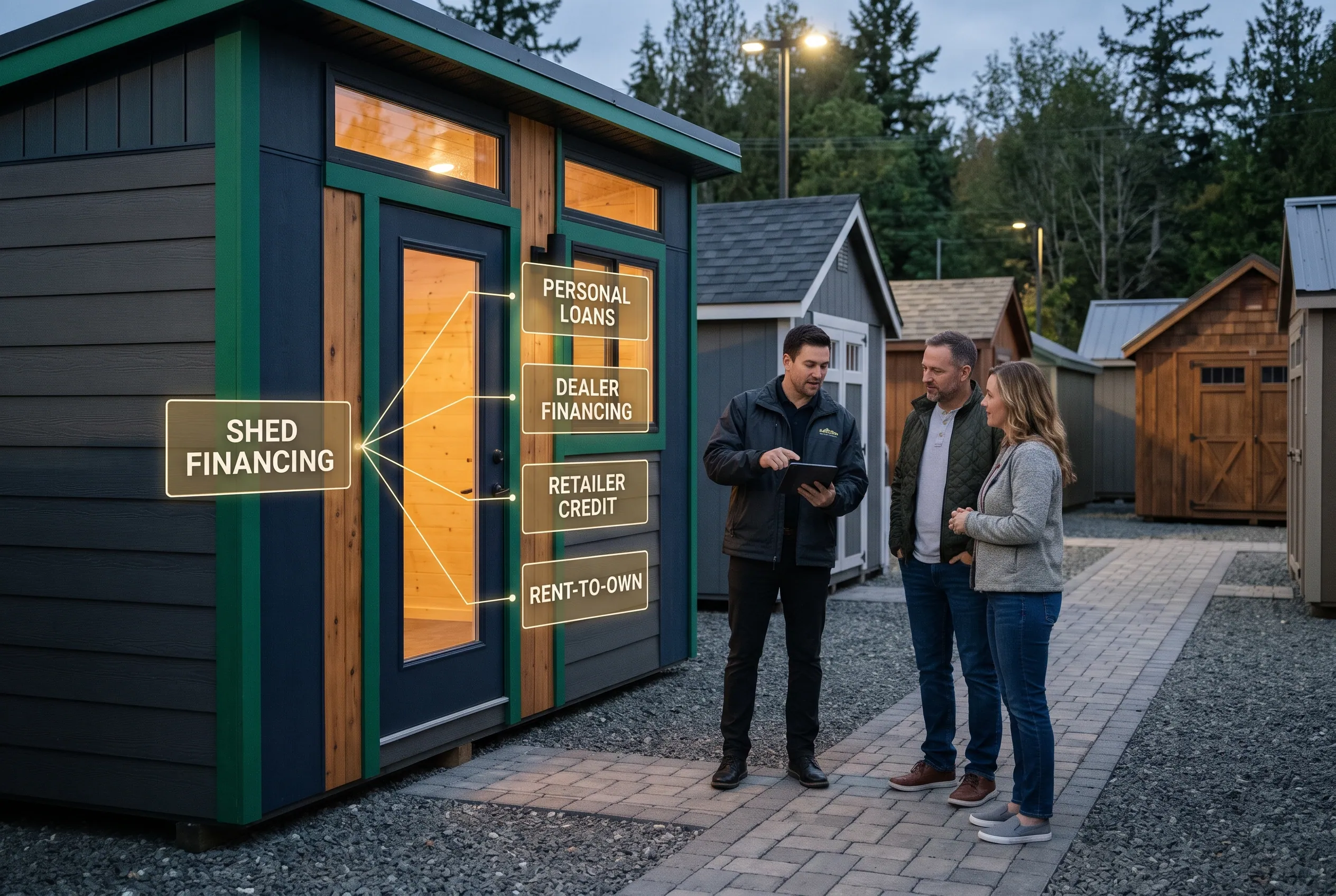 1. Personal Loans From Banks and Credit Unions
A personal installment loan gives you a specific amount of money that you repay in scheduled payments over an agreed period. Depending on the lender, you may be able to use the money to buy a storage shed and pay for related expenses.
The Consumer Financial Protection Bureau explains that lenders may consider your credit history, income, current debts, loan amount, repayment period, and other factors when setting loan terms. Read its guide to personal installment loans.
Advantages
- You can compare offers from several lenders before choosing.
- A fixed-rate loan generally provides predictable principal-and-interest payments.
- You may be able to use the loan for the shed and other eligible project costs.
- You are not limited to financing offered by the shed manufacturer.
Disadvantages
- Approval is not guaranteed.
- The lender may charge an origination fee, which is a fee for setting up the loan.
- A longer loan term can increase the total interest paid.
- Late or missed payments may harm your credit and lead to collection activity.
A personal loan is worth investigating when you qualify for competitive terms and want a clear repayment schedule. Compare the amount deposited to your account with the amount you must repay, including fees.
2. Manufacturer and Dealer Financing
Many shed sellers work with outside lenders or financing companies. You choose a building, apply through the seller’s program, and repay the financing provider under its contract.
For example, Tuff Shed’s official financing page currently advertises several programs, including a fixed-rate offer of 9.99% APR for 120 months through Service Finance, subject to its stated conditions. The page also describes promotional financing and separate rent-to-own or lease options.
That advertised rate is a provider-specific offer, not a rate every buyer will receive. The page lists conditions for individual plans, including down-payment requirements and credit checks. Confirm the current offer, the amount you must put down, and whether your chosen building qualifies before applying.
Advantages
- You can discuss the building price and financing options with the same seller.
- The seller may offer promotional plans for qualifying purchases.
- A payment estimator may help you make an initial budget.
Disadvantages
- The offer may apply only to certain buildings or purchase amounts.
- Promotional terms may differ from standard financing terms.
- A convenient application process does not guarantee a competitive total cost.
Ask the dealer for the cash price and financed price in writing. Then compare the actual loan disclosures with at least one other suitable offer.
3. Retailer Credit Cards and Promotional Financing
A store credit card may help finance a qualifying shed purchase. However, ordinary retailer financing and a manufacturer’s dedicated shed-financing program are not necessarily the same thing.
For example, The Home Depot’s Credit Center advertises six-month promotional financing on qualifying storewide purchases of $299 or more made with its consumer credit card. The offer requires credit approval and states an APR range of 17.99%–29.99%. It also warns that interest is charged from the purchase date if the qualifying balance is not paid in full within six months.
This is a deferred-interest offer, not necessarily a six-month period in which interest disappears permanently regardless of repayment.
Lowe’s credit offers also advertise six-month special financing on qualifying purchases of $299 or more. Its published conditions include credit approval and exclusions.
Before relying on either retailer’s offer, confirm that the specific shed, delivery, installation, and order qualify. Also check the standard APR that applies after the promotional period.
These cards can be useful when the purchase qualifies and you can comfortably clear the balance before the deadline. They can be expensive when the balance remains unpaid.
4. Rent-to-Own and Lease-Purchase Plans
Rent-to-own allows you to make regular payments to use a building under a contract that may provide a path to ownership. The exact ownership conditions depend on the agreement.
Some shed programs advertise no credit check or a low initial deposit. These features may make the arrangement accessible to buyers who cannot qualify for conventional financing.
But accessibility is not the same as affordability.
The Federal Trade Commission’s rent-to-own guidance explains that longer contracts can result in higher total costs and that missing payments may mean losing the item and money already paid.
Before accepting a rent-to-own offer, ask:
- How much will I pay over the entire contract?
- When will I legally own the shed?
- Can I purchase it early, and at what price?
- What happens to previous payments if I return the building?
- What happens if I miss a payment?
- Who pays for repairs, removal, or other costs if the agreement ends?
A no-credit-check offer may be worth investigating when other options are unavailable. However, compare the total ownership cost with a personal loan or dealer loan before committing.
How Much Does a 14×20 Shed Cost?
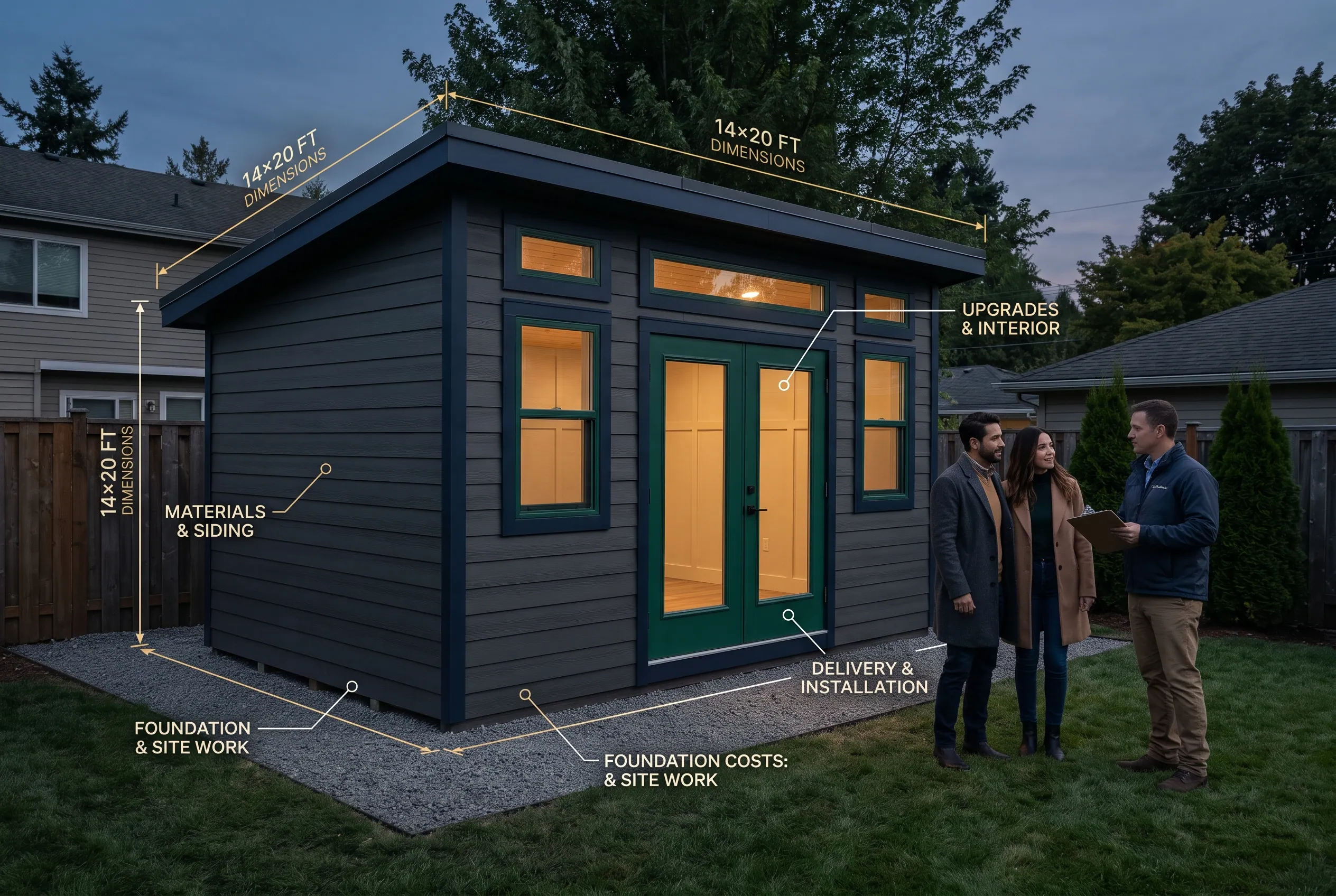
The price of a 14×20 shed depends on its purpose, materials, features, delivery arrangements, and installation needs.
One supplier-specific example is Three Five Sheds’ 2026 price list, which lists a 14×20 shed for $10,090, including installation. The supplier says prices can change without notice.
A finished office shed costs considerably more in another published example. White Pine Structures’ office-shed pricing lists 14×20 models from $19,010 to $22,040, depending on the siding selected. Those prices are effective from April 2026, subject to change, and exclude delivery, options, and sales tax.
These are examples from two different suppliers, not a national average. A basic storage building is not directly comparable to a finished, insulated office.
Before financing, ask for an itemized quote covering:
| Cost item | What to verify |
| Shed itself | Size, materials, doors, windows, and included features |
| Delivery | Distance limits and extra delivery charges |
| Installation | Whether setup is included in the advertised price |
| Foundation or site work | Gravel, concrete, leveling, or other preparation |
| Permits | Whether local rules require approval or inspections |
| Taxes | Applicable sales taxes and other required charges |
| Upgrades | Electrical work, insulation, shelving, or customized features |
Your final project price may differ from the financing amount if some costs are not eligible for the loan.
How Do You Compare Shed Financing Costs?
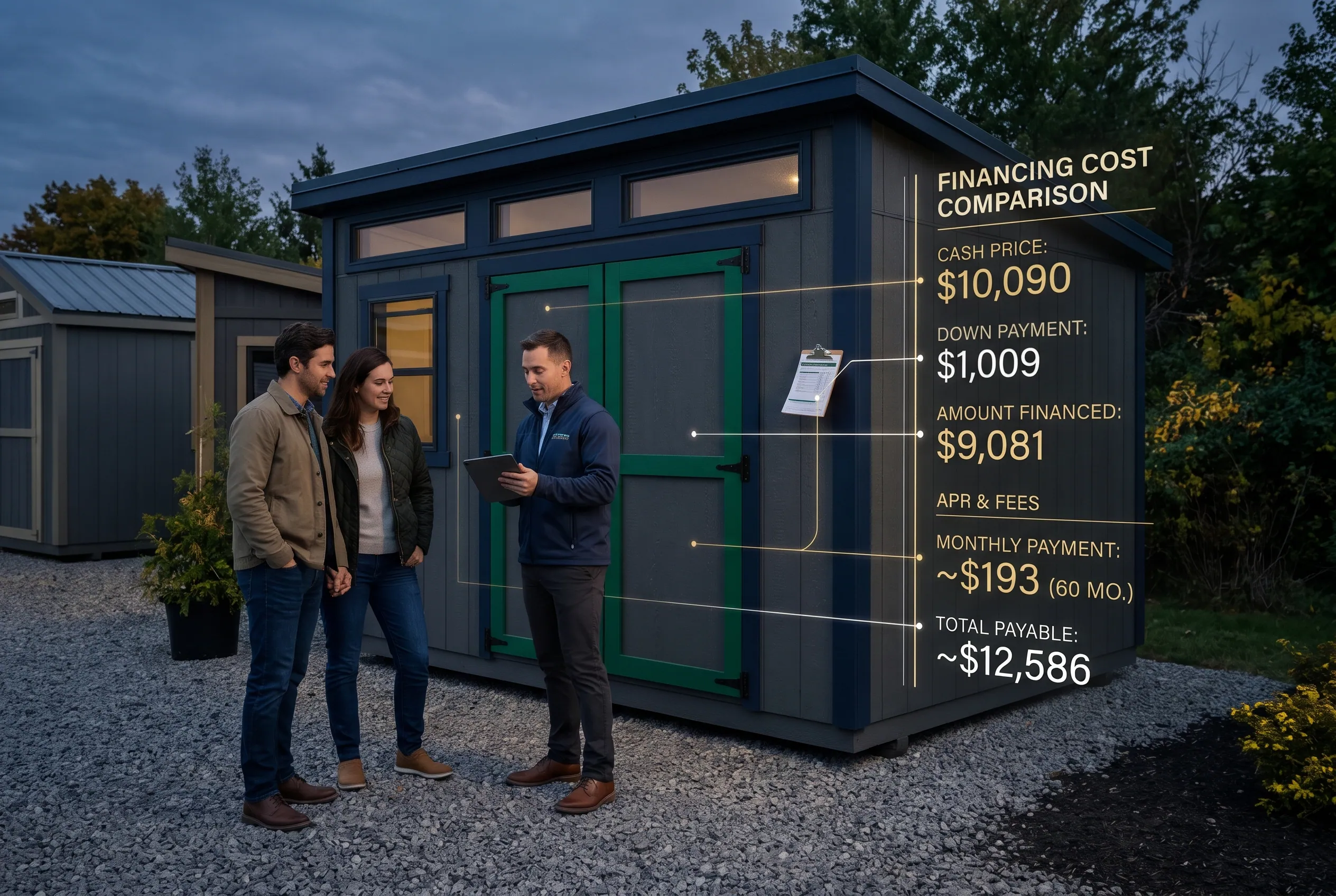 The most useful comparison includes the amount you borrow, the annual percentage rate (APR), fees, repayment period, monthly payment, and total amount payable.
Understand APR and interest
The interest rate measures the cost of borrowing the principal, which is the amount borrowed before interest and fees. APR, or annual percentage rate, provides a broader borrowing-cost measure that includes interest and certain fees.
The CFPB’s explanation of interest rate and APR explains why these measures should not be treated as interchangeable.
When comparing two offers, use APR where applicable, and examine the full loan disclosure for fees and repayment terms. Compare similar loan amounts and periods whenever possible.
Example: Financing a $10,090 shed
Imagine that a shed costs $10,090, including installation. Suppose a lender offers a hypothetical five-year loan with a 10% fixed annual interest rate, and you make a 10% down payment.
These assumptions are for illustration only. They are not an actual lender offer or a statement of eligibility.
| Calculation | Estimated amount |
| Shed cash price | $10,090 |
| Down payment (10%) | $1,009 |
| Amount financed | $9,081 |
| Annual interest rate | 10% |
| Repayment period | 60 months |
| Monthly loan payment | About $193 |
| Total of 60 loan payments | About $11,577 |
| Total paid, including down payment | About $12,586 |
| Estimated borrowing cost | About $2,496 |
The example assumes equal monthly payments, a fixed annual interest rate, and no additional fees, taxes, or project costs beyond the stated shed price. Figures are rounded to the nearest dollar.
The estimated monthly payment looks manageable on its own, but the loan adds about $2,496 to the cash price over five years. Actual payments depend on the lender’s interest rate, APR, fees, and repayment terms.
A shorter repayment period would generally reduce total interest on a conventional fixed-rate loan, but it would also increase the required monthly payment.
Compare the total, not just the payment
When you receive financing quotes, write down these figures side by side:
- Cash price of the same shed.
- Down payment.
- Amount financed.
- APR and any separate fees.
- Monthly payment and number of payments.
- Total of all loan payments.
- Total out-of-pocket cost, including the down payment and upfront expenses.
This comparison helps you avoid choosing an offer simply because its monthly payment looks low.
What Credit Score Do You Need to Finance a Shed?
There is no single credit score that guarantees approval for every shed-financing program. Lenders use different rules, and their decisions may depend on more than your score.
They may review your income, existing debt payments, credit history, requested loan amount, and the repayment terms you choose.
If your credit is in good shape, compare several loan offers rather than assuming the seller’s financing is automatically cheapest. If your credit is weak, consider these steps:
- Ask about prequalification. Some lenders allow you to check likely eligibility with a soft credit inquiry, which generally does not affect your credit score. Confirm the lender’s process before proceeding.
- Compare actual loan offers. Check APR, fees, required down payment, and total repayment. A low advertised rate may not be available to every applicant.
- Review your credit reports. Correcting an inaccurate entry may help your application, although no specific score increase or approval can be promised.
- Consider reducing the purchase price. A smaller building or larger down payment may lower the amount you need to finance, provided you do not drain your emergency savings.
- Treat no-credit-check offers carefully. They may offer an alternative, but verify the full cost and ownership conditions.
A hard inquiry can affect your credit score, and missing loan payments may also hurt your credit. Check what the application involves before authorizing it.
If no reasonable financing option fits your budget, delaying the purchase and saving toward it may be safer than accepting a contract with unaffordable payments.
Which Shed Financing Companies and Retailers Should You Compare?
Start with providers that sell the type of shed you need, then compare their written terms with outside loan offers.
Tuff Shed
Tuff Shed lists traditional financing through Service Finance and separate rent-to-own or lease options through other providers. Its published offers include a 9.99% fixed APR for 120 months, subject to program conditions, as well as promotional financing options.
Check the current offer, down payment, qualifying building, and total repayment on its official financing page.
Heartland Sheds
Heartland Sheds offers financing through Affirm. Its page advertises rates as low as 0% APR on eligible monthly installment plans and states that eligibility depends on factors such as the purchase amount and selected terms.
The company says the application uses a soft credit check and lists a $1,500 starting purchase threshold. Confirm the offer available for your order before relying on these conditions.
Sheds Unlimited
Sheds Unlimited describes several financing structures, including fixed monthly payments and deferred-interest options. Some advertised terms are state-specific, and other conditions apply.
Pay particular attention to whether interest accrues during a promotional period. Small payments during that period may not pay off the balance before deferred interest becomes due.
Shed World and Local Dealers
Shed World’s financing page provides another place to investigate financing options. Local dealers may also work with outside financing companies or rent-to-own providers.
Availability, deposit requirements, and repayment terms can differ by location. Ask for a written quote rather than relying on a general advertisement.
Home Depot and Lowe’s
Retailer credit cards may be useful when the building purchase qualifies for the current offer. However, the existence of a general credit-card promotion does not guarantee that a particular shed, delivery charge, or installation order is eligible.
Before applying, confirm the qualifying purchase, standard APR, promotional deadline, and any interest that could apply if you miss the deadline.
Important: Provider examples are not endorsements. Compare the actual terms you qualify for, and verify promotional offers again before signing because they can change.
How to Use a Shed Financing Calculator
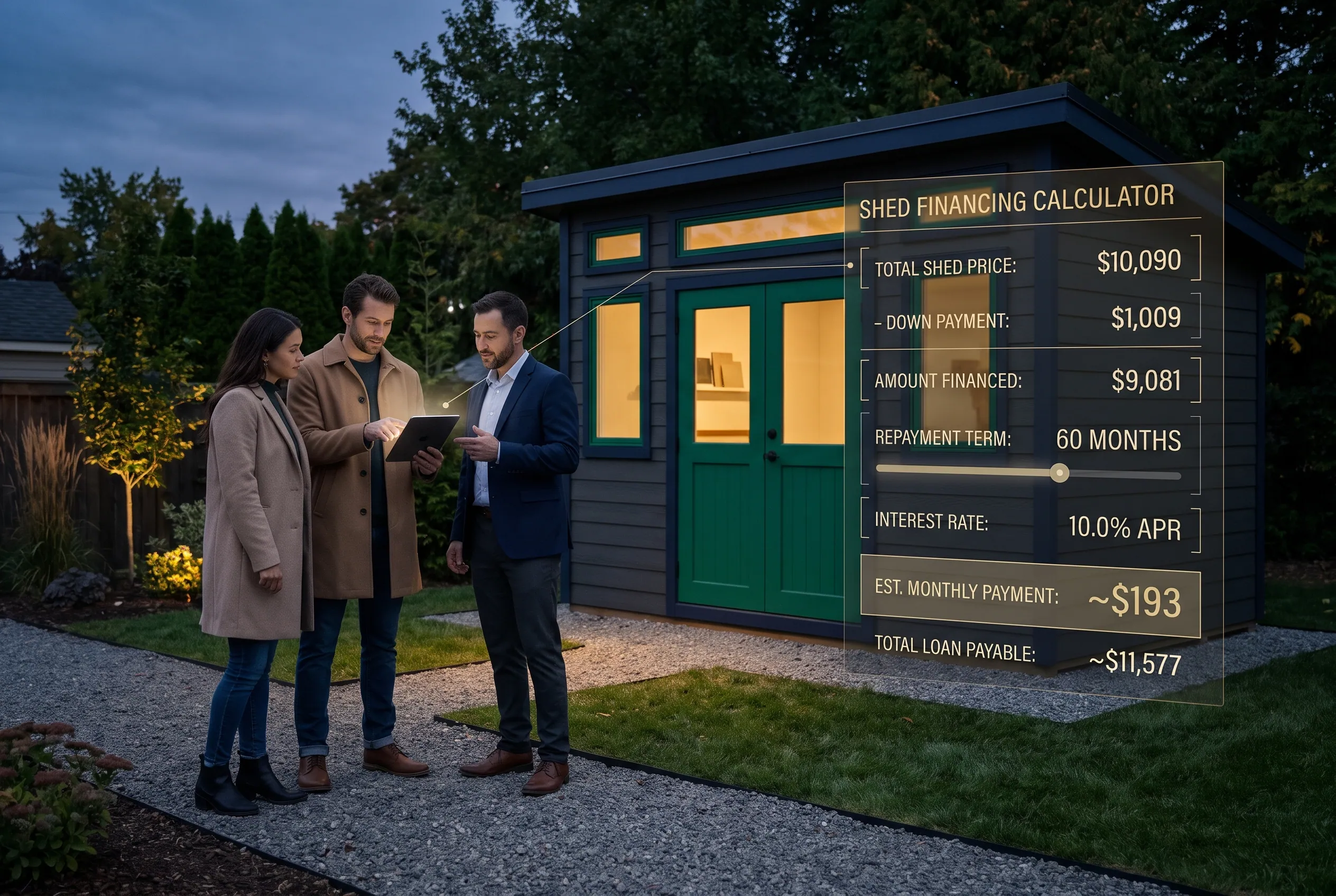 A shed financing calculator estimates your monthly payment from the amount borrowed, interest rate, and repayment term. It can help you decide whether a purchase fits your budget before you apply.
To use one:
- Enter the shed’s total eligible purchase price.
- Subtract your planned down payment to find the amount financed.
- Enter the loan’s interest rate or the calculator’s required rate measure.
- Select the repayment term in months.
- Review the estimated monthly payment and total loan payments.
- Add known fees and project costs that the calculator does not include.
For a conventional fixed-rate installment loan, a calculator typically estimates equal monthly principal-and-interest payments. Do not treat that estimate as a lender quote; exact fees and disclosures may change the result.
If the offer uses deferred interest, rent-to-own payments, or another special structure, a standard loan calculator may not reflect its full cost. Request a repayment schedule from the provider and compare the total amount payable under the contract.
The useful result is not simply a low monthly payment. It is a realistic estimate that includes the costs you must cover now and throughout the agreement.
What Should You Check Before Signing a Shed Financing Agreement?
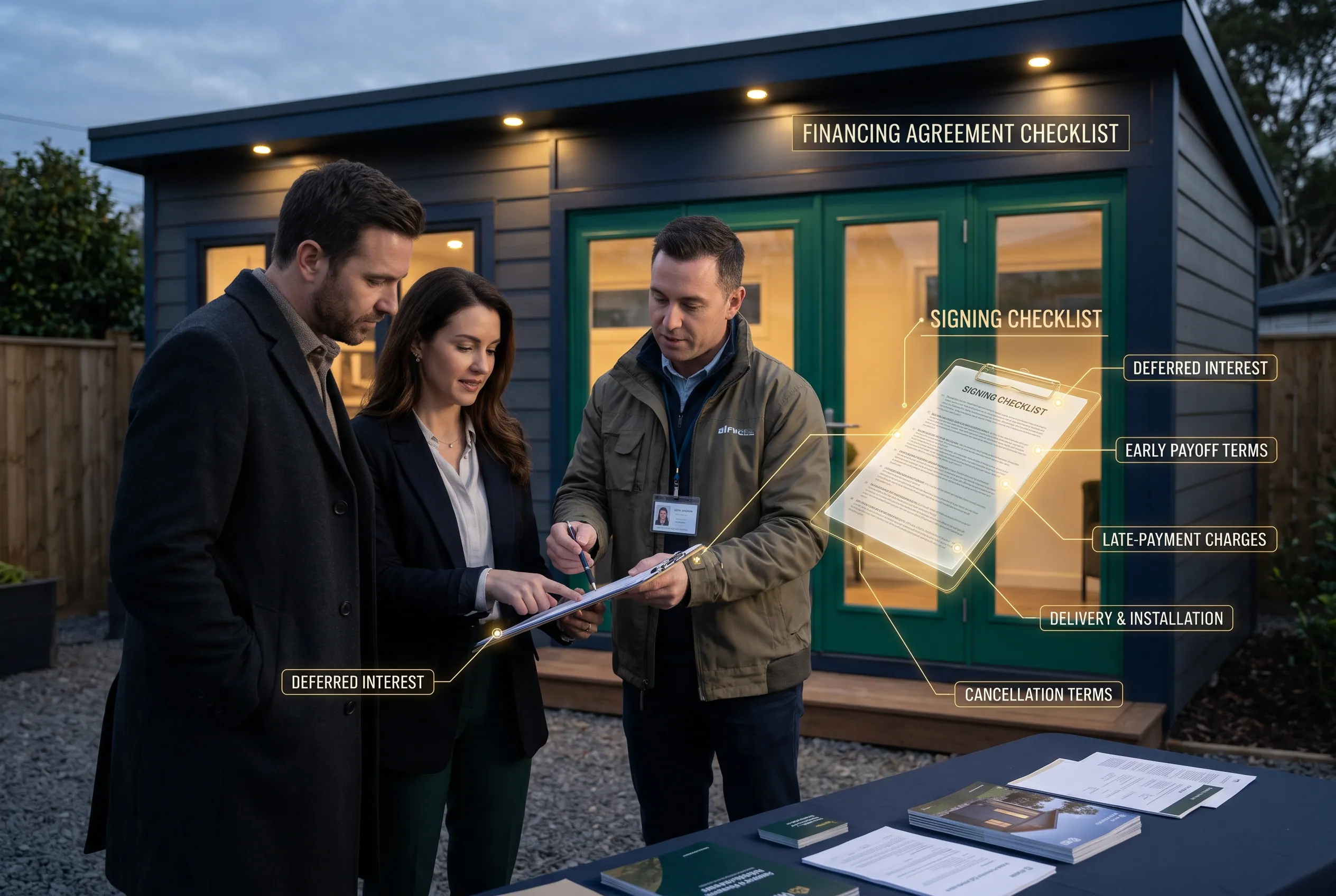 Before accepting a financing offer, read the contract and compare it with the written cash-price quote.
Pay particular attention to these risks before you commit:
- Deferred interest: Confirm the promotion’s end date and whether interest accrued during the promotion will be charged if you fail to clear the balance.
- Late-payment charges: Check when a payment becomes late and what fees or other consequences may follow.
- Early payoff: Find out whether you can repay the loan early without a penalty and how much you would owe on a particular date.
- Rent-to-own ownership: Confirm when ownership transfers and what happens if you stop paying or return the building.
- Delivery and installation: Verify that the quoted price includes the work needed to place the shed on your property.
- Cancellation terms: Ask what happens if you cancel after ordering or if the installation cannot proceed.
- Credit reporting: Check whether payments may be reported to credit bureaus and how missed payments are handled.
Keep a copy of the agreement, the final quote, and the payment schedule. If a salesperson promises a special condition, make sure that promise appears in the written terms.
When a contract’s total cost or ownership conditions remain unclear, ask the provider to explain them in writing before proceeding.
Should You Finance a Shed or Save and Pay Cash?
Financing may be useful if you need the shed soon, can afford the repayments, and have found terms that are reasonable compared with the cash price.
Paying cash avoids borrowing interest, but using all your savings for a shed can leave you unprepared for an emergency. Consider your remaining savings, household bills, existing debts, and likely project expenses before deciding.
Saving for longer may be a better option if financing is expensive or the purchase can wait. You could also select a smaller shed, reduce optional upgrades, or divide the project into stages.
The right choice balances timing, total cost, and financial flexibility. Do not take on an agreement merely because the seller advertises a low initial payment.
Frequently Asked Questions About Shed Financing
Can You Finance a Shed With No Credit Check?
Some shed dealers and rent-to-own providers advertise no-credit-check lease options. Their eligibility rules, deposits, total payments, and ownership conditions vary. A lack of credit check does not guarantee approval or make the plan inexpensive.
Does Home Depot or Lowe’s Financing Cover a Shed?
Both retailers advertise credit-card financing offers, but you must confirm whether your specific shed order qualifies. Check the current promotion, qualifying purchase amount, standard APR, and deadline before relying on a promotional rate.
How Much Would a 14×20 Shed Cost With Financing?
A supplier’s published price can provide a starting point. For example, Three Five Sheds lists a 14×20 shed at $10,090, including installation, on its 2026 price list. Your financed cost will depend on your down payment, interest rate, fees, repayment period, and any additional project expenses.
Can You Finance a Shed With Bad Credit?
Possibly. Some lenders consider applications from borrowers with different credit profiles, but approval and terms vary. Compare the total cost of any available loan or lease-purchase plan before accepting a high-cost offer.
Your Shed Financing Checklist
Before you commit, make sure you have:
- A written quote for the complete shed project.
- At least two suitable financing offers to compare.
- The APR, fees, monthly payment, and total repayment for each offer.
- Written details of promotional deadlines or rent-to-own ownership conditions.
- A payment amount that fits your budget without exhausting emergency savings.
The best shed financing choice is the one you understand, can comfortably repay, and can justify after comparing the full cost with paying cash. Take time to check the numbers and contract before you sign.
Disclaimer
This article provides general financial education, not personalized financial, investment, legal, or tax advice. Financing terms, costs, eligibility, and legal requirements vary, and approval or savings are not guaranteed. Review the agreement carefully and seek qualified advice when needed.