

Building a real estate portfolio with duplexes starts with one good property, a realistic budget, and a plan for managing rental income and expenses. You do not need to buy several properties at once. A better approach is to buy a duplex you can afford, learn how to manage it, and use its actual financial performance to guide your next decision.
One practical starting strategy is house hacking. You buy a duplex, live in one unit, and rent out the other. The rent can help cover your housing costs while you learn to manage tenants and maintain a property. However, loan approval, positive cash flow, and future purchases are never guaranteed. Your results depend on the property price, financing, local rental demand, expenses, and available savings.
Here is how to build your duplex portfolio step by step, from preparing your finances to deciding when you are ready for another property.
Direct Answer
Start with one duplex you can afford, compare eligible financing, and calculate rent after vacancy, operating costs, repairs, and mortgage payments. Build reserves before buying, then consider another property only when your finances and first property’s performance support it.
What Does It Mean to Build a Real Estate Portfolio With Duplexes?
A duplex is a residential property with two separate living units. Each unit usually has its own living space, kitchen, and bathroom. Depending on the building, the units may sit side by side or one above the other.
A real estate portfolio is the collection of properties you own as investments. You can begin with one duplex and add more properties as your finances, experience, and investment goals allow.
Duplexes appeal to beginners because one property can provide two potential rental-income streams. If you live in one unit, the other may generate rent. If you later move elsewhere and rent both units, the duplex may become a fully rented investment property.
But owning two rental units does not guarantee a profit. You remain responsible for expenses such as property taxes, insurance, repairs, vacancies, and mortgage payments.
The goal is to buy a property that fits your budget and has rental income that reasonably supports its costs. Any future purchase should pass the same test.
Is House Hacking a Good Starting Strategy?
House hacking can be a useful entry point for investors who want to own a property and are comfortable living close to their tenants.
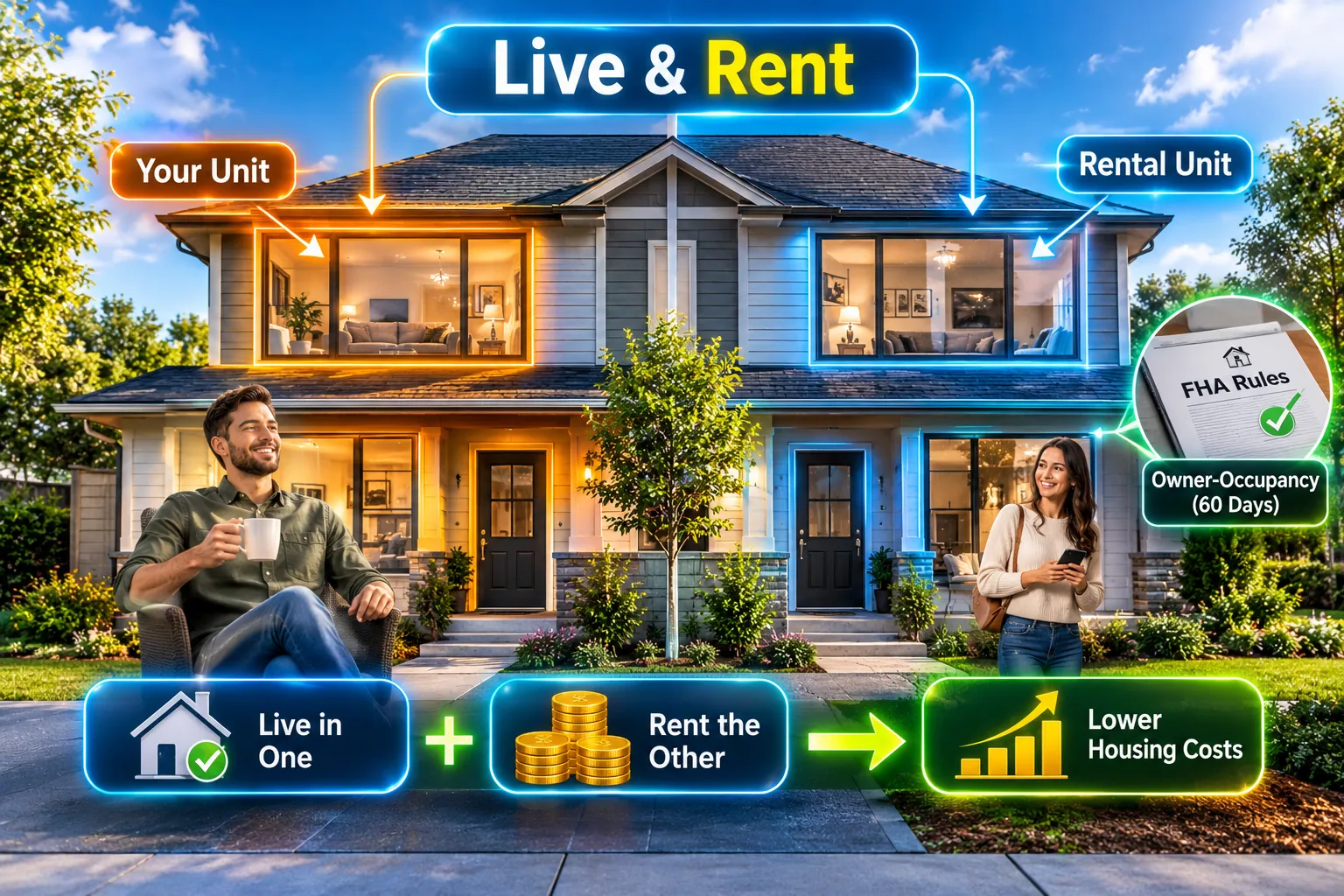
Live in One Unit and Rent Out the Other
Imagine buying a duplex with two similar units. You occupy one and rent the second to a qualified tenant.
The rental income may reduce the amount you pay toward housing each month. You also learn the basics of tenant communication, maintenance, rent collection, and property expenses while managing a relatively small investment.
Before buying, consider three questions:
- Can you afford the full mortgage payment if the rented unit is vacant?
- Are you comfortable handling tenant requests while living next door?
- Does the rental income help your budget after expenses, rather than just before them?
Your answer to these questions matters more than the idea of collecting rent alone.
Important: Owner-occupied financing comes with occupancy conditions. Under the standard FHA principal-residence rule, at least one borrower must generally occupy the property within 60 days of signing the security instrument and intend to remain for at least one year. Check the current HUD FHA Single Family Housing Policy Handbook and your loan documents for the rules that apply to your loan. Do not use an owner-occupied loan based on a plan you do not genuinely intend to follow.
Compare Owner-Occupied and Investment Properties
There are two common ways to start.
| Factor | Owner-occupied duplex | Non-owner-occupied duplex |
| Living arrangement | You live in one unit | You live elsewhere |
| Rental income | Usually from the other unit | Potentially from both units |
| Financing | May qualify for owner-occupied loan programs | Investment-property lending rules apply |
| Daily responsibilities | You live close to the tenant | You manage the property remotely or locally |
| Main consideration | Personal housing costs and privacy | Full rental economics and operating costs |
House hacking may suit a buyer who wants to live in the property and has limited investment experience. Buying a rental-only duplex may suit someone with sufficient funds who prefers to keep personal housing separate.
Neither approach is best for everyone. Compare the total costs and obligations before choosing.
Prepare Your Budget and Choose a Financing Option
Your budget should include more than the down payment. You need enough money to complete the purchase, cover initial expenses, and manage unexpected problems after closing.
Calculate Your Down Payment, Closing Costs, and Cash Reserves
Start by listing your available savings. Then separate the money you can use for the purchase from the money you need to keep for other obligations.
Important costs include:
- Down payment.
- Lender fees, appraisal, title services, and other closing costs.
- Inspections and immediate repairs.
- Moving expenses and any necessary furnishings.
- Cash reserves for vacancies, repairs, and regular bills.
The Consumer Financial Protection Bureau’s home-buying guidance gives a general closing-cost estimate of 2% to 5% of the purchase price, excluding the down payment. Your actual costs depend on the loan, property, lender, and location. The CFPB also recommends keeping an emergency cushion rather than using all available savings at closing.

For example, suppose you are considering a duplex priced at $300,000 and qualify for an FHA loan with a 3.5% down payment.
| Cost | Illustrative amount |
| Purchase price | $300,000 |
| Down payment at 3.5% | $10,500 |
| Estimated closing costs at 2%–5% | 6,000–15,000 |
| Total before repairs and reserves | 16,500–25,500 |
This is a hypothetical illustration, not a loan quote. It excludes moving costs, immediate repairs, cash reserves, and any other expenses not included in the assumed closing-cost range.
A low down payment makes the initial purchase more accessible for some borrowers. It does not make the property inexpensive to operate.
Compare FHA, Conventional, and Eligible VA Financing
Three financing options may be worth exploring, depending on your circumstances.
FHA loans: The Federal Housing Administration insures loans made by approved private lenders. Eligible borrowers may qualify for a down payment as low as 3.5%. FHA loans require mortgage insurance, and maximum loan amounts vary by county. FHA financing can be useful for some buyers with smaller down payments, but it is not automatically the cheapest choice.
Consumer Financial Protection Bureau
Conventional loans: These loans are not insured by the FHA. Down-payment requirements and pricing depend on the loan program, borrower, property, and lender. Some programs allow owner-occupied buyers to purchase small multifamily properties. Ask whether the available program covers your intended duplex and compare its full costs with other offers.
VA loans: Eligible veterans and service members may have access to VA-backed financing. Certain multi-unit purchases can qualify when the borrower satisfies occupancy and other requirements. For example, the VA’s lender guidance sets additional conditions for using prospective rent from a multi-unit property, including reserve and landlord-capability requirements. Eligibility and terms must be confirmed with a VA-experienced lender.

Request written loan estimates from more than one lender. Compare interest rates, monthly payments, mortgage insurance, lender fees, required cash at closing, and applicable conditions. The lowest advertised rate may not produce the lowest overall borrowing cost.
Understand How Rental Income Affects Loan Approval
A lender may consider expected rental income when evaluating an eligible duplex loan. But you should not assume that the lender will count every dollar of advertised rent as your qualifying income.
Fannie Mae’s current rental-income guidance describes documentation and calculations for eligible two- to four-unit principal residences and one- to four-unit investment properties. Depending on the transaction, lenders may require a rental appraisal, comparable rents, lease documents, and other evidence. If a signed lease does not reasonably match market rents, the lender may need additional support or use a lower amount.
Fannie Mae
Before making an offer, ask the lender how it will evaluate rent from the second unit, what documents it needs, and how the property will affect your debt and reserve requirements.
Choose a Market and Find the Right Duplex
A low purchase price does not necessarily mean a good investment. Look for a property where local rental demand, condition, price, and expected expenses work together.
Research Local Rent and Comparable Properties
Start with rental listings for properties similar to the duplex you are considering. Compare units with similar size, condition, location, amenities, and utility arrangements.
Do not rely only on the highest advertised rent. Asking rent is not proof that a tenant will pay that amount or that the unit will remain occupied.
Check several factors:
- What are comparable units currently advertised for?
- How long do similar rentals appear to remain available?
- Are local employers and other sources of renter demand reasonably stable?
- Which utilities will tenants pay, and which will remain your responsibility?
- Are rents high enough to support the property’s expenses at a realistic purchase price?
National statistics can provide context, but local evidence should guide your decision. For example, the U.S. Census Bureau reported a national rental vacancy rate of 7.3% in the second quarter of 2026. That figure describes the broader housing market; it does not predict the vacancy rate of a particular duplex or neighborhood.
Press Release
Evaluate Location, Property Condition, and Landlord Rules
A property near employment centers, public transportation, schools, or everyday services may attract renters. But location alone cannot make an overpriced or poorly maintained property profitable.
Review the building’s age and condition. Ask about its roof, plumbing, electrical systems, heating, cooling, and other major components. Find out whether the units have separate meters and whether the property is legally approved for two living units.
You should also investigate local landlord-tenant rules, rental registration, inspection requirements, deposit limits, and applicable safety standards. Requirements differ by state and locality.
Before making a decision, get insurance quotes for the actual property. A building that looks affordable before insurance and repairs may become expensive after you account for them.
How to Calculate Cash Flow Before Buying a Duplex
The most useful way to assess a duplex is to estimate how much money remains after realistic expenses and financing costs.
Cash flow is the money left over after the property’s income pays its relevant expenses and debt obligations. Positive cash flow does not guarantee that the investment will increase in value, and negative cash flow does not automatically mean the property will never suit your goals. You need to understand why the numbers look the way they do.
Calculate Rental Income and Operating Expenses
Begin with the rent you reasonably expect to collect. Then allow for vacancies and the property’s operating costs.
Common expenses include:
- Property taxes and insurance.
- Routine maintenance and repairs.
- Owner-paid utilities and common-area costs.
- Property-management fees, if applicable.
- Vacancy and unpaid rent.
- Regular administrative and operating expenses.
Also plan separately for major replacements, such as a roof or heating system, and include the mortgage, mortgage insurance where applicable, and other financing costs in your final cash-flow calculation.
Understand Net Operating Income and Cash Flow
Net operating income (NOI) is rental income after vacancy and normal operating expenses, before mortgage payments and income taxes. Major capital improvements and replacement reserves should be tracked separately from the standard NOI calculation.
Cash flow goes a step further. It accounts for debt payments and the other cash expenses you need to fund.
A property can have positive NOI but negative cash flow if its mortgage payments are too high. This is one reason a rental property’s asking price and advertised rent are not enough to judge the deal.
Use a Worked Example to Test the Numbers
Suppose you buy a hypothetical duplex for $300,000. You estimate that each unit can rent for $1,400 per month, so the total scheduled rent is $2,800 per month.
The following figures are assumptions for learning purposes, not current market averages or a real property forecast.
| Annual calculation | Amount |
| Scheduled rent: $2,800 × 12 | $33,600 |
| Vacancy allowance: 5% of scheduled rent | −$1,680 |
| Estimated rent after vacancy | $31,920 |
| Property taxes | −$3,600 |
| Insurance | −$2,400 |
| Owner-paid utilities | −$1,200 |
| Routine maintenance | −$1,680 |
| Property management | −$2,554 |
| Estimated net operating income | $20,486 |
| Major-replacement reserve | −$1,500 |
| Mortgage principal and interest | −$21,000 |
| Estimated annual cash flow | −$2,014 |
The example produces a cash shortfall of about $168 per month, even though the duplex collects an estimated $2,800 in monthly rent when both units are occupied.
Property taxes and insurance are already included in operating expenses here. The assumed mortgage payment covers principal and interest only; it is not a loan quote. The example also does not include every possible cost, such as income taxes or any additional financing charges that might apply.
Your own numbers will vary, but the lesson is important: high rental income does not necessarily mean positive cash flow.
If a deal produces a shortfall, test what happens with a lower offer price, higher verified rents, different financing terms, or lower operating costs that you can reasonably support. Do not assume optimistic rent increases or reduced repairs simply to make a purchase look attractive.
Use the 1% Rule as a Screening Tool, Not a Guarantee
The 1% rule is a quick screening method. It asks whether a property’s monthly gross rent is about 1% of its purchase price.
For a $200,000 property, the rule would suggest looking for roughly $2,000 in monthly gross rent. It can help investors compare opportunities early in their search.
However, it ignores many important details, including financing costs, property taxes, insurance, vacancies, repairs, and local market conditions. A duplex that passes the rule may still lose money.
Use it to decide which properties deserve further analysis, not to decide whether a property will be profitable.
What to Check Before You Buy a Duplex
Once a property appears financially promising, inspect it before committing to the purchase.
The Consumer Financial Protection Bureau’s home-inspection guidance recommends arranging an independent inspection early enough to investigate problems and decide how to proceed.
Consumer Financial Protection Bureau
Your due-diligence process should cover the following areas.
Physical condition: Obtain an inspection and ask for specialist checks when needed. Get estimates for significant repairs rather than guessing how much they will cost.
Rental potential: Compare market rents with the leases, if any, already in place. Review tenant payment records where lawfully available and confirm whether the property’s rental setup meets local requirements.
Financial records: Review property taxes, insurance, utility bills, recent repairs, and other available records. Estimate any costs that may change after purchase.
Purchase terms: Understand your inspection contingency, financing contingency, deposit obligations, and deadlines. These rights depend on the signed contract and applicable law.
If the inspection reveals a costly defect, pause and evaluate the options available under your contract. You may seek a repair, negotiate the price, or decide not to proceed if your contractual rights allow it.
A promising rental estimate is not a reason to ignore a major structural problem or a financial commitment you cannot comfortably support.
Manage Your First Duplex and Protect Your Cash Flow
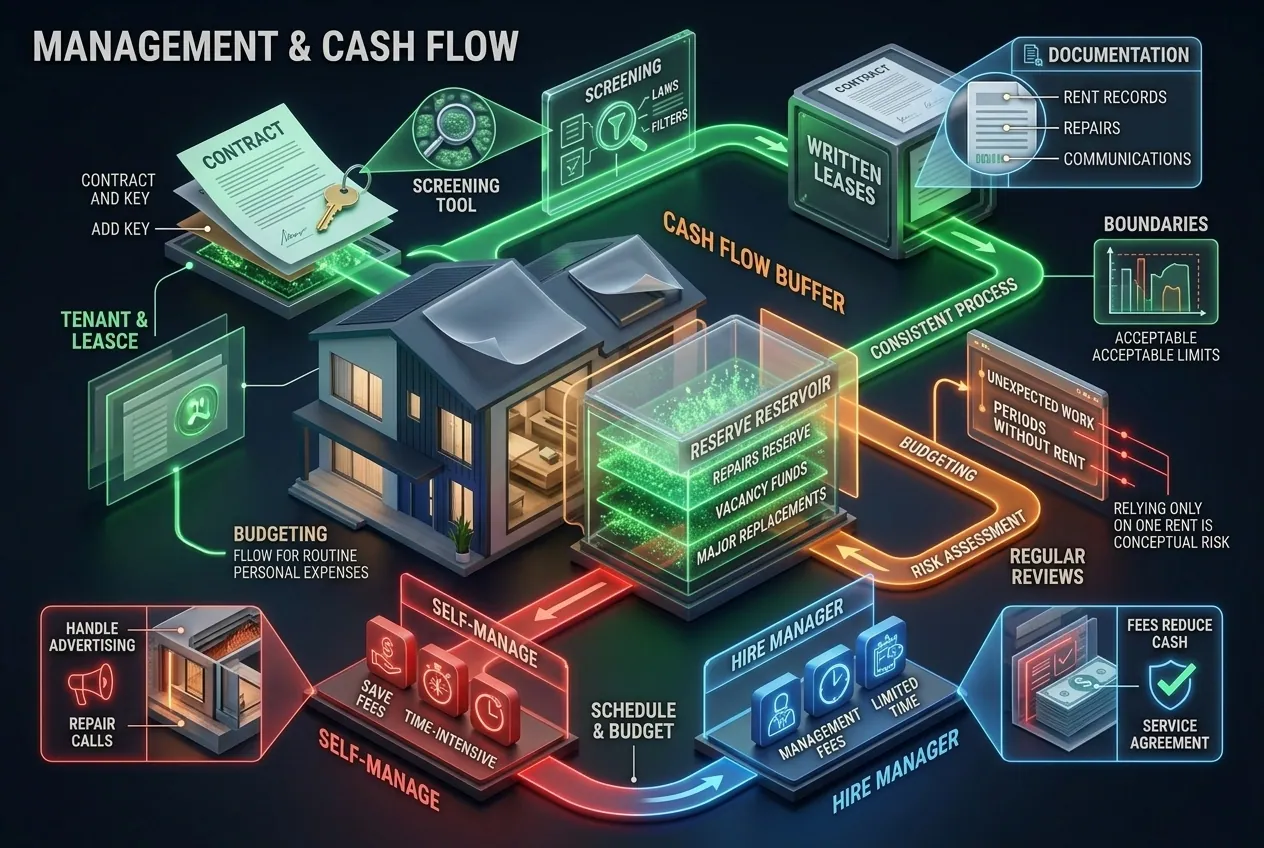
Buying the property is the beginning of the work, not the end. Good management helps protect rental income and makes it easier to judge whether the property is ready to support your next investment.
Set Up Tenant Screening, Leases, and Rent Collection
Create a consistent screening process that follows applicable federal, state, and local laws. Decide in advance how you will evaluate rental applications, document decisions, collect rent, and respond to maintenance requests.
Use written leases and keep records of payments, communications, repairs, and agreements. Clear documentation can help prevent confusion and make financial reviews easier.
If you live in one unit, set reasonable boundaries. You can be responsive without agreeing to every request immediately or allowing informal conversations to replace written records.
Budget for Repairs, Vacancies, and Major Replacements
Keep reserves separate from the money you use for routine personal expenses. Estimate likely maintenance needs from the property’s condition and repair history. Then decide how much cash you need to keep available for unexpected work and periods without rent.
Do not rely on rent from the second unit to cover every bill precisely on time. A tenant may move out, a repair may delay a new rental, or an insurance premium may increase.
Review your actual numbers regularly. Compare collected rent with expected rent, track expenses, and investigate any repeated overspending. The goal is to identify problems before they become a cash crisis.
Decide Whether to Self-Manage or Hire a Property Manager
Managing a duplex yourself can save management fees, but it takes time. You may need to handle advertising, applications, leases, repair calls, rent collection, and tenant concerns.
A property manager may suit an owner with limited time, a demanding job, or plans to buy properties in other locations. However, management fees reduce the cash available from rent, and the service agreement needs careful review.
Compare actual service costs, included tasks, repair approval limits, lease fees, and contract termination terms. Choose the approach that fits your schedule and budget.
How to Expand Your Duplex Portfolio Without Overextending
Your first duplex should teach you whether your investment assumptions match reality. Use what you learn before committing to another property.
Review Your First Property’s Actual Performance
After you have collected rent and paid expenses for a reasonable period, compare the results with your original estimates.
Ask yourself:
- Did the property collect the rent you expected?
- Were maintenance and operating costs close to your budget?
- Did vacancies or repairs reduce cash flow?
- Are your reserves still adequate?
- Can you manage the property without neglecting your other obligations?
If the answers reveal a weak deal or unstable cash flow, improve the operation or strengthen your finances before expanding.
Understand Equity, Refinancing, and Future Financing
Equity is the difference between a property’s current value and the debt secured against it. As you repay the mortgage or property values change, your equity may increase or decrease.
Some investors consider refinancing or borrowing against equity to help fund another property. These approaches can involve closing costs, new debt payments, changing interest rates, and the risk of losing the property if payments are not made.
Equity is not the same as cash you can safely spend. Before borrowing, compare the new payment with realistic rental income and determine whether the existing property could handle a vacancy or major repair.
Decide When You Are Ready for Another Property
There is no universal rule that says you must buy another duplex every year. A better decision depends on your financial position, the current property’s performance, and the next deal’s numbers.
Consider another purchase only when you can cover the new property’s cash requirements, maintain reserves for existing obligations, satisfy the lender’s requirements, and manage the added workload.
You may be ready to expand after your first property demonstrates stable operations and your finances can support another purchase. You may also decide that owning one well-managed duplex is enough for your goals.
Portfolio growth should improve your financial position, not leave you dependent on every tenant paying on time.
Common Mistakes to Avoid When Investing in Duplexes
Many costly mistakes begin with a budget or assumption that is too optimistic.
Using all your savings for the down payment. Keep funds for closing, repairs, vacancies, and emergencies. A property that leaves you unable to pay for a necessary repair can put the entire investment under pressure.
Treating gross rent as profit. Calculate operating expenses and debt payments before deciding whether the deal works.
Skipping an independent inspection. Hidden problems can turn a good-looking purchase into an expensive repair project.
Relying only on the 1% rule. Use full financial calculations and local rental evidence rather than a single shortcut.
Ignoring the landlord’s workload. Tenant communication, maintenance, and recordkeeping require time even when you own only one duplex.
Expanding before the first property is stable. Additional properties introduce more debt, expenses, and responsibilities. Learn from your first investment and confirm you can afford the next one before proceeding.
Frequently Asked Questions
What is the 1% rule for duplexes?
The 1% rule suggests that monthly gross rent should be about 1% of a property’s purchase price as an initial screening guideline. It does not account for all expenses or financing costs, so it cannot guarantee a profitable duplex.
How much money do you need to buy a duplex?
The amount depends on the purchase price, loan type, down payment, closing costs, repairs, and required reserves. Some eligible FHA borrowers may qualify for a 3.5% down payment, but that is only one part of the total cash needed.
How profitable can owning a duplex be?
Profitability depends on rental income, vacancies, operating expenses, financing, repairs, and taxes. Calculate the property’s likely cash flow using realistic local numbers before buying. A duplex can generate rent and still produce negative cash flow.
Can you build a real estate portfolio starting with one duplex?
Yes. You can start with one duplex, learn to operate it, review its financial results, and consider another property when your finances and experience support the decision. You do not need to expand every year for the first property to be worthwhile.
Your First Step Toward a Duplex Portfolio
Start by reviewing your available savings, existing debts, and monthly budget. Then research rental properties in a market you understand and estimate both the purchase costs and the ongoing expenses.
Compare financing options with qualified lenders, use realistic rent estimates, and keep enough cash available to handle unexpected problems. A duplex portfolio grows through informed decisions, careful management, and patience—not simply by buying more properties.
Disclaimer
This article provides general educational information, not individualized financial, legal, or tax advice. Costs, financing terms, landlord rules, and results vary by property, lender, location, and personal circumstances; returns are not guaranteed. Confirm loan terms with a qualified lender and seek qualified legal or tax help for decisions that require it.