
Leasing commercial laundry equipment can help you install heavy-duty washers and dryers without paying the full purchase price upfront. It can also make equipment costs easier to plan, especially when a lease includes maintenance and repairs.
However, leasing is not automatically cheaper than buying. Your actual cost depends on the machines you need, the contract length, installation requirements, service coverage, and what happens when the agreement ends. Before signing, compare the total scheduled payments with the cost of buying or financing similar equipment.
This guide explains how commercial laundry equipment leasing works in the United States, what published prices can tell you, and how to choose an arrangement that fits your business.
Direct Answer
Leasing commercial laundry equipment lets a business use heavy-duty washers and dryers for scheduled payments instead of buying them upfront. Costs, maintenance, ownership, and exit options depend on the contract.
Experience
Before accepting a lease, multiply the monthly payment by the number of contract months, then add upfront expenses and excluded costs. Compare that total with buying or financing similar equipment, and confirm maintenance coverage and end-of-term conditions in writing.
Is Leasing Commercial Laundry Equipment Right for Your Business?
Leasing may be a good choice if you need commercial washers and dryers but want to keep more cash available for other business expenses. It can be especially useful when opening a laundromat, upgrading hotel laundry facilities, or installing shared laundry machines in an apartment building.
Commercial laundry equipment costs more than many household appliances because it must handle heavier loads and frequent use. A business may also need several machines, installation work, and suitable water, drainage, electrical, or gas connections.
Leasing can spread equipment costs across monthly payments instead of requiring the full purchase amount immediately. Some providers also include service and repairs, which can make maintenance costs easier to predict.
But there are trade-offs. You may pay more over the contract term than you would by buying equipment outright. You may also have limited control over equipment replacement, upgrades, and early termination.
Leasing is worth considering when:
- You want to preserve cash for rent, wages, supplies, and other startup expenses.
- You need equipment quickly but do not want to buy everything upfront.
- You prefer an agreement that includes clearly defined maintenance services.
- You operate a shared laundry room where a provider offers equipment and ongoing service.
Buying may make more sense if you have enough available capital, expect to use the machines for many years, and can manage repairs yourself. Financing may provide a middle ground by spreading the purchase cost across loan payments while allowing you to acquire the equipment.
The key is to compare costs and responsibilities, not just monthly payments.
How Does Commercial Laundry Equipment Leasing Work?
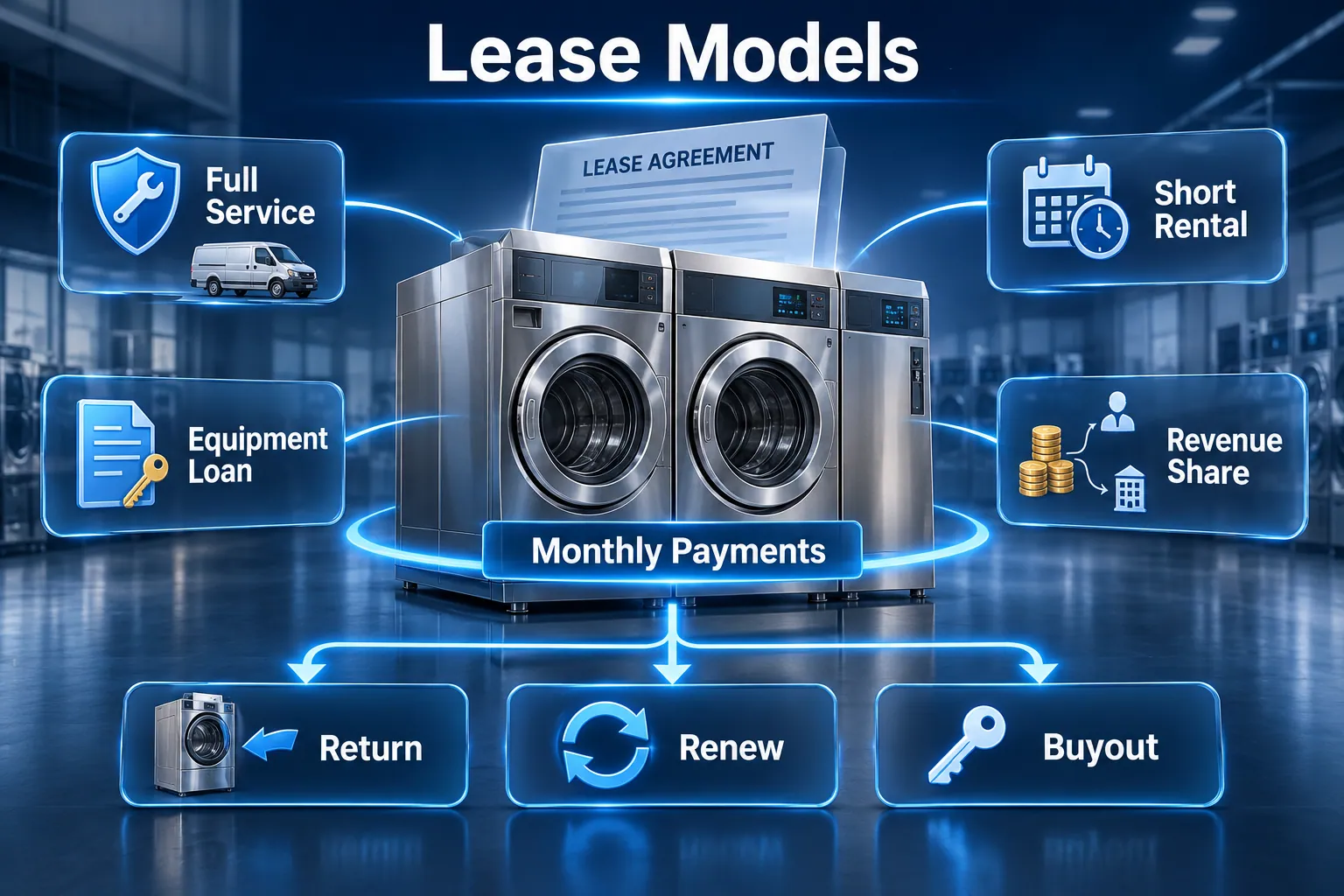
A commercial laundry equipment lease is an agreement that allows your business to use specified washers, dryers, or other equipment in exchange for payments over an agreed period.
The provider supplies the equipment under the contract. Depending on the arrangement, the provider may also handle installation, maintenance, repairs, or equipment replacement.
You pay according to the agreement, but you do not necessarily own the machines. Some contracts provide an option to purchase the equipment at the end, while others require you to return it or renew the agreement.
Common leasing and payment options
1. Full-service equipment lease
A full-service lease combines equipment use with specified support services. Depending on the provider, the monthly payment may include delivery, installation, parts, routine maintenance, and repairs.
This arrangement can help a business avoid some unexpected repair bills. However, you should verify exactly what is covered. Major repairs, misuse, site damage, and replacement equipment may be subject to separate conditions.
2. Equipment rental
Rental arrangements can offer flexibility when you need equipment for a shorter period or want to test a setup before making a longer commitment.
Check whether the agreement allows early return and whether short rental periods carry higher monthly charges. A rental may not include maintenance or provide an option to purchase.
3. Equipment financing
Financing generally means borrowing money to buy the machines and repaying the loan over time. Payments may include principal, interest, and fees.
Unlike a standard rental, financing is intended to fund a purchase. You may own the equipment subject to the loan agreement, security interest, and repayment obligations.
For example, Speed Queen Commercial’s financing information describes equipment loans and related promotional offers. These are financing arrangements, not standard leases. Review the current rate, fees, repayment period, and approval requirements before comparing them with a lease.
4. Revenue-sharing arrangements
Revenue sharing is common in some shared laundry-room settings, such as apartment communities. A provider may install and service machines in exchange for a share of the money residents pay to use them.
This may reduce the property owner’s equipment responsibilities and initial spending. In return, the owner may give up part of the laundry income.
The agreement should clearly explain how revenue is calculated, which party collects payments, who handles repairs, and how long the arrangement lasts.
Who owns the machines?
Never assume you will own the equipment after making the final payment.
Read the agreement to establish whether you must return the machines, can renew the lease, or have a purchase option. If a buyout is available, find out the required payment and any conditions attached to it.
The U.S. Small Business Administration’s leasing guidance notes that leases can have different structures, including buyout options and early termination penalties. Those details can materially affect the value of a deal.
How Much Does It Cost to Lease Commercial Laundry Equipment?
There is no single monthly price for commercial laundry equipment leasing in the United States. A small shared laundry room and a busy self-service laundromat have different equipment needs, so their quotes may differ significantly.
Prices also depend on machine size, brand, quantity, contract length, location, installation work, and service coverage.
Published provider prices
The following examples show why it is important to request a quote for your own equipment needs.
| Provider and equipment category | Advertised starting price |
| Southeastern Laundry — on-premises laundry | $115 per month |
| Southeastern Laundry — multifamily housing | $85 per month |
| Southeastern Laundry — laundromat | $205 per month |
| Oasis Laundry — vended dryer | $125 per month |
| Oasis Laundry — stacked dryer unit | $200 per month |
| Oasis Laundry — vended express washer | $205 per month |
These are provider-published starting prices reviewed on October 22, 2026. They are not nationwide averages, guaranteed offers, or directly comparable packages.
For example, Southeastern Laundry lists prices by business category, while Oasis Laundry gives examples for specific machine types. The published information does not establish that every figure covers the same equipment quantity, capacity, contract length, or service package.
Southeastern Laundry also advertises installation, parts, service, and repairs as benefits of its leasing arrangements. Your written quote should confirm whether those services apply to the specific offer you receive.
Check each provider’s service area as well. A company may advertise commercial laundry leasing without supporting your location.
What affects your monthly lease payment?
Several factors can change the price.
Machine capacity. Larger machines can handle bigger loads, but they may cost more to lease. Choose capacity based on expected laundry volume rather than simply selecting the smallest monthly payment.
Number and type of machines. A business may need multiple washers, dryers, stacked units, or machines with different load capacities. The total package matters more than the advertised price of one component.
Contract duration. A longer agreement may reduce the monthly payment but increase the total amount committed. A shorter contract may cost more each month.
Maintenance coverage. A lease that includes parts and repairs may have a different price from an equipment-only rental. Compare the actual coverage rather than treating every lease as full-service.
Installation requirements. Delivery may be included, but your property could need new plumbing, drainage, electrical work, gas connections, or ventilation. These expenses can make a low monthly payment less attractive.
Equipment condition and features. New and used machines can have different costs and maintenance needs. Payment systems, controls, energy efficiency, and specialized laundry requirements may also affect the quote.
Calculate the total scheduled lease payments
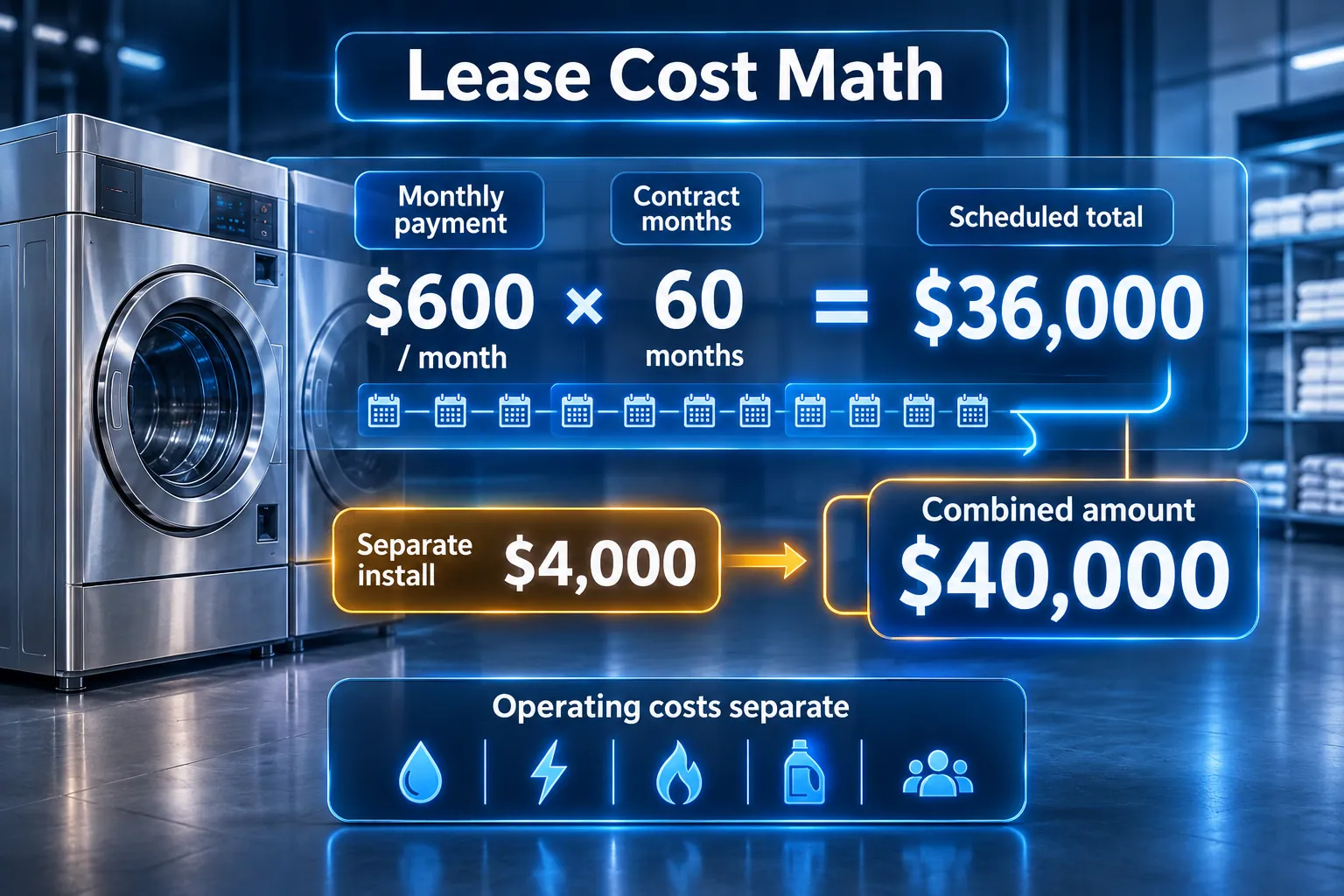
Monthly cost alone does not show the full financial commitment.
Use this simple formula:
Total scheduled lease payments = Monthly payment × Number of contract months
For example, imagine a business receives a hypothetical quote of $600 per month for a 60-month equipment lease.
- Monthly payment: $600
- Contract length: 60 months
- Total scheduled payments: $600 × 60 = $36,000
The business would commit to $36,000 in scheduled lease payments over five years, before any additional costs not included in the quote.
Suppose the business also needs $4,000 of separate installation work. If that expense is paid upfront and is not included in the lease, the combined amount becomes $40,000.
This example is for planning only. It is not a real provider quote.
The calculation also does not include water, electricity, gas, detergent, labor, or other operating expenses. Those costs need to be budgeted separately unless the contract specifically covers them.
Before comparing offers, ask each provider for an itemized written quote showing the monthly payment, contract duration, upfront fees, installation, included services, excluded expenses, and end-of-term costs.
Leasing vs. Buying vs. Financing: Which Option Fits Your Business?
The right option depends on available cash, expected equipment use, maintenance responsibilities, and your plans for the business.
| Factor | Leasing | Buying outright | Financing a purchase |
| Upfront cost | May be lower | Highest initial cash need | May require a down payment |
| Monthly obligations | Lease payments | No loan payment if paid in cash | Loan repayments |
| Equipment ownership | Depends on contract; often retained by provider during the lease | Business owns the equipment | Ownership and lender rights depend on the loan agreement |
| Maintenance | May be included | Usually the owner’s responsibility | Usually the owner’s responsibility unless separately covered |
| Long-term cost | Can be higher than buying | May be lower over the equipment’s useful life | Includes interest and fees |
| End-of-term options | Return, renew, or buy if permitted | Keep, sell, or replace | Continue ownership after meeting repayment obligations |
When leasing may be a better fit
Consider leasing when preserving cash is important and the contract provides useful services at a reasonable total cost.
For example, a new laundromat may need money for signage, rent, permits, staff, and marketing in addition to equipment. A lease may leave more cash available for those expenses.
However, the business still needs enough income to make payments throughout the agreement. If customer demand takes longer than expected to develop, fixed payments can become a burden.
When buying may be a better fit
Buying may suit an established business with enough cash to purchase appropriate equipment while keeping sufficient money available for operating expenses and unexpected problems.
Ownership gives the business more control over the equipment. The owner may also be able to sell the machines later, although their resale value and condition are not guaranteed.
The trade-off is that major repairs and replacement costs can fall directly on the business.
When financing may be worth comparing
Financing lets you spread a purchase across repayments instead of paying the full price upfront.
But do not judge a loan only by the monthly installment. Compare the interest rate, fees, total repayment, term, collateral requirements, and consequences of missed payments. A low starting rate may change if the loan has a variable interest rate.
A practical approach is to request three comparable proposals: a lease, a purchase quote, and a financing offer. Compare the same equipment specifications and account for service costs that are treated differently under each option.
How to Choose the Right Machines and Service Plan
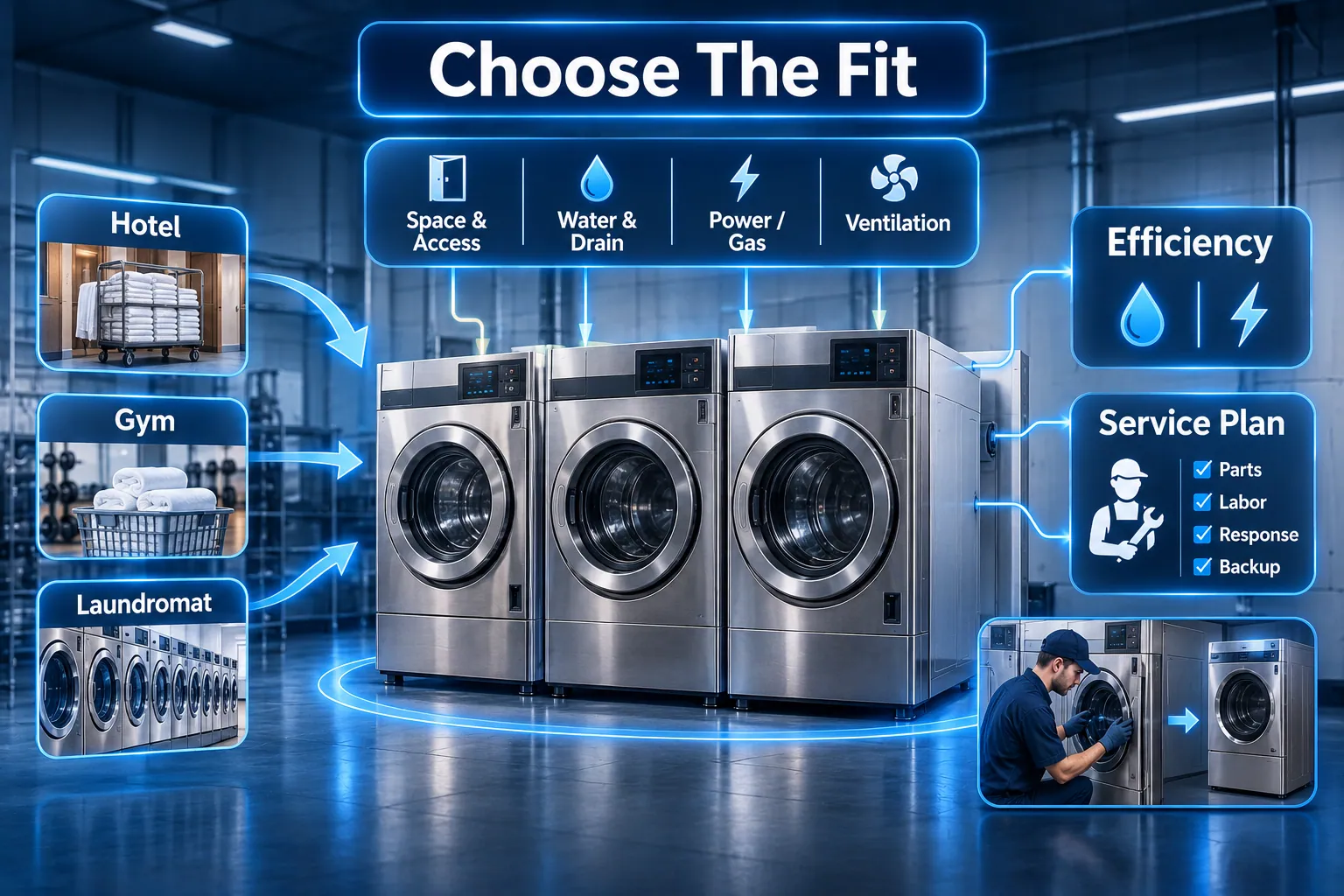
A lease can be financially attractive and still be a poor choice if the equipment cannot handle your workload. Start with the work your business needs to complete each day.
Match equipment to your laundry volume
Estimate how much laundry you expect to process during normal and busy periods. A hotel handles towels, sheets, and other linens, while a gym may handle towels and customer garments. A self-service laundromat must provide enough machines to serve customers during peak hours.
Consider the number of daily loads, average load size, turnaround time, and expected busy periods. If your business already processes laundry, use actual operating records where available.
For a new business, build a reasonable estimate and test how sensitive your budget is to lower or higher demand.
Do not lease more capacity than you can use simply because a provider offers a larger package. On the other hand, undersized equipment can create queues, delayed service, and lost business.
Check installation and operating needs
Before accepting a quote, confirm that the machines can be installed at your property.
Check:
- Available space, doorways, and access for delivery.
- Water supply and drainage capacity.
- Electrical requirements and gas connections, where applicable.
- Dryer ventilation and other building requirements.
- Installation work, permits, and inspection responsibilities.
Ask whether the provider will inspect the site before finalizing the equipment package. A site assessment can reveal expensive changes before you commit to a contract.
Compare water and energy efficiency
Utility use affects the cost of operating laundry equipment throughout the lease.
ENERGY STAR reports that certified commercial clothes washers are, on average, 9% more efficient and use about 45% less water than standard models. These figures apply to its specified commercial washer comparison; they should not be treated as guaranteed savings for every machine or business.
See the ENERGY STAR commercial clothes washer guidance for product information.
Ask providers for the specifications of the exact models they propose. Compare similar machines, expected use, and local utility prices. More efficient equipment may help lower operating costs, but the result depends on your laundry volume, settings, water heating, and other conditions.
Understand the service coverage
A full-service lease may include routine maintenance, parts, and repairs. Yet a promise of “service included” can mean different things under different agreements.
Confirm:
- Whether labor and replacement parts are included.
- Whether emergency service has separate charges.
- How quickly the provider aims to respond to a breakdown.
- Who supplies a replacement machine when a repair takes time.
- Whether misuse, accidental damage, or neglected maintenance is excluded.
For a hotel or healthcare facility, equipment downtime may disrupt daily operations. For a self-service laundromat, unavailable machines can also mean lost sales. The cost of a service interruption may be more important than a small difference in monthly lease payments.
What Should You Check Before Signing a Lease?
Read the agreement from beginning to end before committing. Ask the provider to explain any condition that is unclear, and get important promises in writing.
Use this checklist.
1.Total payment commitment
Confirm the monthly payment, number of payments, due dates, deposits, and any required upfront amount. Check whether fees, taxes, delivery, or installation are included.
2. Contract length
Find out when the agreement begins and ends. Ask whether you can extend it and whether renewal happens automatically if you do not give notice.
3. Early termination
Check what happens if the business closes, moves, or no longer needs the equipment.
An early termination charge may be substantial. Before signing, confirm the cost of ending the contract early and whether the agreement allows equipment transfers to another location.
4. Maintenance and repair terms
Read the service section carefully. Confirm responsibility for parts, labor, routine servicing, emergency calls, and repairs caused by misuse or damage.
Do not rely on a salesperson’s verbal assurance if the written contract says something different.
5. Equipment return or purchase
Ask who is responsible for removing and returning the machines when the lease ends. Check the required return condition, possible damage charges, and pickup fees.
If a buyout option exists, confirm the price or calculation method and the deadline for exercising it.
6. Insurance and damage responsibilities
Find out who bears the risk if equipment is damaged, stolen, or affected by a site incident. Review any insurance requirements and confirm whether existing business coverage applies.
7. Installation and operating requirements
Confirm who pays for delivery, installation, utility upgrades, and any required building work. Clarify who is responsible if the site is not ready on the expected installation date.
What about tax deductions?
Do not assume every equipment lease payment is automatically 100% deductible.
The Internal Revenue Service (IRS) explains that federal tax treatment depends on whether an agreement is classified as a lease or a conditional sales contract. Payments under a qualifying lease may be deducted as rent, while a conditional sales contract may be treated as a purchase, with different rules for recovering the equipment’s cost.
The agreement’s wording, purpose, and surrounding facts can affect that classification. State and local tax treatment may differ as well.
Before signing, ask a qualified tax professional to review the proposed agreement if the tax treatment could materially affect your decision. Do not make a purchase or lease decision based on a provider’s tax claim alone.
How to Compare Commercial Laundry Equipment Leasing Companies
Two providers may offer similar monthly payments but deliver very different services. Compare their proposals using the same equipment requirements and questions.
First, ask for a written quote that identifies the brand, model, capacity, quantity, contract term, monthly payment, installation costs, and included maintenance.
Next, confirm the provider serves your location. Ask where technicians are based, what the usual service process is, and how emergency repairs are handled.
Then compare the complete payment commitment. A cheaper monthly price may leave you responsible for repairs or installation that another provider includes.
It is also worth checking whether the company has experience serving businesses like yours. A provider focused on apartment laundry rooms may not offer the right equipment or support for a high-volume laundromat.
Finally, review the contract itself. Clear terms about service, renewals, buyouts, and early termination matter more than a broad promise of low-cost leasing.
When comparing proposals, use the same assumptions wherever possible. If one provider quotes a single washer and another quotes a complete room of washers and dryers, their monthly prices do not provide a meaningful comparison.
Common Mistakes to Avoid
A few avoidable mistakes can make a lease more expensive or less useful than expected.
Choosing the lowest monthly payment. Check the complete payment schedule and excluded costs before deciding.
Assuming every repair is included. Confirm coverage for parts, labor, emergency calls, and replacement equipment.
Ignoring installation. Make sure the property can support the equipment and that any necessary building work is included in your budget.
Choosing equipment without estimating demand. Undersized machines can delay service, while oversized equipment can leave you paying for capacity you rarely use.
Confusing financing with leasing. A loan generally funds a purchase and creates repayment obligations. A standard lease usually gives you the right to use equipment under contract terms.
Assuming advertised offers guarantee approval. Starting prices and promotional financing offers may depend on location, equipment, credit review, and other conditions.
Overlooking the end of the contract. Return fees, renewal deadlines, and buyout costs can change the total value of an agreement.
Frequently Asked Questions About Commercial Laundry Equipment Leasing
1. How much does it cost to lease commercial laundry equipment?
Published US provider examples range from $85 per month for certain multifamily laundry arrangements to $205 per month for some laundromat or express washer offers. These are advertised starting figures, not market averages. Your quote depends on equipment, quantity, contract duration, installation, and service coverage.
2. What is included in a commercial laundry equipment lease?
Some agreements include equipment, delivery, installation, routine service, parts, and repairs. Others cover only the right to use the machines. Read the written agreement to confirm what is included and whether emergency repairs, damage, or replacement equipment carry extra charges.
3. Is it better to lease or buy commercial laundry machines?
Leasing may suit a business that wants to preserve upfront cash or needs a service package. Buying may suit a business that has enough capital and expects to use the equipment for many years. Compare total cost, maintenance, ownership, and exit terms before choosing.
4. Can you lease commercial laundry equipment with no money down?
Some providers advertise no-money-down offers, but that does not guarantee every business will qualify. Ask whether deposits, installation, site work, or other initial charges still apply, and confirm the terms of the specific offer in writing.
5. What happens when a commercial laundry equipment lease ends?
The agreement may require you to return the machines, renew the lease, or purchase the equipment through a buyout option. Confirm the deadlines, equipment condition requirements, removal fees, and buyout price before signing.
Your Next Step: Get a Comparable Lease Quote
Before approaching providers, make a short list of your equipment needs. Estimate daily laundry volume, decide how many washers and dryers you require, and identify any installation work your site may need.
Request written proposals using the same basic requirements. Compare monthly payments, total scheduled payments, service coverage, installation costs, ownership, and end-of-term conditions.
Then compare the lease with buying and financing similar equipment. The right choice is the one that supports your business’s cash flow and operating needs without creating an expensive commitment you do not fully understand.
A lower monthly payment can be helpful, but a clear contract and a realistic view of the total cost are what make a leasing decision worth considering.
Disclaimer
This article provides general financial education, not personalized financial, investment, legal, or tax advice. Costs, contract terms, tax treatment, and business needs vary, and results are not guaranteed; consider consulting a qualified tax professional or legal adviser when reviewing significant equipment lease commitments.